Michael Francis debuts with the Seattle Symphony

Michael Francis. Photo: Chris Christodoulou

Michael Francis, a young British conductor who also plays double bass with the London Symphony made his debut with the Seattle Symphony Thursday night.  Though he had a small orchestra at his disposal, Francis made up for it with a program that was conceptually sound, challenging for musicians, and rewarding for listeners.

Francis’ rise to prominence has followed the same well-worn path that has promoted other virtually unknown maestros into the spotlight. Three years ago, Francis was recruited to the podium from the ranks of the LSO, when 12 hours before a concert Valery Gergiev pulled out. A month later, the John Adams pulled out of a concert he was to conduct with the LSO. Again, Francis was pushed to the podium. Today, Francis regularly acts as an assistant conductor with the LSO helping to prepare performances and with rehearsals when Gergiev can’t.

Continue reading Michael Francis debuts with the Seattle Symphony

Autumn evenings return to Nordstrom Recital Hall

By Gigi Yellen

Muscular. Delicate. Impeccable. Polished. Quick descriptions, all, of performances that deserved a bigger audience Saturday night at Nordstrom Recital Hall, opening the third season of Seattle’s Russian Chamber Music Foundation concerts. Pianist Natalya Ageyeva, artistic director, at the keyboard for two of the three works on the program, anchored the concert with a dazzling technique. Her Russian-composer programming was pretty dazzling, too, introducing a rarely-heard piano trio by Schubert’s contemporary Alexander Alyabiev; five Novelettes by the teenage Alexander Glazunov; and, in a sterling performance, the 1941 Piano Quintet in g, op. 57, by Glazunov’s most famous pupil, Dmitri Shostakovich.
Continue reading Autumn evenings return to Nordstrom Recital Hall

An organ extravaganza at Benaroya

Craig Watjen Organ.

By R.M. Campbell

What the Seattle Symphony Orchestra called “An Organ Celebration” Saturday night at Benaroya Hall was planned more than a year ago, in honor of the 10th anniversary of the C B. Fisk organ. The concert would feature two of city’s preeminent organists — Carole Terry and Joseph Adam — along with a string ensemble from the orchestra itself. Some of the best-known works in the literature, such as Bach’s Toccata and Fugue in D Minor and Poulenc’s Organ Concerto in G Minor, would be on the program, along with pieces by Charles Marie Widor, Giovanni Gabrieli, Handel and a world premiere by Samuel Jones.
Continue reading An organ extravaganza at Benaroya

Pergolesi’s masterpiece (or at least one of them)

By Philippa Kiraly

Pergolesi lived only 26 short years at the start of the 18th century. During that time he wrote two enduring masterpieces in totally different genres—the comic opera “La Serva Padrona,” and the beautiful “Stabat Mater,” commissioned by the monastery of San Luigi di Palazzo. Both have been continuously in the repertoire ever since.

In modern days, the “Stabat Mater,” written for solo soprano and alto voices, has been a staple of school choirs as both voices can be sung by groups, but less often today is it performed as we heard it Saturday night at Town Hall.
Continue reading Pergolesi’s masterpiece (or at least one of them)

The Five: Melia Watras plays new music by Shulamit Ran Monday

Melia Watras. Photo courtesy UW.

Just because I can’t hear Melia Watras perform on the 25th, doesn’t mean you shouldn’t. In case you don’t know, Watras is one of Seattle’s talented crop of violists (a hard instrument to play because of its size.)  She teaches at the University of Washington and is 1/4 of the Corigliano Quartet. She’s good. and she is performing a recital at Meany Hall on Monday night which pairs contemporary pieces for viola and the works that inspired them. George Rochberg’s Viola Sonata along with works by Luciano Berio, Atar Arad (Watras’ viola teacher) are on the program as well as others.

One of the main attractions on the program is a brand new work, written for Watras, by the Pulitzer Prize winning composer Shulamit Ran. Watras approached Ran about her idea for a concert program that paired contemporary works with the pieces that inspired them, hoping Ran might be interested in the project. To Watras’ delight she was. Inspired by Luciano Berio’s Folksong Black is the color, Ran wrote Perfect Storm for solo viola.

The seed for Perfect Storm was planted in Ran’s mind when she began thinking about famous viola licks.  As she says in her program notes for the piece: “harder to do than with violin or cello.”  The main theme from Black is the color, played on viola stuck. Ran had found her inspiration. Ran uses this theme as a both a return moment and a point of departure for the piece’s development and architecture.  What results is a piece with architectural sweep, and intense which moves between sweet lyricism to episodes of ferocious music.

In advance of her concert tomorrow night, Melia Watras participated in TGN’s series The Five. Her answers follow the jump.

Continue reading The Five: Melia Watras plays new music by Shulamit Ran Monday

Caminos del Inka: A Musical Journey through the Inca Trail

By Philippa Kiraly

If, like me, you don’t really know where the Inca Train went, it was laid out for us at the start of this Seattle Symphony concert by guest conductor Miguel Harth-Bedoya. It went north from Peru to Southern Colombia through Ecuador, and south from there through Bolivia and Chile to Northern Argentina.

Harth-Bedoya, a Peruvian who is now music director of the Fort Worth Symphony, explained that much of the music composed in those countries may have had a first hearing or been part of the folk tradition, but was never published there since there were no music publishing houses. Only that music which reached the European publishing houses has come to our attention, he said. From those works that have, like those of Piazzolla and Golijov, not to mention Villa-Lobos in Brazil, we know that music of very high quality was and is being created.
Continue reading Caminos del Inka: A Musical Journey through the Inca Trail

A dream team: the Kavafian-Schub-Shifrin Trio

By Philippa Kiraly

Violinist Ani Kavafian, pianist Andre-Michel Schub and clarinetist David Shifrin had been friends and musicmakers together for years before they formed the Trio made up of their last names, and the communion betweeen them was clear Wednesday night at the University of Washington’s Meany Hall.

Opening the UW International Chamber Music Series there, they gave a splendidly-played, excellently-designed program for their not-so-usual combination of instruments of works by Mozart, Bartok, Stravinsky and William Bolcom.
From the first strains of Mozart’s Trio in E-Flat, the “Kegelstatt,” for viola, clarinet and piano, there was a notable equality of balance between the players. Being alto instruments, the clarinet and viola can easily be overwhelmed by a piano with the lid full up, but never did that happen. A warm tone with plenty of energy but without force pervaded this elegant performance in which Shifrin’s smooth almost buttery clarinet carried most of the top voice.
Continue reading A dream team: the Kavafian-Schub-Shifrin Trio

Andras Schiff combines Mendelssohn and Schumann at Benaroya

By R.M. Campbell

Hungarian pianist Andras Schiff, who opened the Seattle Symphony Distinguished Artist Series Monday night at Benaroya Hall, has always gone his own eclectic way, doing an entire program devoted to the tiny piano sonatas of Domenico Scarlatti, for instance, or Bach and Janacek, Schubert, Bartok and Mozart. For his Seattle recital, he paired Mendelssohn and Schumann.

One does not think of the two as a natural combination, but one should. They were born only a year apart — Mendelssohn in 1809 and Schumann the following year — and were part and parcel of the early Romantic movement in Germany. Each died young: Mendelssohn in 1847, at 38, and Schumann, nine years later, at 46. Their talent was obvious early on, Mendelssohn particularly, with careers that were wide-ranging and far-reaching. Lyricism came naturally to both. The Mendelssohn pieces were well-chosen, from the justly celebrated “Variations Serieuses” to open the concert, and the F-sharp Minor Fantasia to start the second half. Paired with the “Variations” was Schumann’s First Sonata and to close the formal program was Schumann’s great Fantasia in C.
Continue reading Andras Schiff combines Mendelssohn and Schumann at Benaroya

The weekend in classical music: Schumann, Stravinsky, and Hagen

Clara and Robert Schumann

To hear pianist David White tell the story of one of the most famous clove triangles in the history of music, Johannes Brahms and Robert Schumann’s music wouldn’t exist as we know it without the presence of Clara Schumann — friend to Johannes, wife of Robert, accomplished pianist, and gifted composer. it is hard to disagree with this sentiment. Robert tended to be at his best with Clara as his muse, and the durability of Brahms music today — especially his piano music — depends to some degree on Clara’s advocacy.

In honor of the 200th anniversary of Robert Schumann’s birth, the Onyx Chamber Players presented a two night mini-festival of music by these three 19th Century icons. I was only able to make it to Sunday evening’s performance of C. Schumann’s Piano Trio, Brahm’s Op. 101 Piano Trio, and R. Schumann’s Piano Quintet.

Due to a mistake by the Seattle Times, Sunday’s performance was delayed by 30 minutes. A preview which ran in the Times noted an incorrect start time of 7:30 pm — instead of 7 pm. When I make a mistake like this, I get carping emails from publicists. When the Seattle Times messes up, concert start times get moved. Oh well. A few people straggled in between when the concert was supposed to start and when it actually did. Not enough to warrant a change though.
Continue reading The weekend in classical music: Schumann, Stravinsky, and Hagen

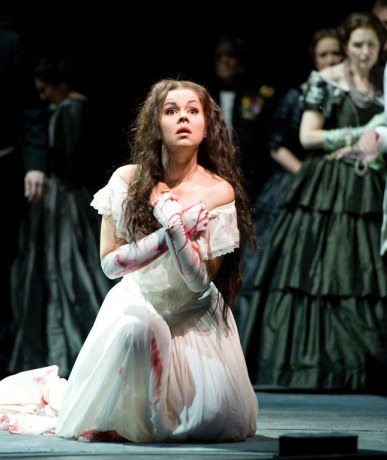
“Lucia di Lammermoor returns to Seattle Opera

Aleksandra Kurzak as the mad Lucia. Photo: Rozarii Lynch.

By R.M. Campbell

When Speight Jenkins, general director of Seattle Opera, was not in his usual seat just prior to the beginning of Donizetti’s “Lucia di Lammermoor” Saturday night at McCaw Hall, there were worries: the soprano had a sore throat, the tenor a bad back, the baritone, a sour stomach. But, as Jenkins quickly explained when he stepped in front of the curtain, he had no bad news. He wanted to dedicate the performance to Joan Sutherland, who died, at 83, Oct. 11 in Switzerland. She was, as anyone who knows anything about music over the past half century, was one of the greatest singers of the 20th century, famous for the beauty and size of her voice, a stupendous technique, creamy legato, evenness of her registers and a vast palette of colors, among her many attributes. It was her performance in “Lucia”, in 1959, at Covent Garden — the first time the opera had been done at the house since 1925 — that catapulted her to the fame, and huge admiration she enjoyed the rest of her life. The soprano made her Metropolitan Opera debut, in 1961, in the title role of “Lucia,” causing a 12-minute ovation at the end of the Mad Scene, according to the New York Times obituary. Five years later she made her debut at Seattle Opera in Delibes’ “Lakme,” returning several times in different roles but never Lucia.
Continue reading “Lucia di Lammermoor returns to Seattle Opera