For a good many people, the image of Johannes Brahms is inseparable from Maria Fellinger’s photographs. Fellinger, a friend of the composer, captured him in his later years: belly pushing outward, age etched into his face, his long beard and hair gone white or very light gray. Yet even in these twilight portraits, Brahms maintains his composure. He looks commanding, his suit still purposeful. These are the attributes of a composer who has lived life, knows what he believes, and is ready to share those convictions without hesitation. This same spirit permeates much of his later music, including the Fourth Symphony. By this point in his career, any hesitation in his musical voice has vanished entirely.

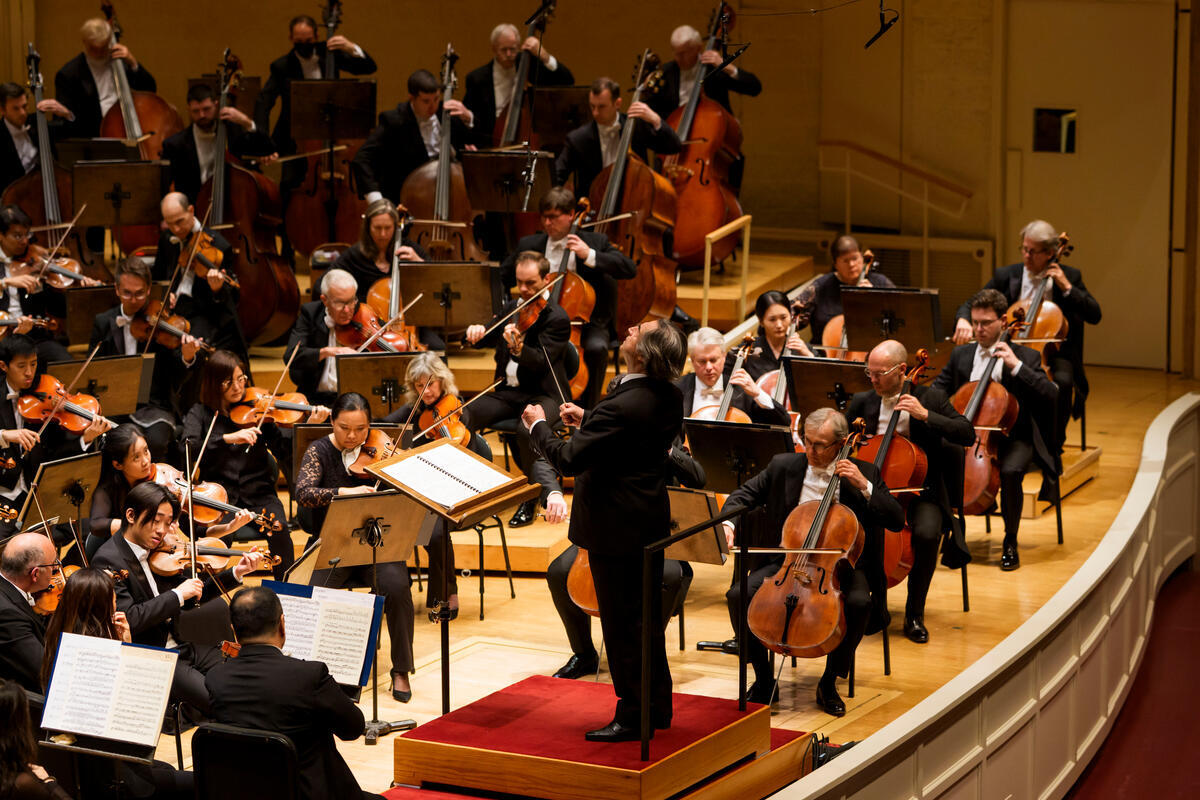
The same can be said for Riccardo Muti. At 84, Muti has defined his career on his own terms. He has led two of the finest orchestras in the world, Chicago and Philadelphia, directed La Scala, one of the world’s great opera houses, and guest conducted nearly everywhere else that matters. By now, we know who Muti is as a conductor. Yet, there are concerts, like the series just finishing up with the Chicago Symphony, that challenge us to reconsider this figure of the grand traditions. For these concerts, Muti offered Brahms’ Fourth Symphony, Stravinsky’s Divertimento, a suite from the composer’s neoclassical ballet The Fairy’s Kiss, and Rodrigo’s popular guitar concerto, the Concierto de Aranjuez. These programs are a reminder that, like Brahms in his later years, Muti is still wringing every last ounce of meaning from the traditions and forms that have carried classical music into the 21st century.
Brahms’ Fourth Symphony was unequivocally the centerpiece of this well-crafted concert. There is nothing unfamiliar about this work. It is performed with regularity in Chicago, and Muti himself has conducted it many times. Yet Muti’s approach paid dividends throughout this cornerstone of the orchestral repertoire. If Brahms’ Fourth speaks of a man at the height of his craft summing up a lifetime of thought, Muti’s interpretation suggested a parallel path up to the podium.

Though the first movement was worryingly uneven, in the second movement, Brahms’ writing sprang to life. Muti demonstrated his celebrated care in orchestral balancing, coaxing the inner voices—the often-submerged woodwinds and violas—to assert themselves equally against the powerful swell of the outer strings and brass.
By the finale, with its passacaglia, Muti brought a more urgent pace while keeping the focus on each section of the orchestra, leading to a satisfying conclusion. The sharpness in the movement was enabled by Chicago’s famed brass section, punching through and on top of the rest of the ensemble. Under Muti, the piece didn’t thunder forward the way other conductors might insist, but Muti seems to understand that Brahms is great because of what is written on the page, not because of what interpreters might bring to the work.
Muti delighted the audience in the first half with two works that are lighter in weight than the Brahms but no less enjoyable. The same qualities abundant in the symphony were present here as well. Stravinsky’s Divertimento opened the evening. Stravinsky sought to honor Tchaikovsky with the work, incorporating the great composer’s music with his own. Muti guided a loving performance of these Stravinsky gems. Orchestral sections shined, with the shape of melodies taking priority throughout. The orchestra’s excellent principals were given room to show off, especially cellist John Sharp and clarinetist Stephen Williamson.

Rodrigo’s Concierto de Aranjuez was no different in its delicate delivery. Here the focus was on Pablo Sainz-Villegas, who joined on guitar. Sainz-Villegas is probably the most prominent guitar soloist today, having joined the Chicago Symphony regularly over the years. Muti handled the piece’s dynamics well, giving space for Sainz-Villegas to dazzle with an assured tone coupled with genuine songfulness. The second movement’s melancholy will not soon sound better than it did on Saturday evening, especially with the added depth provided by Scott Hostetler’s English horn solos.
Muti is not pushing orchestral music into new terrain. Instead, he is doing something even more valuable by showing how much life still resides in the old one. His Brahms, like the man in Fellinger’s photographs, looks backward without nostalgia and forward without haste, reminding us that in art as in life, is not about invention alone, but skill and mastery.
Originally Published at Seen and Heard International
Elsewhere
“The Andante is one of Brahms’ most affecting inspirations, and Muti’s acute balancing and pacing brought forth a beautifully played and lovingly detailed rendering of this introspective music. Perhaps the Allegro giocoso could have gone with greater verve for better contrast but the quasi-scherzo was still graceful and effective, apart from a jarring horn lapse in the middle section.”
Leave a Reply