The weekend in classical music: Schumann, Stravinsky, and Hagen

Clara and Robert Schumann

To hear pianist David White tell the story of one of the most famous clove triangles in the history of music, Johannes Brahms and Robert Schumann’s music wouldn’t exist as we know it without the presence of Clara Schumann — friend to Johannes, wife of Robert, accomplished pianist, and gifted composer. it is hard to disagree with this sentiment. Robert tended to be at his best with Clara as his muse, and the durability of Brahms music today — especially his piano music — depends to some degree on Clara’s advocacy.

In honor of the 200th anniversary of Robert Schumann’s birth, the Onyx Chamber Players presented a two night mini-festival of music by these three 19th Century icons. I was only able to make it to Sunday evening’s performance of C. Schumann’s Piano Trio, Brahm’s Op. 101 Piano Trio, and R. Schumann’s Piano Quintet.

Due to a mistake by the Seattle Times, Sunday’s performance was delayed by 30 minutes. A preview which ran in the Times noted an incorrect start time of 7:30 pm — instead of 7 pm. When I make a mistake like this, I get carping emails from publicists. When the Seattle Times messes up, concert start times get moved. Oh well. A few people straggled in between when the concert was supposed to start and when it actually did. Not enough to warrant a change though.
Continue reading The weekend in classical music: Schumann, Stravinsky, and Hagen
From Russia with love

The Odeonquartet’s fall concerts brought back pieces the group has played before, and injected a premiere of a piece they played on their recent trip to Russia. Heather Bentley, the group’s violist posted about their Russian tour on TGN.

Each of the two concerts — the first one on Vashon Island and last Monday’s performance at the Good Shepherd Center’s Chapel Performance Space — ended with Alexander Galzunov’s Op. 39 String Quintet; it is a big, romantic wet kiss. Glazunov’s moments of genius came across as heartfelt. For my ears, the highlight of the concert came at the very beginning of the night’s program.
Continue reading From Russia with love

Bruno Cinquegrani: Donizetti expert?

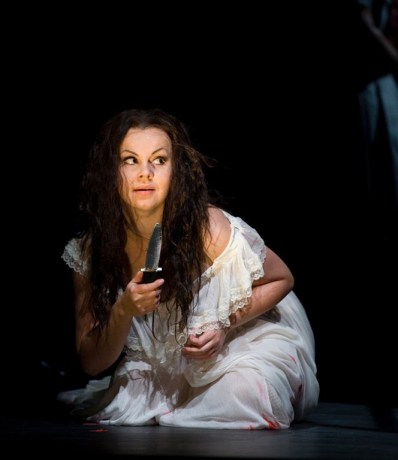
Aleksandra Kurzak as Lucia. Photo courtesy Seattle Opera.

Bruno Cinquegrani doesn’t consider himself a Donizetti expert, even when posed with a long list of experiences with the composer’s operas that suggest the contrary. “I’m not exactly an expert,” he remarked to me last week when I talked with him at the Seattle Opera’s rehearsal space in the South Lake Union neighborhood.
Continue reading Bruno Cinquegrani: Donizetti expert?

RVW’s Job receives Seattle premiere; two orchestras look for conducting leadership

RVW

Uncertainty faces at least two of Seattle’s community orchestras this season. The untimely passing of George Shangrow has left Orchestra Seattle hanging on. In spite of the fine music making by the group, Orchestra Seattle was always driven by George’s personality and his own vision for the group. He founded the orchestra. Philharmonia Northwest is another local orchestra which is also experiencing change at the podium.

After years leading the Philharmonia, conductor Roupen Shakarian decided the commute from the islands had become too much. Other projects beckoned. With Orchestra Seattle conductor less, Shakarian has been recruited back to Seattle to fill in at the podium for that orchestra’s partial season.  Try as he might, Shakarian can’t seem to get away from having orchestral responsibilities in Seattle.
Continue reading RVW’s Job receives Seattle premiere; two orchestras look for conducting leadership

Spano and Hamelin charge through Gershwin and Ravel Thursday night

George Gershwin: American revolutionary?

A last minute decision at the Seattle Symphony transformed this week’s subscription concert from ordinary to extraordinary. The program, which features competing halves, was initially arranged with the crowd favorites (Copland’s Appalachian Spring and Gershwin’s Rhapsody in Blue) falling first, while the lesser known pieces (Stravinsky’s Symphony in Three Movements and Ravel’s Concerto for Left Hand) coming after intermission.

The Seattle Symphony’s audience has demonstrated a general distrust of music unknown to them. Last week’s concert is an example. As it was reported on this site by Mr. Campbell and by others I have spoken with since the concert, the orchestra level was only 60% – 70% full. Dvorak’s Seventh Symphony anchored a program of Debussy, Bloch, and a new piece by Aaron Jay Kernis. Only Dvorak’s Seventh comes close to being an immediately familiar piece.

For opening night of this week’s concert, Taper Auditorium was full. I wondered out loud to a few people before the concert if Gershwin and Copland would be enough to dispel any misgivings for Stravinsky and Ravel. “Never underestimate the pull of Rhapsody in Blue,” a long-time observer of the symphony wisely advised. Even if Gershwin could generate a robust audience, there was a risk that after the audience heard Rhapsody and Appalachian Spring there would be an exodus at intermission. This was a genuine risk. It happened last spring for Adams’ Harmonielehre.
Continue reading Spano and Hamelin charge through Gershwin and Ravel Thursday night

John Cage and the Seattle Percussion Collective at Gallery 1412

John Cage’s music is a source of great frustration for me. It Is paradoxically rigid and fluid. Unpredictability reigns with decisions left to chance and the whims of musicians. Cage’s instruments are familiar — often used in unfamiliar ways. Just as often, Cage doesn’t use instruments at all but relies on ordinary objects to create the sounds that populate a work. Nevertheless, Cage’s music is capable of conjuring a powerful, elemental reaction. Every Cage piece I’ve heard generates extreme feelings of awe and deep spiritual awareness.

This was the case recently with the Seattle Percussion Collective. The ensemble presented a series of late Cage pieces last Friday at Gallery 1412 at the Capitol Hill and Central District collision. The Collective is not quite two years old. Since setting out in 2009 the group has garnered critical praise and accumulated a loyal following. Percussion music, like Gamelan music, tends to cater to a niche audience. But the Collective seems to reach beyond their niche audience.
Continue reading John Cage and the Seattle Percussion Collective at Gallery 1412

Seattle Percussion Collective plays Gallery 1412

Seattle Percussion Collective Plays John Cage from gatheringnote on Vimeo.

Last night the Seattle Percussion Collective played a show of late John Cage percussion works at Gallery 1412 at the collision of Capitol Hill and the Central District. I’ll be writing a longer post about the experience later today.  In the meantime I urge you watch the video above — a performance of two composed improvisations played simultaneously. If you have even a passing interest in percussion music the Collective is playing another show tonight at the Good Shepherd Center’s Chapel Performance Space. The music won’t be Cage, but there will be a number of premieres for percussion and other instruments, including Greg Sinibaldi’s Quintet for Percussion and Piano. Since they formed in 2009, the Seattle Percussion Collective has generated a loyal following. Gallery 1412 was almost completely full. Dale Speicher told me last night that their Chapel performances have always generated big crowds. If you go to their Chapel performance, it would be wise to get their early.

The show starts at 8 PM. The Chapel Performance Space is located in the Wallingford Neighborhood at 4649 Sunnyside Ave. N, 4th Floor, Seattle, WA.

Cappella Romana turns to England

By Philippa Kiraly

As a rule we expect Cappella Romana to enlighten and enthrall us with music of the Greek and Russian Orthodox churches from the Middle Ages to the present day. For its first concert of this season, it turned to the English church choral tradition of the Renaissance in a fascinating, moving performance directed by a guest conductor from England, Guy Protheroe.

Choosing Holy Rosary Church in West Seattle for the venue Saturday night, a place where the choir has sung before, gave the requisite reverberation to allow the music to bloom, though it made words very hard to distinguish.
Continue reading Cappella Romana turns to England

Schwarz opened his farewell season Saturday night

Denyce Graves

By R.M. Campbell

After nearly three decades of association with the Seattle Symphony Orchestra, Gerard Schwarz is saying goodbye. This season will be his last as music director, although he will return to the SSO podium in subsequent seasons as conductor laureate.

The annual gala Saturday night at Benaroya Hall, which raises several hundred thousand dollars every fall for the orchestra, was dedicated to Schwarz. The first piece, “The Human Spirit,” was written by him, and the second, a cello concerto written by the SSO composer-in-residence Samuel Jones, was performed by Schwarz’ son Julian. The closing work, a suite taken from Strauss’ opera “Der Rosenkavalier,” was arranged by Schwarz. The only piece on the program which did not bear any involvement with Schwarz, except as a conductor, was Mahler’s song cycle “Lieder eines fahrenden Gesellen.”
Continue reading Schwarz opened his farewell season Saturday night

Beethoven and Wine festival concludes with the Eighth Symphony and Third Piano Concerto

Beethoven, without wine.

Beethoven and wine; wine and Beethoven, the Seattle Symphony kicked off the 2010/2011 season with three shorter all-Beethoven concerts preceded by an hour of wine tasting. The Beethoven and Wine festival isn’t new. Last season was its inagueral season. It’s a disappointing world we live in. These days it takes putting “wine” in the title of the program to fill Benaroya to near capacity. Wine and ___ (fill in the blank with a composer or musical period) has proven to be such a successful model that I noticed a new Baroque and wine series has been added to the SSO season. Other orchestras have included wine tasting in their programs as well.
Continue reading Beethoven and Wine festival concludes with the Eighth Symphony and Third Piano Concerto