This season with the SSO, nearly every week is an adventure in brand new music written especially for this, Gerard Schwarz’s last season as music director. The Gund/Simony commissions are in addition to the new pieces and premieres already scheduled for the season.
This was again the case this past weekend. Two new pieces, one brand new, the other receiving a Seattle debut, were on the program. Bright Sheng’s Shanghai Overture is the second piece in two weeks by the composer performed by the SSO. Sheng’s Prelude to Black Swan — a Gund/Simonyi commission — introduced the annual performance of Beethoven’s Ninth Symphony.
Young American musician Lara Downes opened UW’s President’s Piano Series Wednesday night with an enlightening program of 20th century American music. All the composers but one are well known: Roy Harris, Samuel Barber, Aaron Copland, George Gershwin, plus Florence Price, and all were born close together around the turn of the century, with Barber the youngest, born 1910, and Price the oldest, born 1888.
Price was a rarity at that time, a recognized woman composer with a large body of works under her belt, and even rarer, a black woman composer. She attended the New England Conservatory of Music, became head of the music department at Clark University and won first prize in the Wanamaker Competition and a performance of her first symphony by the Chicago Symphony Orchestra. Continue reading Lara Downes’ American program kicks off 2010/2011 President’s Piano series
It restores faith in the future of classical music to go to hear the Seattle Youth Symphony Orchestra. There are many kids listening attentively in the audience to the mass of kids playing on stage. The big orchestra is professional in demeanor, and the performance is high class playing.
While much of this is due to the fine adult musicians who nurture their talent—the conductors of all of SYSO’s orchestras and the coaches who work with individual sections as well as each child’s individual instrumental teacher—a lot is due the kids themselves. If they didn’t stick to the work and give up many hours to practice, they wouldn’t be where they are today. Continue reading Classical music lives on in the youngest generation
There can be only have been one really good reason for Seattle Opera Young Artists Program to perform Donizetti’s “Viva la Mamma!” or to give it its full Italian name “Le convenienze ed inconvenienze teatrali.”
That reason lies in the person of baritone Daniel Scofield, who undertakes the role of the aforementioned Mamma! in drag (as it was originally written), and succeeds triumphantly and hilariously as well as musically to hold the stage whenever he is on it.
“Viva” is an unevenly written farce, a frothy romp with so little substance and so disjointed a plot that there is little to hold onto, while the music comes from before Donizetti has really found his own distinctive voice. It only works if there is excellent acting and staging, and thank goodness, this production has both, thanks to the young singers and to stage director Jeffrey Marc Buchman. Half the fun is that all of the roles are instantly recognizable to anyone who has been backstage during a production. Continue reading Seattle Opera Young Artists and Viva la Mamma!
It wasn’t until the concert itself that the title of Northwest Sinfonietta’s performance last Friday, “Gypsy Nights,” became clear. Yes, music director Christophe Chagnard’s own work titled “Opre, Roma!” with its three guitars clearly had a gypsy component, but Dvorak, Mahler and Shostakovich?
As the concert progressed at Nordstrom Recital Hall, Chagnard’s choices made sense. Dvorak was represented by his Slavonic Dance No. 8, played with all the musicians except the cellos standing and swaying with the lively beat. It was the kind of performance to have everyone ready to join in and dance in the aisles, such was its verve and spirit, and kinship to Roma music of that era in Czechoslovakia. Continue reading Northwest Sinfonietta’s ‘Gypsy Nights”
On tour around the country, the Moscow Virtuosi Chamber Orchestra made a stop at Benaroya Hall, Sunday night. It seems as though Seattle’s Russian community turned out for it in droves—I heard little English spoken that night, and it was a deeply attentive audience.
The two halves of the program were separated by close to two centuries, the first half containing the Symphony No. 4 in D Minor (called “La Casa del Diavolo,” or “The House of the Devil”) by Boccherini from 1771, and Mozart’s Piano Concerto No. 9 in E Flat Major from only six years later. The two works of the second half were composed even more closely together: Schnittke’s Sonata for violin, chamber orchestra and harpsichord, transformed from his own 1963 sonata for violin, and Shostakovich’s Chamber Symphony in C Minor, arranged under his aegis by Rudolf Barshai from his 1960 Eighth String Quartet, Op 110. Continue reading Moscow Virtuosi Chamber Orchestra lives up to its name
If, like me, you don’t really know where the Inca Train went, it was laid out for us at the start of this Seattle Symphony concert by guest conductor Miguel Harth-Bedoya. It went north from Peru to Southern Colombia through Ecuador, and south from there through Bolivia and Chile to Northern Argentina.
Harth-Bedoya, a Peruvian who is now music director of the Fort Worth Symphony, explained that much of the music composed in those countries may have had a first hearing or been part of the folk tradition, but was never published there since there were no music publishing houses. Only that music which reached the European publishing houses has come to our attention, he said. From those works that have, like those of Piazzolla and Golijov, not to mention Villa-Lobos in Brazil, we know that music of very high quality was and is being created. Continue reading Caminos del Inka: A Musical Journey through the Inca Trail
Violinist Ani Kavafian, pianist Andre-Michel Schub and clarinetist David Shifrin had been friends and musicmakers together for years before they formed the Trio made up of their last names, and the communion betweeen them was clear Wednesday night at the University of Washington’s Meany Hall.
Opening the UW International Chamber Music Series there, they gave a splendidly-played, excellently-designed program for their not-so-usual combination of instruments of works by Mozart, Bartok, Stravinsky and William Bolcom.
From the first strains of Mozart’s Trio in E-Flat, the “Kegelstatt,” for viola, clarinet and piano, there was a notable equality of balance between the players. Being alto instruments, the clarinet and viola can easily be overwhelmed by a piano with the lid full up, but never did that happen. A warm tone with plenty of energy but without force pervaded this elegant performance in which Shifrin’s smooth almost buttery clarinet carried most of the top voice. Continue reading A dream team: the Kavafian-Schub-Shifrin Trio
To hear pianist David White tell the story of one of the most famous clove triangles in the history of music, Johannes Brahms and Robert Schumann’s music wouldn’t exist as we know it without the presence of Clara Schumann — friend to Johannes, wife of Robert, accomplished pianist, and gifted composer. it is hard to disagree with this sentiment. Robert tended to be at his best with Clara as his muse, and the durability of Brahms music today — especially his piano music — depends to some degree on Clara’s advocacy.
In honor of the 200th anniversary of Robert Schumann’s birth, the Onyx Chamber Players presented a two night mini-festival of music by these three 19th Century icons. I was only able to make it to Sunday evening’s performance of C. Schumann’s Piano Trio, Brahm’s Op. 101 Piano Trio, and R. Schumann’s Piano Quintet.
Due to a mistake by the Seattle Times, Sunday’s performance was delayed by 30 minutes. A preview which ran in the Times noted an incorrect start time of 7:30 pm — instead of 7 pm. When I make a mistake like this, I get carping emails from publicists. When the Seattle Times messes up, concert start times get moved. Oh well. A few people straggled in between when the concert was supposed to start and when it actually did. Not enough to warrant a change though. Continue reading The weekend in classical music: Schumann, Stravinsky, and Hagen
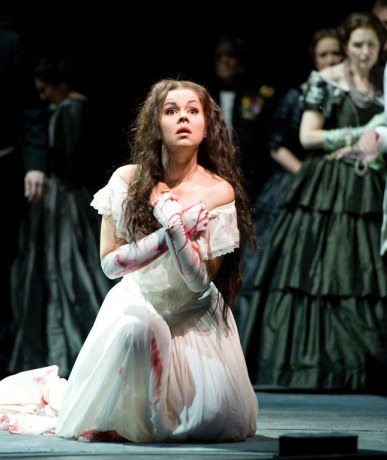
Aleksandra Kurzak as the mad Lucia. Photo: Rozarii Lynch.
By R.M. Campbell
When Speight Jenkins, general director of Seattle Opera, was not in his usual seat just prior to the beginning of Donizetti’s “Lucia di Lammermoor” Saturday night at McCaw Hall, there were worries: the soprano had a sore throat, the tenor a bad back, the baritone, a sour stomach. But, as Jenkins quickly explained when he stepped in front of the curtain, he had no bad news. He wanted to dedicate the performance to Joan Sutherland, who died, at 83, Oct. 11 in Switzerland. She was, as anyone who knows anything about music over the past half century, was one of the greatest singers of the 20th century, famous for the beauty and size of her voice, a stupendous technique, creamy legato, evenness of her registers and a vast palette of colors, among her many attributes. It was her performance in “Lucia”, in 1959, at Covent Garden — the first time the opera had been done at the house since 1925 — that catapulted her to the fame, and huge admiration she enjoyed the rest of her life. The soprano made her Metropolitan Opera debut, in 1961, in the title role of “Lucia,” causing a 12-minute ovation at the end of the Mad Scene, according to the New York Times obituary. Five years later she made her debut at Seattle Opera in Delibes’ “Lakme,” returning several times in different roles but never Lucia. Continue reading “Lucia di Lammermoor returns to Seattle Opera


 Gathering Note