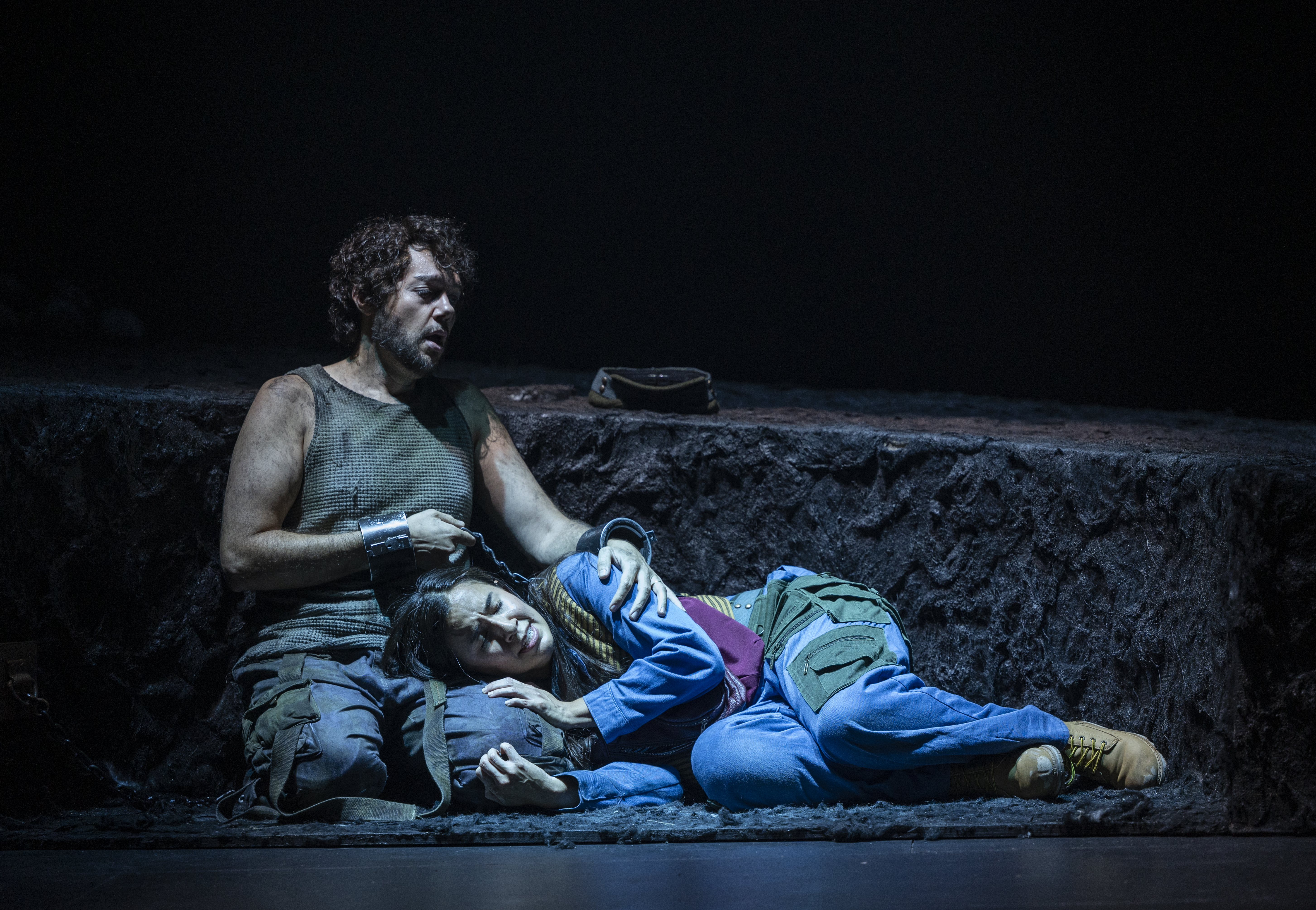
As the overture of Ferdinando Paër’s Leonora filled the historic Studebaker Theater, the audience for Chicago Opera Theater’s opening opera of the season experienced a once-in-a-lifetime opportunity to witness an important – yet sadly overlooked – early 19th century opera. In fact, calling this a once-in-a-lifetime opportunity may understate its rarity. The performances of Leonora that began on October 4th marked the work’s North American premiere. Chicago Opera Theater’s production complements the Lyric Opera’s own run of Beethoven’s Fidelio, not only bringing the story of love and tyranny to life but also showcasing the emotional depth that Paër infused into his music, which stands in contrast to Beethoven’s take on the same story.
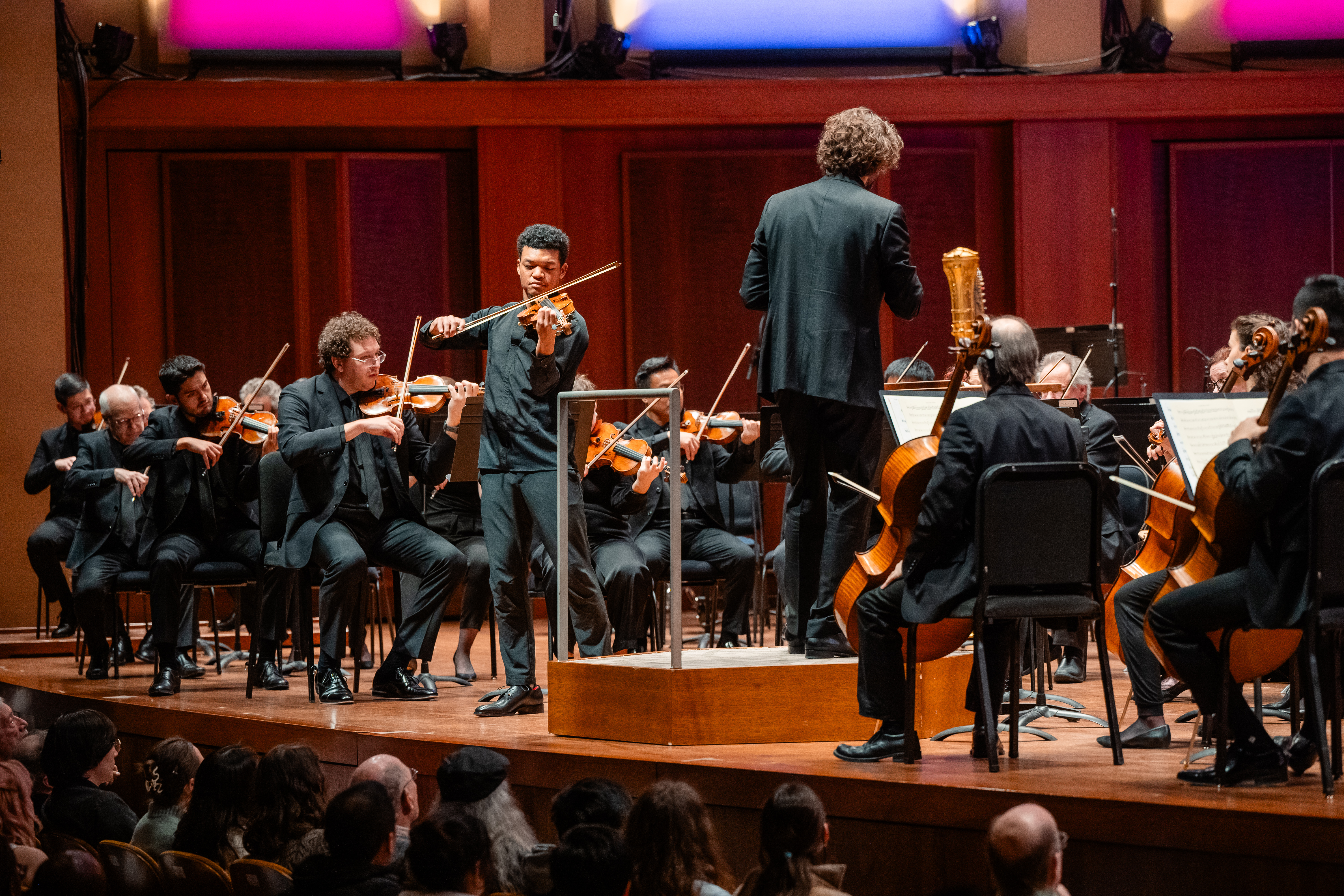
Randall Goosby plays Mozart, Photo Credit: Brandon Patoc
Violinist Randall Goosby, who has been dazzling audiences since his debut with the Jacksonville Symphony at the age of nine, took center stage with the Seattle Symphony for a recent series of concerts. Goosby’s smooth and warm tone, reminiscent of an earlier era of violin performance – which is not surprising from a former student of Itzhak Perlman’s – has been praised by critics and audiences alike. His career took a major step forward in 2021 with the release of his first album of Dvorak, Florence Price and other rarities: Roots. Goosby followed that up in 2023 with a release of Price’s two violin concertos performed with the Philadelphia Orchestra.
For his Seattle debut, he performed Mozart’s Violin Concerto No. 3 in G Major – sharing the spotlight with another rising star in classical music, guest conductor Christian Reif. After recently taking the helm of the Gävle Symphony, Reif has built up his bona fides in the U.S. this season with engagements in St. Louis, Milwaukee and now Seattle.
Ludovic Morlot impressed again this week with a program that featured the smartly chosen Ameriques of Edgard Varese and Stravinsky’s classic ballet the Rite of Spring. As Morlot pointed out in the open rehearsal earlier in the week — Varese is to Stravinsky the way Beethoven is to Haydn. Ameriques’s homage to the Rite is overt, borrowing themes, rhythms, and mimicking solos. The Rite opens with a bassoon solo, Ameriques opens with a flute solo (bravo Seth Krimsky and Judy Kriewall).
Morlot seems to be focusing the orchestra on the fundamentals of their craft: rhythmic precision, dynamic range, color, and above all else the idea of an orchestra as a musical team. Ear splitting climaxes were a signature of the Schwarz era. Morlot’s climaxes in Ameriques were forceful without being painful to hear.
When the big moments came during Ameriques, there was always room for more sound, more energy. This paid huge dividends at the piece’s conclusion when Morlot pulled a massive, driving crescendo out of the orchestra. Chailly, Boulez, Dohnanyi, none of them in their recordings of the piece, achieve the same humongous sound and none of them match the drama of the work’s final bars.
Some might have thought pegging Ameriques at the end of the program created an anticlimactic concert experience. They would be wrong. The Rite of Spring is a popular piece and its rhythms, harmonies, and violence are part of the vocabulary of most classical music lovers. Putting a popular piece last always leaves the crowd satisfied. Varese’s vocabulary, however, isn’t far removed from Stravinsky. There are enough interesting fragments and repeated ideas to keep the piece interesting. As far as visceral listening experiences go, Varese wins easily. Hearing Varese and Stravinsky side-by-side I couldn’t help but wonder why we don’t hear Varese more often especially placed in the context of more familiar and warmly accepted contemporaries like Gershwin and Stravinsky.
If you like the Rite of Spring shaped by pathos, fury, and romantic fire then Morlot’s view of the piece probably wouldn’t have caused you to riot. Morlot’s performance was perhaps too tame for the piece, but just the right approach for an orchestra playing with the renewed clarity, focus, and shared musical goals of the SSO.
I hope Morlot gives the Rite another go in a few seasons. I’d be interested to hear if the conductor can generate more heat once he and the orchestra are more familiar with one another.
Mozart’s “The Magic Flute” is a fairy-tale set in an exotic land with good and evil clearly laid out and all sorts of magic generously sprinkled throughout the piece. It has held the stage steadily since its premiere in Vienna in 1791. The production closes the company’s current season.
The first two performances this weekend at McCaw Hall were sold-out. The remaining seven should be, for the production is a comic book version rich in comedy, philosophy, strongly-drawn characters dressed fantastically, everything and everyone popping out in the usual places but not quite in the usual manner, thanks to stage direcor Chris Alexander, set designer Robert Dahlstrom with Robert Schaub, costume designer Zandra Rhodes and lighting designer Duane Schuler.
Cornish College is fast becoming Seattle’s center of daring, modern classical music performances. It is a rapid turn around for a college and a music program which identifies itself readily with John Cage, a composer critical to the growth of avant garde music in the United States. The school doesn’t boast a resident student orchestra like the University of Washington, but it has brought the Seattle Modern Orchestra to the school to perform as part of its music season. It’s talented and busy faculty routinely perform in recitals at the school and around town. In addition, more than a few of them are involved in curating programs and events of their own — like tomorrow’s May Day, May Day new music festival at Town Hall.
Cornish’s 2010-2011 season ended last Friday with a retrospective concert of Argentinian, American, Jewish composer Osvaldo Golijov. Anchored by the Odeonquartet, the program included a line up of musicians that included Joseph Kauffman (bass with the Seattle Symphony); Laurie DeLuca (clarinet with the Seattle Symphony); and Paul Taub (flute and Cornish faculty member).
George Balanchine’s “A Midsummer Night’s Dream” is one of the most enduring, and magical, ballets in Pacific Northwest Ballet’s repertory. It never wears out its welcome. And so it was revived this weekend at McCaw Hall.
The ballet had its local premiere in 1985 and over the next decade was frequently performed. In 1997, the ballet was given an entirely new look, and what a splendid look it was with Martin Pakledinaz in control of the set and costumes. Astonishingly, the new design was the first for a Balanchine story ballet, this one dating to 1962. Dozens of dance critics held their annual meeting for the Seattle premiere. The next year the company took it on tour as its calling card for its European debut at the Edinburgh Festival, and the next season to London where it was filmed by BBC, with Istanbul, Hong Kong and the Hollywood Bowl over the next few years. Wherever the production went it received fulsome praise. Continue reading Balanchine’s summer magic is revived at McCaw Hall
It now has become a commonplace to note that the Northwest has been particularly fertile ground for choreographers. Robert Joffrey, Merce Cunningham and Mark Morris have powerful Seattle roots. The city would like to claim the fourth, Trisha Brown, but somehow she managed to skip Seattle on her way from her hometown of Aberdeen (like the painter Robert Motherwell), stopping in the Bay Area for Mills College and a couple of years in Reed College in Portland before arriving in New York where she has lived most of her life.
Mozart knew what he was about when he chose the Don Juan story for his opera “Don Giovanni.” The character lives, today as much as he has through the ages, the seductive rake without conscience or regard for the consequences of his actions.
The opera is invariably popular. The current production, mounted by Seattle Opera’s Young Artists Program and performed at the Theatre at Meydenbauer Center, is set today, in a seedy little cafe somewhere in Southern Europe, where the entertainment is old, very old, movies from the silent era which play much of the time on the back screen. Continue reading Don Juan—er, Don Giovanni—is alive and well in the 21st century
We don’t often have the opportunity to hear either of the great Bach Passions, so we owe a big vote of thanks to the Early Music Guild for bringing us a stellar performance of the St. John Passion by Portland Baroque Orchestra, Les Voix Baroques, and Cappella Romana, Sunday afternoon at Town Hall.
Monica Huggett, violinist and artistic director of Portland Baroque, chose to perform it with a small orchestra of fourteen and small chorus of twelve.which included the soloists. While this Passion is shorter than the St. Matthew, two and a quarter hours including an intermission, this puts quite a burden on the singers who stood throughout, particularly tenor Charles Daniels, who sang all the chorales and choruses as well as the demanding role of the Evangelist. Continue reading Portland Baroque presents Bach’s St John Passion as part of Handel Festival
A 101 years since its premiere in Monte Carlo, Massenet “Don Quichotte” finally made its way to the exotic Northwest where Seattle Opera opened a new production of this “heroic comedy” this weekend at McCaw Hall.
Although the company has traversed a good share of the Massenet canon, plus a couple of rarities thanks to Joan Sutherland and Richard Bonynge, it had never approached his last work, written only a few years before his death in 1912. It did not attempt to break new ground; rather it presented a production that was often subtle, often striking and allowed the luxurious perfume of the composer’s music a chance to breathe. Two excellent casts were assembled for performances Saturday night and Sunday afternoon, continuing through March 12. Continue reading Don Quichotte takes the Seattle Opera stage


 Gathering Note