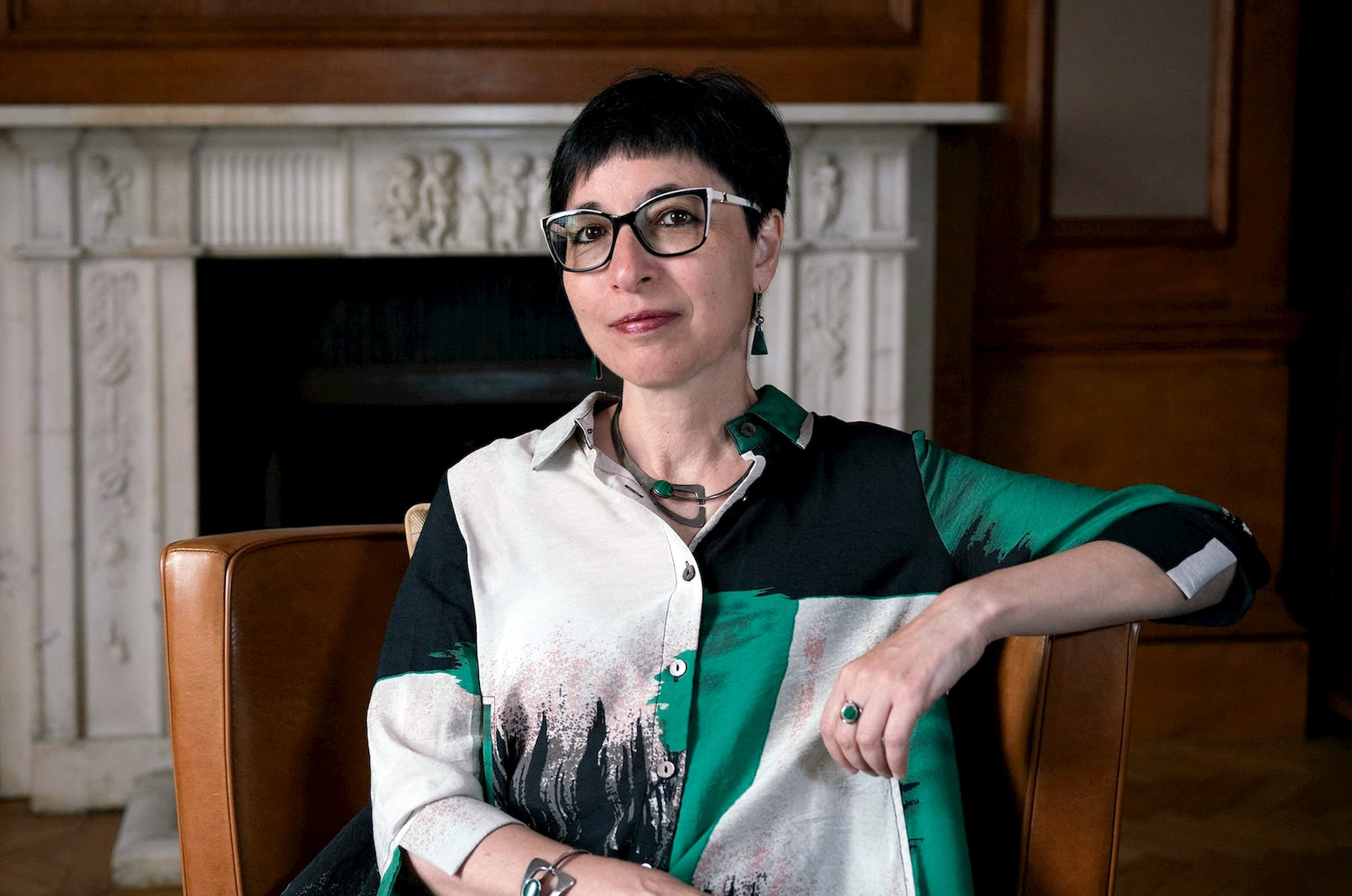
Elena Dubinets heads to the Concertgebouw

Fantastic news from the Netherlands: Elena Dubinets has been named Artistic Director of the Concertgebouw Orchestra. Dubinets was a transformative force during her time at the Seattle Symphony, and now Amsterdam is about to see why.

During her Seattle days, Dubinets brought fresh ideas to programming that made the Symphony not just good but great. Remember when they commissioned John Luther Adams’ Become Ocean? That wasn’t just any new piece—it won the Pulitzer Prize and it helped reestablish the Seattle Symphony’s relevance.

I first encountered Dubinets’ work during my time as a student at the University of Iowa, though I didn’t realize it then. In the fall of 2000, she curated a Russian contemporary music festival, which Taruskin covered for The New York Times. I sat in the audience, captivated and wide-eyed, as I absorbed the unfamiliar sounds. Our paths crossed again years later when I briefly served on the board of the Seattle Chamber Players and later assisted her and the Seattle Symphony with visa applications for a group of artists who had limited experience performing in the United States.

She left Seattle during the pandemic—a loss for Seattle—and spent the last few years doing brilliant work with the London Philharmonic. Now, she’s heading to Amsterdam to work with Klaus Mäkelä, the Concertgebouw’s incoming music director. Mäkelä is already being hailed as one of the most exciting young conductors in the world and pairing him with Dubinets feels like a good match.

Quarter notes: broke

The Detroit Symphony comes out of a damaging strike with a new outreach initiative aimed at suburban audiences. New York City Opera is on the ropes as deficits continue to mount, ticket sales drag, and musicians are calling for the company to do Carmen. By now we know the Philadelphia Orchestras has filed for bankruptcy. How bad is it in Philly? The fact that so many of their top shelf musicians are taking auditions elsewhere should be a hint. Need more proof just read this.

Quarter notes: farewell

I had been wondering when the Seattle Symphony would announce some big, audacious, splashy farewell for Gerard Schwarz’s final season. There was a two concert Hovhaness festival and the season finale is Mahler’s Resurrection Symphony, but neither seemed a big enough way to say good bye to a conductor who oversaw the growth of the Seattle Symphony for 26 years. That was until I opened my email yesterday.

In partnership with two leading philanthropists — Agnes Gund and Charles Simonyi — eighteen (yes, eighteen!) new pieces, by American composers will be commissioned and premiered through out the course of the season. That is a new piece of music on every concert led by Schwarz. Suddenly, the season looks like a suitable send off.

The composers composing new works and a list of concerts where new works will be premiered follow the jump.
Continue reading Quarter notes: farewell

Quarter notes: end of summer edition

Summer is winding down, classical performance — with the exception of Seattle Opera’s head scratching new production of Tristan und Isolde – are more or less on hiatus until September. All of this leaves a blogger with little to blog about. Yet a few noteworthy bits have popped up here and there.

This Sunday George Shangrow will be remembered at a service held at the University Christian Church in the U District. The service starts at 2 pm and runs until 5 pm. Get there early. Seating is limited and because George’s presence was huge there will no doubt be an overflowing crowd.

Tristan und Isolde wraps up this weekend at McCaw hall. I saw the new production last weekend. The general consensus among critics has been reservedly favorable; consensus among the audience hasn’t been as generous.  Nearly everyone I spoke with thought the orchestra sounded spectacular. Fisch whipped the band into grand Wagnerian shape but it never missed a chance to embrace the score’s warmer moments. Most also liked Tristan’s cast as well. the golden age of Wagner singers is long gone but that didn’t stop Clifton Forbis and Annalena Persson from giving a memorable performance of Tristan and Isolde.  Once again, Persson started her Tristan performance with uncertainty in her voice and a wavering tone.  By the second act she had found Isolde’s voice; her arresting Liebestob provided a satisfying conclusion.

If the audience appreciated the musical qualities of the performance, production elements weren’t regarded as favorably. “The directing and set design were so bad I periodically closed my eyes to listen so I would not be distracted” read one comment posted on the Seattle Times web review.  The painted sets looked like cheap, grey particle board. A new projection system — written up extensively in the Tristan program — added little to the opera’s texture. Israel’s changing costumes were interesting, highlighting the opera’s mythology, but with very little else on stage, they seemed out of place. Kazaras looked to explore “Tristan time” and the idea that an event which takes a few seconds in real time might seem much longer in the mind. This is all well and good as an idea, but on stage it failed to translate, turning the opera into a series of incomprehensible moments.

The music is always paramount with an opera.  But for professional company’s like Seattle Opera the music can’t be everything.  Audiences already expect big things in the pit and on stage — for Wagner especially.  For a production to be successful then, the sets, costumes, stage direction, and everything else that isn’t musical must be good too.  Fisch’s orchestra and Jenkins’s cast were memorable, while Israel and Kazaras’s production forgettable.

Continue reading Quarter notes: end of summer edition

Quarter notes: Shangrow remembered

George Shangrow. Photo John Cornicello.

It’s been more than a week since we learned of George Shangrow’s untimely death. In that time the tributes for this Seattle original have been growing with each day. Orchestra Seattle’s website has been turned into a rolling memorial.

My favorite is from Kerry Fowler who wrote:

“I was a bit nervous the night before my audition for Orchestra Seattle, when I tuned in to KING-FM to hear the end of Beethoven’s Fifth. When it was over, I heard George announce, “Even after all these years, I still get tingles listening to that movement.” I thought, “Now that’s someone I want to play music with.” I wasn’t disappointed.”

On Saturday, the matriarch of Seattle’s critical class Melinda Bargreen, penned a tribute to Shangrow. It is well worth a read if you want a window into George’s essence as a person.

If you prefere to remember George in person, there is a memorial service scheduled for 2 PM August 22, 2010 at the University Christian Church which is open to the public.  I would suggest getting there early as more than 200 people have rsvp’d on the Facebook page for the event.

Grimsley sings Kurwenal again in Seattle Opera’s new production of Tristan

Greer Grimsley as Kurwenal in Seattle Opera’s 2010 Tristan und Isolde. Photo by Rozarii Lynch.

By Philippa Kiraly

It was Speight Jenkins, general director of Seattle Opera who persuaded bass-baritone Greer Grimsley that he should sing Wagner. That was for the 1994 production of “Lohengrin,” and Grimsley has sung in nearly every Wagner production here since.
Talking with him as he prepares to sing Kurwenal in “Tristan and Isolde” which opens Saturday at McCaw Hall, you are immediately struck by his speaking voice, as sonorous as his singing one.

Continue reading Grimsley sings Kurwenal again in Seattle Opera’s new production of Tristan

Schwarz’s Trio for Violin, Horn, and Piano to be premiered next week

Gerard Schwarz

By Peter Klein

We all know about Gerard Schwarz, conductor. Lately, we’ve been hearing more and more about Gerard Schwarz, composer.

Schwarz’ latest work, a “Trio for Violin, Horn, and Piano” (Horn Trio for short), will receive its world premiere at the Seattle Chamber Music Festival on Monday, July 26 at 8:00 PM in Benaroya Hall. Schwarz and the three performers will give an introduction to the work in a free recital at 7:00 PM.

The Seattle Symphony’s Music Director is by no means new to composition. As a teenager, he studied with the noted American composer Paul Creston. Later teachers included Roger Sessions, Jacob Druckman, Milton Babbitt, Vincent Persichetti and Pierre Boulez. But as the trumpet and then the baton became the focus of Schwarz’ career, his composing took a three-decade hiatus. Until recently.

“All of a sudden, I’m into it again. And it’s getting to be exciting,” said Schwarz, speaking by telephone from the Eastern Music Festival in Greensboro, NC, where he is Music Director.
Continue reading Schwarz’s Trio for Violin, Horn, and Piano to be premiered next week

Quarter notes: happy birthday Mahler

Mikhail Pletnev

I’m a few days late (Mahler was born on July 7th), but 2010 is the 150th birthday for Gustav Mahler. Complete Mahler cycles have been popping up in abundance over the last few months. Both Universal Classics and EMI have released “complete” box sets. But, from Universal Classics, comes one of the most creative ways to celebrate Mahler’s birthday — The People’s Edition. From now until September people can visit a special web site and cast their vote for their favorite recording of each symphony from the Decca and DG catalog. The recordings with the most votes will be included in a special, limited edition box set in November.

Mikhail Pletnev was arrested in Thailand for allegedly raping a 14 year old boy. Pletnev claims the ordeal is a misunderstanding. Thai officials share a much different opinion.

Also in the NY Times, Seattle gets a mention in an article looking at the conductor youth movement that seems to be sweeping American orchestras lately.

Finally, Ludovic Morlot made remarks at his public roll out as music director designate of the SSO.  I recorded them on my Flip Camera and posted them here for you to see.  About two hundred people showed up for the event.  Based on the conversations I had with people in the crowd it seemed like a good number of the people in the audience were not subscribers but occasional SSO ticket buyers.  Nearly everyone I spoke to had no idea what to expect with Morlot.  A few were anxious to hear more French repertory.  Others hope he’ll bring Ligeti and Messiaen into the mix.  All were unanimous in their belief that his age alone will go a long way to freshening up the SSO.  The lack of preconceptions should bode well for Morlot as he starts to shape the 2011/2012 season — his first as music director.

“H. M. S. Pinafore:” Seattle Gilbert & Sullivan Society’s July offering

William Darkow stars as the Right Good Captain of the Pinafore. Photo, Pat Andre

By Philippa Kiraly

For all of us Gilbert & Sullivan fans, it’s time to get ready to enjoy the annual offering of comic opera by Seattle Gilbert & Sullivan Society. Like the happy arrival of June strawberries each year, this regular dose of absurd plots, witty words, and irresistible music is worth celebrating.

This year, it’s one of the prime favorites, “H. M. S. Pinafore.” While I would dearly love to see more of the less well known ones, this particular gem helps to fill the coffers, and it is being paired with a rare performance of the curtain-raiser, “Cox and Box,” where an enterprising landlord rents a room twice over to two men who work opposite shifts, and thus never meet, until…

Continue reading “H. M. S. Pinafore:” Seattle Gilbert & Sullivan Society’s July offering

Quarter notes: YNS edition

YNS

By now most people have heard the Philadelphia Orchestra has found a new music director. – YNS for short. He is a predictable choice given the youth movement afoot these days. Chicago bucked the trend by appointing Ricardo Muti. They are the only orchestra which ignored the orchestra group think these days (does that make the Muti choice revolutionary?) Maybe, before Dudamel, before Gilbert, and before the small army of sub-forty year olds took over a number orchestras in the UK the choice would have shocked or inspired. At best, Philadelphia has recruited the next big thing. At worst, the orchestra has found a music director for the next seven years.

(Sorry, but the section on James Garlick has been redacted.)

More contributor news. Did you read Michael Upchurch’s Seattle Times piece on the Toy Box Trio? No? Then ! Keep it up Dana and Harlan.

Did anyone notice Terry Teachout’s piece in the this past weekend? He wonders whether we even need regional orchestras in the digital age. With definitive recordings of just about every piece of standard repertory just a click away, why would anyone go hear a middle of the road performance of the same repertory with a local orchestra? It is an interesting thought experiment. I get hung up on what defines a regional orchestra. The Seattle Symphony is certainly a regional orchestra. So is the Oregon Symphony. Neither have the stature of America’s Big Five, or Big Seven if you include LA and San Francisco and both cater to audiences which stretch beyond the urban centers of Seattle and Portland. Maybe the answer isn’t to allow orchestras to die, or to load a season with pops concerts, but to reexamine the role and mission of the orchestra in the community?  Playing the same old music doesn’t seem to be cutting it anymore.