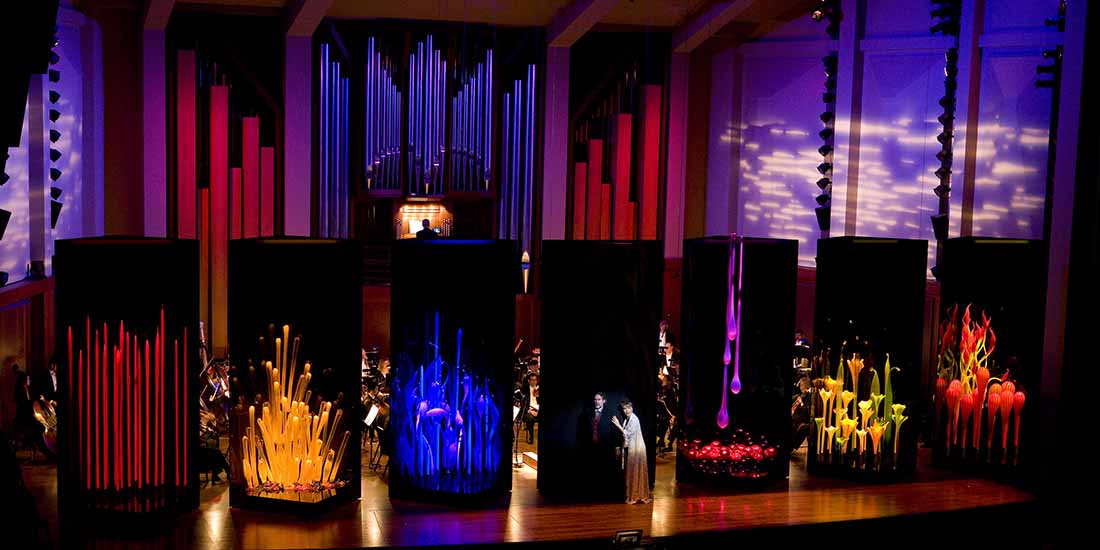
“Let the door be shut and bolted”

Photo Credit: Chihuly Studios, Terry Rishel 

Esa-Pekka Salonen joins the CSO for a two-week residency focusing on Bartók. In week one, Salonen pairs the Concerto for Orchestra with his own Sinfonia Concertante for organ and orchestra, while in week two Bluebeard’s Castle shares the stage with Beethoven’s Second Symphony. As of this afternoon, there are still ample tickets available for Bluebeard’s Castle, and anyone who can go should.

It is one of the spookier pieces of music out there, and Bartók’s vocal writing is excruciatingly demanding. I’ve seen it staged on a double bill with Schoenberg’s expressionist masterpiece Erwartung. But, it was my first experience with the opera, a semi-staged concert performance in Seattle that is firmly planted in my memory. Gerard Schwarz pulled out all of the stops to make it a memorable evening. Schwarz’s production was unforgettable, partially thanks to Charles Simonyi’s support, which enabled the creation of glass sculptures by Dale Chihuly representing six of the seven doors opened by Judith and Duke Bluebeard. This striking production has since traveled to other venues, undoubtedly thrilling audiences.

While Chicago’s performance won’t feature Chihuly’s vibrant sculptures, it boasts its own impressive draw: Esa-Pekka Salonen conducting, alongside soloists Ekaterina Gubanova and Christian Van Horn.

Summer festival season is here

The summer festival season starts in earnest tomorrow with the commencement of the Seattle Chamber Music Society’s 6 week long festival. This year’s festival marks the 30 year anniversary of Toby Saks’ affiliation with the festival. She founded the series, played an integral part in recruiting top-shelf talent for the festival, and after this summer she will be stepping down as artistic director, making way for James Ehnes to take up the role. Concerts do sell out, but there are always free recitals an hour before the official concert begins. One (of many) highlights from the recitals this summer will no doubt be Johannes Moser’s performance of Lutoslawski’s Sacher Variations.

Up north in Bellingham, the Bellingham Festival of Music started on July 1 and continues through the rest of the month. Two Seattle favorites — pianist Jeremy Denk and violinist Stefan Jackiw — appear with the festival orchestra this year. Denk will play Liszt’s Second Concerto and Jackiw will play Sibelius’ Violin Concerto. Both Denk and Jackiw play with extreme intelligence and undoubtedly will invigorate both pieces. Britten’s Serenade for Tenor Horn and Strings (a favorite of mine) will also be played on the same program as Denk’s Liszt and there is a concert performance of Fidelio on July 17th to close the festival out.

Local composer Nat Evans is putting on a festival of sorts of his own by taking his music and love of site-specific experiences on the road to Chicago, DC, NYC, and elsewhere. Evans is also featured in this month’s Believer magazine too.

There’s another election to vote in…

One of the Gathering Note’s occasional contributors — Ozni Torres — needs your help.  He is a finalist in Chicago Classical Music’s “public critic” contest.  Oz introduced me to classical music in college.  He was a valuable tutor in those early years.  His review is the first one, a insightful, fair assessment of Ricardo Muti’s debut as music director of the CSO.  I hope you vote for his “fantastique” review.

Vote Here.

The Muti era begins

Gerard Depardieu

I’m back from a short visit to Chicago. While I was there I had the chance to hear Maestro Muti lead the Chicago Symphony in their first subscription concert of the season. The buzz around Muti and the CSO is intense. Banners with Muti’s mug hang on just about every light pole in the Loop. Bus stop shelters have either audio or video advertisements for the CSO. A week prior 30,000 people ventured downtown to hear Muti lead the CSO in a public concert. All of this attention is expected of course. The CSO is a world class symphony with a world class conductor. The bar for this new partnership is set so high, one wonders whether the CSO and Muti and can meet expectations.

For the first subscription concert Muti reached deep into the bin of neglected scores. What he found was Hector Berlioz’s Lelio or (Return to Life). Lelio is the sequel to Symphonie Fantastique. It is the composer’s story of overcoming unhappiness and a “return to life.” At a basic level, Lelio is Berlioz’s rumination on art, society, and life. In between seemingly random musical interludes are wayward monologues. The monologues themselves are nearly as long as the piece’s music. Compared to Fantastique, Lelio is incongruous, episodic, rambling, and wildly self indulgent.
Continue reading The Muti era begins

J. S. Bach Lived at the Bach Week Festival

Sunday, April 26th, at Evanston’s Music Institute of Chicago, was the concluding day for this year’s Bach Week Festival, although really a weekend. The first concert was held on Friday and was a harpsichord affair. The concert on Sunday seemed to have representative works from the rest of Bach’s oeuvre, featuring a cantata, a motet, two concerti and a suite for solo cello. Excellent performances abounded, but the MVP awards went to David Schrader on harpsichord and Katinka Kleijn, cello. Their contributions, together with the passion and commitment of everyone involved, made this concert a true highlight of the music season.

Continue reading J. S. Bach Lived at the Bach Week Festival

Bach Week Festival Kicks Off Strong

For the past 36 years, there has been a heralding of the music of Johann Sebastian Bach in the Chicagoland area. Spanning a full week and comprising as many as four programs, the Bach Week provides Bach fans with the opportunity to hear wonderful renditions of his best music in intimate and immediate settings. This year’s Bach Week Festival, reduced to two concerts this weekend because of the precarious economy, continues that strong legacy of fine music making. The opening concert featured works for harpsichord, chosen carefully and smartly programmed by the featured soloist, David Schrader.

Continue reading Bach Week Festival Kicks Off Strong

Perlman & Friends Show What Mentoring Can Accomplish

On April 19, as part of Symphony Center Presents, world-renown violinist Itzhak Perlman graced the large stage of the Chicago Symphony Orchestra, without the orchestra. He was there to perform chamber music and he brought along no less than eight of his talented mentees from the Perlman Music Program. Started at the instigation of Perlman’s wife Toby, and realized in 1993, the Perlman Music Program provides young musicians with year long training and performance opportunities. The works chosen to perform were all within the confines of easy listening, but that just brought more focus to the contribution of the musicians. Once your focus is set, you realize quickly that there are a lot of superb artists out there, made even greater by Itzhak’s calm and committed tutelage.

Continue reading Perlman & Friends Show What Mentoring Can Accomplish

Baroque Band Serves ‘Messiah’ for One

Handel’s Messiah has been a personal favorite for a long time. At any time of year, I have no trepidation giving up two and half hours of my life to experience the wondrous sound and spiritual world that Handel created. Needless to say, when Baroque Band announced the ambitious plan to perform this masterpiece with the ensemble’s customary intimacy in Symphony Center’s Grainger Ballroom I was thrilled. I looked forward to it despite having bad experiences in the past with live performance of the work. Several years ago, I attended a performance with the Chicago Symphony Orchestra conducted by Peter Schreier, in which he excised several numbers from both Parts II and III to reduce the amount of time it took to perform the piece to within union stipulations. I was not pleased. That would certainly not be the case here. Baroque Band is a small group of devoted musicians. They would never cherry pick Messiah to make it fit. Alas, on Wednesday, they did, this time I presume to make the music fit the space rental agreement. Despite this, director Garry Clarke, along with his committed group of players, together with members of the Chicago Chorale and able soloists, was able to put together a performance of the work that was so intimate, I felt it was a command performance just for me.

Continue reading Baroque Band Serves ‘Messiah’ for One

Big Boned Bach at the CSO

This past weekend at Symphony Center, culminating in tonight’s performance, was a veritable orgy of orchestral music from that greatest of composers, Johann Sebastian Bach. It is hard to imagine a time when his music was not well-known and virtually memorized, but such a time existed right after his death. Thank God for Felix Mendelssohn Bartholdy who resurrected the world’s interest in that baroque genius. The planet has been in awe of his staggering abilities ever since. Countless audiences have been awarded with imaginative and stunning performances of his music ever since as well. These performances, with members of the Chicago Symphony Orchestra, led by Pinchas Zukerman, can stand with the pack as solid if not completely satisfying.

Tonight’s fare included Bach’s Overture No.1, Violin Concerto No.1, the Oboe & Violin Concerto and the Brandenburg Concerto No.2. If you are a fan of Bach, there is no way you would want to miss that line-up. I actually heard some of these same pieces this year with Chicago’s Baroque Band, a truly baroque-sized ensemble. As Zukerman strode onto stage in his flowing shirt and black slacks, he took his position as concertmaster for the Overture. The CSO was obviously slimmed down, but what remained was still quite substantial. The violins numbered 16, the violas 6, cellos 4, basses 3. Given that much sonic strength, the small harpsichord was barely audible. For comparison, the Baroque Band’s performance numbered about 15 total. The large orchestra provides added volume in the large space of Orchestra Hall, but it made the ensemble much less flexible. The Suite was played slowly and without any additional filigree. The only liberties Zukerman took was to determine how many strings should play at any one point. It was very effective in some movements, but also distracting, especially as the two oboists took turns contributing to the sound, doubling the strings. Both would play, then the second would drop out and fix her reed, only to take it up again several bars later as the first oboe stops. It seemed to be done almost at random. But, like most things in life, once you’re used to the larger sound, at its new plodding pace, the performance was okay. I preferred Baroque Band’s, complete with period oboes and bassoon – no cheating.

Zukerman, wearing both hats as violinist and director, was much more involved in the performance of the Violin Concerto in A minor. His tone was strong with little affectation. Bach would have been proud. The middle movement was especially effective, beautiful even. Zukerman told a compelling and melancholy tale, with a sound full and resonant without much vibrato. He left no time for contemplation however as he immediately moved into the last movement. A small quibble.

Admittedly, the concerto for oboe and violin is one of my favorite works of Bach. Eugene Izotov was the oboist and Zukerman violin. The slower paces were killing me. It’s as if the only reason for them was to make the concert last longer. Realistically, there was only about seventy-five minutes of music in this concert. Nevertheless, there were moments of admirable beauty. The slow movement is a highlight in all of Bach’s music, and it was taken on with aplomb by the soloists, even if there wasn’t a lot of connection between the players. The final movement was much better, quick and exciting with wonderful playing all around, especially by Zukerman.

As a final gesture of admiration for the orchestra, Zukerman gave his violin duties to CSO concertmaster Robert Chen, who was joined by Jennifer Gunn, flute, Eugene Izotov, oboe and Christopher Martin, clarino trumpet, for a performance of the Brandenburg Concerto No.2. It got off to a rocky start as the long dormant Martin missed his high notes. He was sitting around far too long. He played much more quietly for the remainder of the performance. Actually, I felt everyone did. There wasn’t much vigor, even if they all played smartly. The concert was as much an opportunity for Zukerman to perform as for members of the orchestra to shine, and they did albeit dully at times.

Listening to music from the baroque era can be rare in the traditional concert hall. With the exception of large choral works, you aren’t likely to hear much. I think that’s okay if your city has baroque ensembles. I know Seattle does and so does Chicago. Although tonight’s performance was nice and dependable, it lacked the intimacy and daring music-making that can happen with a smaller group. I missed that in these performances. When I want to hear Strauss and Brahms, I am heading for the Chicago Symphony Orchestra. When I want to hear Bach however, the CSO will find me absent, as I am in my seat at the Baroque Band or Music of the Baroque.

Glover Delivers the Kitchen Sink

The Music of the Baroque continued its series of concerts this year with a celebration of the deaths and lives of various composers. Or at least the anniversaries thereof. Music Director Jane Glover spared no expense in creating this concert, having to contract many performers for the minutest of roles. She also did not spare her own sense of creative programming for this concert, featuring a coronation anthem, a mass, a segment of an opera, and an early Romantic symphony. I think the kitchen sink was also given a prominent role. Unfortunately, such a hodgepodge of music, both in terms of purpose and style, didn’t create the greatest overall effect, but the finale, Mendelssohn’s Italian

For the first time ever, I sat in the balcony at the Harris Theater of Music and Dance, and I can say unequivocally that the acoustics are quite nice at the top. After all, all the sound seems headed in that direction anyway. Also, with the plethora of seats available, it was quite comfortable for everyone up in the rafters. The evening began with Handel’s coronation anthem Zadok the Priest, a five minute piece of bombast for orchestra and chorus. Glover’s opening of the piece, hushed and contemplative, seemed more thoughtful than was necessary, but the rest was performed with the proper intent. For this piece, a third trumpeter was added, never to be seen again. I would have liked for the trumpet section to have stood just to show off their talent more, but alas, that did not occur.

It was followed, with virtually no change to the size of the orchestra, by Haydn’s Mass No.9, the Heiligmesse. I am not fond of mixing liturgical music into secular concerts, but the conductor wanted to highlight the composer’s achievements in an area beyond the symphony. Fair enough, except this particular mass was the wrong choice. This mass is unique in Hadyn’s oeuvre in that it uses the chorus almost exclusively throughout its thirty five minutes. Although Haydn uses all of his exceptional gifts to vary the choral sounds, in addition to the orchestral writing, at the end of the day, it was a thirty five minute piece for orchestra and chorus. Simply put, it was too much of a good thing. Beautiful music and music making abounded in this performance. The strings and winds were very responsive to all the changes the mass required. The sparse solo vocal work was handled nicely by a quartet of soloists from the chorus, beefed up to six in the lovely Et incarnatus

section of the Credo. By the time you get to the Sanctus, your ears are about done however, so I was glad the rest was relatively short, including the oddly peppy Dona nobis pacem.

As a pairing, the Handel and Haydn were not bad, although it presented a rather frigid and Teutonic soundscape. The second half was a definite contrast, a thawing of sorts. It began in a very Baroque world. Harpsichord in the center, violins to the left, lower strings to the right, the rest in the back. Four soloists walked on stage with Madame Glover to perform part of Act IV of Henry Purcell’s The Fairy Queen, an adaptation of Shakespeare’s A Midsummer Night’s Dream. Each soloist had the smallest part possible. For this fifteen minute segment, the majority of which was taken up by trumpet fanfares, a countertenor was hired for all of three minutes, and only in a duet with the alto. Regardless of its excessiveness, the music and performance were exceptional, especially the co-principal trumpets, Barbara Butler and Charles Geyer. They even stood up so that we could know they were featured. It was more fun that way. With this little world now over, a massive overhaul of the stage was undertaken to create room for a Beethoven-sized orchestra. The harpsichord, used only in the preceding piece, was taken away, the chorus risers were pulled forward so the array of winds could sit atop them. They were ready to leave the world of England, the running theme between the three composers so far, and move to Italy.

Felix Mendelssohn, of course, was extremely popular in England, and found inspiration in the British Isles on several occasions. Listening to the Purcell immediately brought to mind Mendelssohn’s overture and incidental music to the same Shakespearean play. Maybe that was too easy a connection for Glover. Maybe it would have made too much sense. Either way, we were presented with a performance of the composer’s Italian Symphony No.4. To my astonishment, it was an admirable rendition. The opening movement was filled with such drive, and such precise playing for all involved, especially the strings which had no place to hide. The string section consisted of  thirteen violins, four violas, three ‘celli, and two basses. The cellos were completely outmatched by the mass of sounds. There simply weren’t enough of them. Still, the movement had fire and the contributions of each part were clearly delineated in such a small community of players. The second and third movements were played equally well, although less inspired interpretively, but the fourth movement, now in minor, was the ultimate redemption. Jane Glover conducts in an interesting way, where she highlights the even beats only by waving her right hand from 2 o’clock to 8 o’clock manically. She looks like she is trying to get a spot out of a dirty window she is frantically wiping. Her enthusiasm translated clearly to both the orchestra and the audience, which garnered her a very nice round of applause from a rather pleased audience.

In all, each piece was played wonderfully, and each was worth hearing. It was my first time listening to Haydn’s Mass, as well as the Handel and Purcell. It is just the combination of them that wasn’t as satisfying. Next season for the Music of the Baroque features less Romantic ambitions, and focuses on Handel (Glover is currently writing a book on the man), Bach, Mozart and Haydn. I sort of like this orchestra in this element. It makes sense – no room for the kitchen sink.