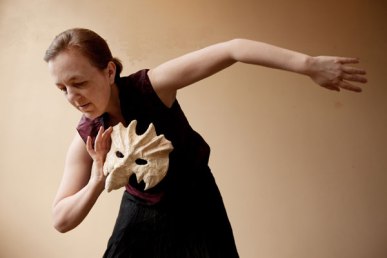
The Fisher Ensemble “At the Hawk’s Well”

By Harlan Glotzer

Entering the Chapel at the Good Shepherd Center this evening, I was struck with the calm and focus of a dedicated artistic space. This was largely due to the beautiful ambiance of the stage and sonic arena created by the Fisher Ensemble for the world premiere of the piece At the Hawk’s Well even before it officially began. I was greeted by a stage, though stark, not lacking in visual interest. Two paper masks created by Louise McCagg sat atop three blocks arranged in a stair pattern, which was in turn flanked by two white screens lit from behind. Simple blacks and whites, but I couldn’t help but follow my eyes around the set three or four times before I felt satisfied that I had truly seen the initial image. The strong but soothing angles were accompanied by prerecorded recitation. I could not quite make out what I was hearing, but the male voice on the PA was smooth and low. I could pick out a word or two here and there, but it seemed less important what was being said and more the flavor of how the sounds filled the architecture of the stage. All this before the music even started! I knew I was in for a treat.

Continue reading The Fisher Ensemble “At the Hawk’s Well”

Fiddle and Drum Is Given its American premiere at the Paramount

By R.M. Campbell

Joni Mitchell, who made her name in the late 1960s and 1970’s as a folk singer, has spent most of her career in the United States. However, she was born in Canada and is still recognized as a Canadian artist. A few years ago Jean Grand-Maitre, artistic director of Alberta Ballet, approached Mitchell with the idea of setting a ballet on some of her songs. After some negotiations between the two, songs from the 1980’s were selected by Mitchell, most of which, she writes in the program “were poorly received in the 1980’s.” To that collection, she added a trio of songs, two of which have texts not by Mitchell — Rudyard Kipling and William Butler Yeats. In addition, the decor is a series of primarily abstract images created by Mitchell that are replicated on a disc suspended over the stage.

Tuesday night’s performance at the Paramount was the production’s American premiere.

Continue reading Fiddle and Drum Is Given its American premiere at the Paramount

Shmidt discusses Kurtag’s Kafka Fragments

Here is my second interview with Mikhail Shmidt.  In this video Shmidt talks about Hungarian composer Gyorgy Kurtag’s “Kafka Fragments,” a piece he will perform this Saturday as part of Icebreaker V.  “Kafka Fragments” is no ordinary piece; it is one of Kurtag’s most important works and one of his most difficult.  People describe it as part song cycle and part autobiography.  Based on my own survey of the piece and Shmidt’s assessment, “Fragments” is daunting for musicians and listeners.  Saturday’s performance may end up as one of the best concerts so far this year.

Mikhail Shmidt discusses Kafka Fragments from gatheringnote on Vimeo.

Following on TGN’s successful live blog of “Drums Along the Pacific,” I will be live blogging “Kafka Fragments.”  “Fragments” is well suited for live blogging.  Songs tend to be short, many lasting less than a minute.  Perfect for snap judgments and short bursts of commentary.

If you can’t attend the performance of “Kafka Fragments,” do the next best thing and check out the live blog on the Live Blogs page.  Closer to the event, I will set up a dedicated post where you can follow the live blog.

Information for the concert can be found at http://www.ontheboards.org

Joshua Bell and Jeremy Denk at Benaroya Hall

By R.M. Campbell

Joshua Bell discovered some years ago that being a very good violinist was not sufficient to earn fame. So, he turned his attractive personality and boyish looks into a populist appeal. He appeared on television in all sorts of roles, did soundtracks, to name a few. The music world had already noticed his playing, now a wider audience discovered him. One might think he had cheapened himself somewhat in the process, but he didn’t. He continued to play with an immaculate tone, clean technique and appreciation for the music at hand, regardless of its origins.

Continue reading Joshua Bell and Jeremy Denk at Benaroya Hall

Mikhail Shmidt discusses Icebreaker V: Love and War

Starting Friday, the Seattle Chamber Players embark on their fifth Icebreaker festival – “Love and War.” While other Icebreakers have focused on American, Russian, and Baltic contemporary music, the latest festival centers on Western Europe. Mikhail Shmidt, one of SCP’s founding members spoke with me about the festival. You can watch and hear Shmidt’s thoughts below.

Mikhail Shmidt discusses SCP’s Icebreaker V from gatheringnote on Vimeo.

Continue reading Mikhail Shmidt discusses Icebreaker V: Love and War

Offenbach’s “La Perichole” is, amazingly, based on truth

By Philippa Kiraly

Watching Seattle Gilbert & Sullivan Society’s 2nd Stage production of Offenbach’s “La Perichole,” it seems blatantly impossible it could have stemmed from a true story, as it is silly to the point of unbelievability. But Offenbach no doubt twisted the truth for his own ends, and the music is entrancing. However, this production is not really up to most of Seattle G & S’s polished summer productions.

Continue reading Offenbach’s “La Perichole” is, amazingly, based on truth

Auburn Symphony dazzles in all Franck concert

Cesar Franck at the organ

By Philippa Kiraly

I love hearing the Auburn Symphony Orchestra. Let me count the ways (not counting the time it does to get there from Seattle): No cost and no problems parking. An acoustically good auditorium, large enough to host a symphony orchestra but small enough for the audience to feel close up and intimate with it. Top ticket price $25. And an orchestra that is worth the trouble to get there.

Continue reading Auburn Symphony dazzles in all Franck concert

Russian National Orchestra plays glorious concert Wednesday

By R.M. Campbell

The Russian National Orchestra spends a good share of its collective life on the road. Since its founding, in 1990, the ensemble has spurned government funding, perhaps unique in all of Europe, in favor of American style private funding. Inevitably it has an international board that insist on an international profile.

It is not a stranger to Seattle. One of the great virtues of Benaroya Hall has been that there is now time and space for orchestras other than the Seattle Symphony. They are a principal highlight of the SSO season, some orchestras greater than others admittedly, but none is shabby. The Russian National Orchestra is among the best. Led by its founding music director, the pianist Mikhail Pletnev, the ensemble did a mostly Russian program Wednesday night: Tchaikovsky’s “Elegy” and Shostakovich’s Ninth Symphony. The concerto du jour belonged to Dvorak which seems almost Russian because of its long identification with the late Mikhail Rostropovich. The cellist at Benaroya was Russian — a young virtuoso of great talent, Sergey Antonov.

Continue reading Russian National Orchestra plays glorious concert Wednesday

A Simple Measure of good music can be satisying…

By Philippa Kiraly

One of its biggest audiences ever filled the little Chapel at the Good Shepherd Center in Wallingford Monday night, for the last of Simple Measure’s Fire-themed concerts. (We had Earth earlier this season, the Air group take place in April, the Water ones in May.)

It’s possible part of the draw was the return visit to Seattle of Alex Klein, the brilliant Brazilian oboist who taught at UW in the 1990s, then became principal oboist of the Chicago Symphony until he contracted focal dystonia, a neurological condition which caused weakness and unreliability in two of his fingers.

Continue reading A Simple Measure of good music can be satisying…