Hans-Jurgen Schnoor takes up St. Matthew Passion with OSSCS

Hans-Jurgen Schnoor

Orchestra Seattle will mount one of the classical music highlights of the spring – Bach’s epic St. Matthew Passion – this Sunday at First Free Methodist Church. As has been the case all season, a guest conductor will helm the orchestra. This week it is noted Bach specialist Hans-Jurgen Schnoor. Earlier in the week, I asked Schnoor about the piece and his approach to a large scale work like the Matthew Passion.
Continue reading Hans-Jurgen Schnoor takes up St. Matthew Passion with OSSCS

Bruno Cinquegrani: Donizetti expert?

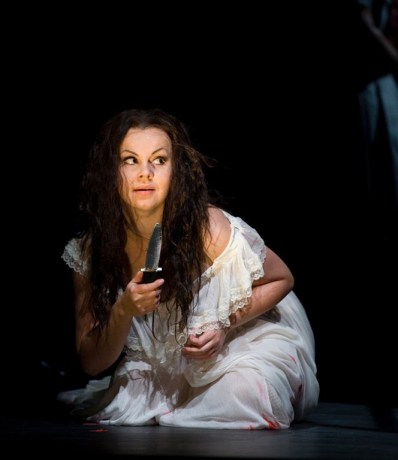
Aleksandra Kurzak as Lucia. Photo courtesy Seattle Opera.

Bruno Cinquegrani doesn’t consider himself a Donizetti expert, even when posed with a long list of experiences with the composer’s operas that suggest the contrary. “I’m not exactly an expert,” he remarked to me last week when I talked with him at the Seattle Opera’s rehearsal space in the South Lake Union neighborhood.
Continue reading Bruno Cinquegrani: Donizetti expert?

RVW’s Job receives Seattle premiere; two orchestras look for conducting leadership

RVW

Uncertainty faces at least two of Seattle’s community orchestras this season. The untimely passing of George Shangrow has left Orchestra Seattle hanging on. In spite of the fine music making by the group, Orchestra Seattle was always driven by George’s personality and his own vision for the group. He founded the orchestra. Philharmonia Northwest is another local orchestra which is also experiencing change at the podium.

After years leading the Philharmonia, conductor Roupen Shakarian decided the commute from the islands had become too much. Other projects beckoned. With Orchestra Seattle conductor less, Shakarian has been recruited back to Seattle to fill in at the podium for that orchestra’s partial season.  Try as he might, Shakarian can’t seem to get away from having orchestral responsibilities in Seattle.
Continue reading RVW’s Job receives Seattle premiere; two orchestras look for conducting leadership

Alan Gilbert on Mahler’s 6th

Alan Gilbert

Alan Gilbert and the NY Phil play Mahler’s 6th Symphony at the end of this month. This short Q&A on the subject comes courtesy of 21C Media Group.

Question: You’ve described the Sixth as possibly your favorite of Mahler’s symphonies. Why?

Alan Gilbert: It’s a very, very pessimistic work that paints a very realistic picture of life’s ups and downs and the search for happiness and meaning. For the particular protagonist in the Sixth Symphony it ends in utter despair, and without hope, which is quite rare in music and art. Usually there is some shred of optimism left! But this piece ends in utter devastation. That’s not what I like about the piece, of course! But the work is such a statement, and is such a powerful expression of life’s experiences; it is an important and indisputably great work.

Q: You’ve already performed the First and Third Symphonies with the New York Philharmonic, and will play the Sixth this week. Later in the season you’ll also do the Fifth. Are you hoping to do all of the Mahler symphonies at some point with the orchestra?
Continue reading Alan Gilbert on Mahler’s 6th

The Muti era begins

Gerard Depardieu

I’m back from a short visit to Chicago. While I was there I had the chance to hear Maestro Muti lead the Chicago Symphony in their first subscription concert of the season. The buzz around Muti and the CSO is intense. Banners with Muti’s mug hang on just about every light pole in the Loop. Bus stop shelters have either audio or video advertisements for the CSO. A week prior 30,000 people ventured downtown to hear Muti lead the CSO in a public concert. All of this attention is expected of course. The CSO is a world class symphony with a world class conductor. The bar for this new partnership is set so high, one wonders whether the CSO and Muti and can meet expectations.

For the first subscription concert Muti reached deep into the bin of neglected scores. What he found was Hector Berlioz’s Lelio or (Return to Life). Lelio is the sequel to Symphonie Fantastique. It is the composer’s story of overcoming unhappiness and a “return to life.” At a basic level, Lelio is Berlioz’s rumination on art, society, and life. In between seemingly random musical interludes are wayward monologues. The monologues themselves are nearly as long as the piece’s music. Compared to Fantastique, Lelio is incongruous, episodic, rambling, and wildly self indulgent.
Continue reading The Muti era begins

The Five: Jayce Ogren

Conductor, composer, singer Jayce Ogren

Jayce Ogren is an example of what is happening in classical music these days. He’s a conductor who has stood before some of the finest orchestras in the world. Ogren finished a tenure with the Cleveland Orchestra in 2009. He has also conducted the Boston Symphony, LA Phil, and City Opera. Before that, he was a conducting apprentice with the Royal Stockholm Philharmonic under the New York Philharmonic’s Alan Gilbert. With conducting bona fides like these, Ogren could easily stick to cultivating a career as a conductor. But, this Hoquiam native is plunging into composing, songwriting, and on Friday he and a new band of Seattle area musicians — Young Kreisler — debut at ACT with a program of Ogren’s own music, kindred depressants Kurt Cobain and Mahler, and Louis Andriessen’s Worker’s Union.

Continue reading The Five: Jayce Ogren

Quarter notes: Shangrow remembered

George Shangrow. Photo John Cornicello.

It’s been more than a week since we learned of George Shangrow’s untimely death. In that time the tributes for this Seattle original have been growing with each day. Orchestra Seattle’s website has been turned into a rolling memorial.

My favorite is from Kerry Fowler who wrote:

“I was a bit nervous the night before my audition for Orchestra Seattle, when I tuned in to KING-FM to hear the end of Beethoven’s Fifth. When it was over, I heard George announce, “Even after all these years, I still get tingles listening to that movement.” I thought, “Now that’s someone I want to play music with.” I wasn’t disappointed.”

On Saturday, the matriarch of Seattle’s critical class Melinda Bargreen, penned a tribute to Shangrow. It is well worth a read if you want a window into George’s essence as a person.

If you prefere to remember George in person, there is a memorial service scheduled for 2 PM August 22, 2010 at the University Christian Church which is open to the public.  I would suggest getting there early as more than 200 people have rsvp’d on the Facebook page for the event.

Questioning the conductors: Meet Morlot!

Our conductor interviews end with the person chosen to lead the SSO to new artistic heights and performance excellend — Ludovic Morlot. Morlot was one of the few conductors I didn’t meet. I was in New York when he was here last fall and when he returned in the spring, an exploding volcano in Iceland and compressed rehearsal schedule prevented an interview then too.

Seattle met Ludovic Morlot today. Not for the first time of course. Morlot guest conducted the SSO twice last season. But it was the first time as the SSO’s music director designate. Morlot will assume his music director duties officially in 2011, but he is already planning his first season with the orchestra and making friends with orchestra musicians, orchestra staff, and of course the city. I will be posting more video from today’s public introduction. Until then, here is a video of my interview with the young maestro from yesterday.

SSO music director designate Ludovic Morlot talks with TGN from gatheringnote on Vimeo.

Questioning the conductors: Christian Knapp

Christian Knapp is the only guest conductor this season, with or without an orchestral post who has admitted to being interested in having his own orchestra. You can draw all sorts of conclusions from his openness. Is he angling to be the SSO’s next music director? Given his history with the orchestra as its associate conductor a few years back, the thought of returning to Seattle in the orchestra’s top artistic spot is probably very enticing. Or, perhaps he has eyes on other posts? Indianapolis is looking for a new conductor (Knapp has guest conducted there as well) and so is the Richmond Symphony.

Knapp is back in Seattle this week to lead the SSO in a performance at the Paramount Theater with the Mark Morris Dance Group. Mark Morris is back for a third year, and this year his troupe will dance to Haydn, Bach, and Vivaldi.

Established conductors, with larger (and fragile) egos, might bristle at being a secondary focus for the audience. Not Knapp, he takes it in stride. Just because Knapp’s temperament is self effacing doesn’t mean he lacks ideas about how the music he will take charge of starting tonight should sound. Quite the contrary. Knapp is full of ideas about Haydn, Bach and Vivaldi, but also new music, repertory staples, and the qualities that he would find ideal for an orchestral post in the United States or abroad.

from on .

Questioning the conductors: Jun Markl


Update : I am not entirely sure what happened with the video for two minutes in the middle. I apologize and will upload a mirror copy tonight.

I had a chance to sit down with Jun (pronounced June) Markl earlier this week. Markl, no stranger to the Seattle Symphony, is guest conducting a program of German music that covers Schumann, Beethoven, and Wagner. Though his program is uber-traditional, Markl takes a relativist view of Beethoven and the masterpieces of the classical music repertory. Markl doesn’t embrace just one view of how Beethoven should sound. As he says in our interview, Beethoven played in France can sound different from Beethoven played in the United States. Differences resulting from geography should be embraced for what they bring to the music.

Markl’s embracing attitude is important for someone in his position. His own family bridges two cultures (his mother is Japanese and his father is German). He also currently leads two orchestras: one in Lyon, France and the other in Leipzig, Germany and is a regular guest conductor in the United States too. Because of his firm command of the Franco-German repertory, I assume some have placed high high on their list of conductors they would like to see replace Gerard Schwarz after next season.  His previous visits to Seattle have given audiences shapely,poised interpretations of mostly familiar repertory.

These interviews often take on a life of their own when the camera is turned off. This time was no different.  When the camera was shut off I had a spirited conversation about the economic differences between American and European orchestras with Alex Prior. Prior, who is assistant to this season’s guest conductors, sat in on the interview. Afterward, I asked him what he thought about Markl’s response to my questions on the subject (which you can watch) and his own thoughts. Prior approached the subject with the free market enthusiasm of someone just beginning to get a handle on American consumerist culture and with the experience of seeing European orchestras hew to the political whims of appropriators.

Our exchange came in the context of contemporary music. In Europe it isn’t uncommon, as Markl explains, for orchestras to offer contemporary music festivals even when they know ticket sales will flatten or dip. In the United States, prolonged encounters with the music of today is a recipe for orchestra fiscal ruin. European orchestras have the luxury of being able to program difficult pieces because of the state subsidies they receive. By contrast American orchestras depend on a steady flow of private subsidies. Prior’s argument is that the American system of orchestra funding is better, because it is market oriented, which allows the audience to have more of a say. I cautioned that if orchestras are purely market oriented there is a risk that new music would be squeezed out by a parade of Beethoven, Brahms, Tchaikovsky, and Mozart.

I hope to be able to speak with Prior for more than a few moments here and there. In the meantime, take a moment to watch what Markl had to say about orchestra economics, the German tradition, and contemporary music.

from on .