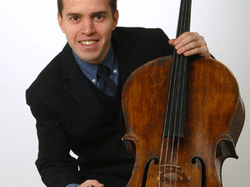
Composer in residence Samuel Jones ends tenure with the Seattle Symphony

By Peter A. Klein

On Friday, June 3, the Seattle Symphony presented a “Samuel Jones Celebration” at Benaroya Recital Hall. Jones, who turned 76 last week, is about to end his 14-year tenure as the Symphony’s Composer in Residence.

Jones’ music is part of the American tonalist tradition that outgoing Music Director Gerard Schwarz has championed in performances and recordings. He freely uses modern compositional techniques, but his music is usually rooted in key centers—sometimes more than one simultaneously. Musical architecture and expression walk hand in hand. Seattle audiences have enthusiastically received Jones’ works, including concertos for horn, tuba, trombone and cello.
Continue reading Composer in residence Samuel Jones ends tenure with the Seattle Symphony

PNB gives “Giselle” its local premiere this weekend

Pacific Northwest Ballet principal dancer Kaori Nakamura as Giselle. Photo Angela Sterling

By R.M. Campbell

Pacific Northwest Ballet has taken three decades to come to glories of “Giselle,” which it did this weekend at McCaw Hall. Nothing much compares with this ballet, which has iconic status in the canon. It must succeed not through fortissimo gestures but pianissimo ones, those that hold us through subtlety and sheer beauty. Nearly all the great ballerinas of the past 150 years have taken on the title role — the list is astonishing. It represents “a superb chance to captivate, to dazzle, and to touch the heart,” to borrow a description from eminent dance critic Edwin Denby.

While the production — that is, sets and costumes, designed by Peter Farmer, for Houston Ballet — is well-worn, the concept is unique — a variant of the traditional one by virtue of newly employed historical sources. While differences in text and choreography are minimal — they will seem of little consequence to most ballet patrons — the professional dance world is fascinated, enough that the Dance Critics Association is holding its annual meeting in Seattle this week in order to see for themselves. It is this “new” version that makes PNB’s production novel.
Continue reading PNB gives “Giselle” its local premiere this weekend

Corella Ballet unveiled in Seattle debut

By R.M. Campbell

When Angel Corella made his debut as a soloist at American Ballet Theatre some 16 years ago at the age of 20, his dancing was a sensation. A few months later he was promoted to principal and in the years to follow became a star attraction, an essential part of the company’s extraordinary collection of great male dancers from the Old World and the New.

The Spanish dancer enjoyed an astonishing career at the company as well as with other ballet companies as a guest artist. A decade ago, he began a foundation to promote classical dance in his native country which has long had a problem sustaining a ballet company with international standing. Three years ago, he and his sister Carmen founded Corella Ballet Castilla y Leon. He is the ensemble’s artistic director and she, associate artistic director. More than 20 individuals appear on the company’s roster, including Angel Corella’s colleague at Ballet Theater, another major star, Herman Cornejo. Most have Spanish names but not all.
Continue reading Corella Ballet unveiled in Seattle debut

The Tudor Choir sings Tallis and Byrd

By Philippa Kiraly

The Tudor Choir has always aimed for the pure tone of an English cathedral choir with its typical sound of boys’ clear treble voices and often male altos. Its latest offering, “All the Queen’s Men,” performed at Blessed Sacrament Church Saturday night, was no exception, and the music, composed during the religious swings of the 1550s to about 1575, ranged from the highly complex works in Latin preferred under Catholic Queen Mary to the simpler plain English preferred under Protestant Elizabeth 1.

Much of it was by two of the era’s great composers, Thomas Tallis and William Byrd, who between them covered a century of church music, tailoring their work to the prevailing religious winds. Others were John Sheppard, whose “Ave maris stella” was a highlight wiith its plainchant interludes, and William Mundy.
Continue reading The Tudor Choir sings Tallis and Byrd

SSO names a new principal flute

DeMarre McGill. Photo Instant Encore.

With Scott Goff retiring the SSO needed a new principal flute and late last week Ludovic Morlot found his man: Demarre McGill. From the press release.

Seattle Symphony announces the appointment of Principal Flute Demarre McGill, who will join the Orchestra in September. He comes to Seattle from the San Diego Symphony where he has been Principal Flute since 2004. The Symphony’s current Principal Flute Scott Goff will retire at the end of this season after 42 years in the position.

Seattle Symphony Music Director Designate Ludovic Morlot commented, “The first principal appointment is always important for a new music director, and I am so pleased that Demarre McGill will be joining the Orchestra in the fall as Principal Flute. I admire his incredible talent and energy, as well as the work he has done to introduce new audiences to classical music — something I, too, am passionate about.”

McGill’s brother is none other that Anthony McGill, principal clarinet in the Met Opera Orchestra. Can’t wait to hear McGill in next season’s performance of Prelude to the Afternoon of a Faun.

Quarter notes

Last night it was the University of Washington Symphony conducted by Jonathan Pasternack. On Friday, it will be Julia Tai and the Seattle Modern Orchestra. Both are developing into two of the area’s more interesting orchestras. What distinguishes these two orchestra’s isn’t necessarily the precision of their playing. Neither is flawless, but both have created moments of inspired beauty on stage.

Tai’s orchestra — a rotating cast of local musicians — has established itself firmly as champions of 20th and 21st century new music masterpieces. For example, their Friday concert at Meany Hall features a parade of contemporary concerti including: Scelsi’s Anahit, Berio’s Circles, and Ligeti’s Chamber Concerto. Her soloists are some of the area’s best too: Michael Lim, Clifford Dunn, Valerie Muzzolini Gordon, Matthew Kocmieroski and Gunnar Folsom.

Pasternack, the newish director of the UW Symphony, is no slouch when it comes to 20th century music, his focus is just different. This season he’s dug out Penderecki’s Viola Concerto (which gets played next month by Melia Watras); loaded the stage with Shostakovich’s Symphony No. 11, and last night combined Nielsen’s Symphony No. 4, Prokofiev’s First Violin Concerto, and Charles Ives’ Unanswered Question and Central Park in the Dark. Elisa Barston, as always oozed poetry as the violin soloist, and the student ensemble made good by Ives’ two short pieces. Nielsen’s symphony ran into occasional problems; sections got twisted in Nielsen’s leaping and thrusting music. But, what the performance lacked in execution it more than made for in raw power. Timpanists Lacey Brown and Brian Pfeiffer roared, the orchestra’s violins harnessed the energy of the night to great effect, and principal cello Sonja Myklebust offered bold, assured statements of her own. All in all, the performance was a welcome change from the tepid concerts that seem to be on the rise around town. Nielsen’s symphony was played and conducted as if it mattered.

The Fourth Symphony’s glorious finale.

Bartok’s Sonata for Two Pianos and Percussion closes out SSO chamber series

If you made it to the Nordstrom Recital Hall last Friday you were likely part of history. Not history of the epoch altering kind, but of the musical kind. It was the first time many of the people in the audience, most with decades of experience with Seattle’s classical music scene, could recall a live performance of Bela Bartok’s daunting Sonata for Two Pianos and Percussion. The piece was part of the Seattle Symphony’s final chamber concert of the season. The program also featured Bartok’s Contrasts, Mendelssohn’s First Piano Trio, and George Enescu’s Impressions d’enfance for violin and piano.

Balance problems, especially coming from the piano plagued most of the performances.  This is a familiar story for the recital hall.  Sometimes this problem is overcome, other times not so much. The only piece where the musicians seemed to conquer the hall’s notably fussy acoustic was the Mendelssohn trio. Kimberly Russ, the Seattle Symphony’s resident pianist, has probably spent more time grappling with Benaroya and Nordstrom’s acoustic than any of the other pianists playing on the program. This came through in a tempered performance at the keyboard which allowed the eloquent playing of cellist Roberta Downey and violinist Jeannie Wells Yablonsky to be heard. Although I would hardly describe the trio’s performance as fiery, it wasn’t merely a competent run through of the piece either. Russ, Downey, and Yablonsky made this work sound philosophical and mature.

Continue reading Bartok’s Sonata for Two Pianos and Percussion closes out SSO chamber series

“A reminder of the blindness of genocidal hatred”

Composer Lori Laitman.

By Philippa Kiraly

Mina Miller used these words when introducing the latest Music of Remembrance concert Monday night. Miller is artistic director of the concert series which she began thirteen years ago, and every concert has been one which leaves the listener with much to ponder after.

Monday’s performance at Nordstrom Recital Hall was no exception. Part of the concert focused on the boys in the concentration camp Terezin and the poetry they wrote; part was a memory of the ancient settlement of Jews in Thessalonika, of whom there were 54,000 at the beginning of the war, and after the nazis’ systematic massacre, about 1100 at the end, two percent.

As usual, there was music by a composer who died in the camps, in this case the String Quartet No. 2, “From the Monkey Mountains,” by Pavel Haas, and music of today’s composers in memoriam.
Continue reading “A reminder of the blindness of genocidal hatred”

Mozart’s Magic Flute closes out Seattle Opera season in superb fashion

By R.M. Campbell

Mozart’s “The Magic Flute” is a fairy-tale set in an exotic land with good and evil clearly laid out and all sorts of magic generously sprinkled throughout the piece. It has held the stage steadily since its premiere in Vienna in 1791. The production closes the company’s current season.

The first two performances this weekend at McCaw Hall were sold-out. The remaining seven should be, for the production is a comic book version rich in comedy, philosophy, strongly-drawn characters dressed fantastically, everything and everyone popping out in the usual places but not quite in the usual manner, thanks to stage direcor Chris Alexander, set designer Robert Dahlstrom with Robert Schaub, costume designer Zandra Rhodes and lighting designer Duane Schuler.

And, of course, there is some of Mozart’s most sublime and expressive music.
Continue reading Mozart’s Magic Flute closes out Seattle Opera season in superb fashion