Week in classical music: Rush Hour, Composer Slash, and Hoketus


For the first time in my life I didn’t feel like a geezer at a classical concert. Thank you Seattle Symphony. Thank you Rush Hour series. And, most of all, thank you Prokofiev, Tchaikovsky, Stephen Hough, and the Pablo Heras Casado.

The SSO’s Rush Hour series is designed to appeal to a younger, downtown audience. Concerts fall on Fridays, have an earlier start time of 7 pm, and are shorter. Friday’s program was a little longer than an hour. To make a shorter concert, a piece, or two are excised from the week’s regular program. This week, Liszt’s Mephisto Waltz No. 1 was axed from a program that also featured Prokofiev’s Third Symphony and Tchaikovsky’s First Piano Concerto with Stephen Hough at the keyboard.

Prokofiev wrote the Third using themes and material from his lusty, though not very popular, opera the Fiery Angel. The symphony is a jittery, disconcerting experience compared to the better known First and Fifth Symphony. Those works seethe life, grin at the listener with humor, and easily gallop into our subconscious with catchy melodies. The Third dispenses with all of these wonderful, Prokofiev traits. The opening eruption reminded me of Bernard Hermann’s stabbing music from Psycho. Glissandos which slip from the orchestra’s strings in the third and fourth movement, do so with shivering effect. The orchestration is coagulated. Only in the second movement do we even get a hint of the melodic Prokofiev we know.
Continue reading Week in classical music: Rush Hour, Composer Slash, and Hoketus
Northwest Sinfonietta’s ‘Gypsy Nights”

By Philippa Kiraly

It wasn’t until the concert itself that the title of Northwest Sinfonietta’s performance last Friday, “Gypsy Nights,” became clear. Yes, music director Christophe Chagnard’s own work titled “Opre, Roma!” with its three guitars clearly had a gypsy component, but Dvorak, Mahler and Shostakovich?

As the concert progressed at Nordstrom Recital Hall, Chagnard’s choices made sense. Dvorak was represented by his Slavonic Dance No. 8, played with all the musicians except the cellos standing and swaying with the lively beat. It was the kind of performance to have everyone ready to join in and dance in the aisles, such was its verve and spirit, and kinship to Roma music of that era in Czechoslovakia.
Continue reading Northwest Sinfonietta’s ‘Gypsy Nights”

Prokofiev’s 3rd Symphony headlines an almost all Russian program at SSO

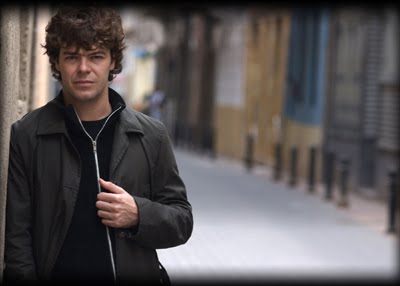
Pablo Heras-Casado

By R.M. Campbell

For his Seattle Symphony Orchestra debut Thursday night at Benaroya Hall, Spanish conductor Pablo Heras-Casado conceived a predominantly Russian program. The one exception was Liszt’s “Mephisto” Waltz, No. 1: absolutely nothing from Heras-Casado’s native land or to suggest his Spanish origin.

However, one should not cavil. Instead we got a riveting account of Prokofiev’s Third Symphony. The piece is not done so much, especially compared with the composer’s First Symphony. Derived in part of his problematic opera, “The Fiery Angel,” the symphony takes what Prokofiev thought was the most salvageable musical ideas. The opera is difficult to absorb, awkward on stage and can be lurid at times. But much of the music is striking: Little wonder Prokofiev didn’t want to let it gather dust in some basement archives awaiting discovery.
Continue reading Prokofiev’s 3rd Symphony headlines an almost all Russian program at SSO

Kristallnacht recalled by Music of Remembrance

By Philippa Kiraly

One of the pleasures of Music of Remembrance concerts is the spoken (and written) historical context provided by founding director Mina Miller.

On Monday, the 72nd anniversary of Kristallnacht, the Night of Broken Glass when the nazis rampaged throughout Germany, destroying Jewish property wholesale, Music of Remembrance focused on the rich heritage of Jewish folklore, including music inspired by folksong and theater.

S. Ansky’s famous play written on an aspect of Yiddish folk culture, “The Dybbuk,” premiered in Moscow’s Habima Theater 1922 and went on to travel across the world (this writer saw it in New York in 1962). The music composed for it by Joel Engel has been much less heard.
Continue reading Kristallnacht recalled by Music of Remembrance

The week in classical music: Stock, Yannatos, Lucia, and the University of Washington

James Yannatos

To the front of me was David Stock. To my left, Harvard composer James Yannatos. Just another week with the Seattle Symphony, and another world premiere courtesy of the Simonyi/Gund Farewell Commissions project. David Stock’s Farewell Commission – Blast – wasn’t the only new piece on the program this past Saturday however. James Yannatos’ reworked version of Ritual Images also received a world premiere performance by Schwarz and the orchestra. Stock’s piece, a boisterous mélange of percussion, brass, and pulsing strings got the concert started, but it was Yannatos’ Ritual Images which commanded my attention more. Not simply an Ives knock-off, Ritual Images expands the American primativist vocabulary.  Yannatos stitches where Ives would have collided bits of Americana together. Ritual Images lacks the free wheeling feeling humor that makes Ives’ music so much fun to hear. But Yannatos makes up for this deficiency with a better sense of orchestration.
Continue reading The week in classical music: Stock, Yannatos, Lucia, and the University of Washington

Moscow Virtuosi Chamber Orchestra lives up to its name

By Philippa Kiraly

On tour around the country, the Moscow Virtuosi Chamber Orchestra made a stop at Benaroya Hall, Sunday night. It seems as though Seattle’s Russian community turned out for it in droves—I heard little English spoken that night, and it was a deeply attentive audience.

The two halves of the program were separated by close to two centuries, the first half containing the Symphony No. 4 in D Minor (called “La Casa del Diavolo,” or “The House of the Devil”) by Boccherini from 1771, and Mozart’s Piano Concerto No. 9 in E Flat Major from only six years later. The two works of the second half were composed even more closely together: Schnittke’s Sonata for violin, chamber orchestra and harpsichord, transformed from his own 1963 sonata for violin, and Shostakovich’s Chamber Symphony in C Minor, arranged under his aegis by Rudolf Barshai from his 1960 Eighth String Quartet, Op 110.
Continue reading Moscow Virtuosi Chamber Orchestra lives up to its name

PNB reexamines Tharp

Twyla Tharp’s Opus 111, presented as part of ALL THARP, Nov. 5-14, 2010. Photo Angela Sterling

By R.M. Campbell

Over the past five years, since the arrival of Peter Boal as artistic director, Pacific Northwest Ballet has been busy acquiring works of Twyla Tharp, including a pair it commissioned a couple years ago. Those were the product of a long residency when Tharp was in house, working with dancers, meeting donors and indulging the press. They are invariably evocative, sometimes compelling, sometimes witty and always inventive. One’s attention does not wander away at any moment.

The company revived three of those pieces Friday night at McCaw Hall: “Opus 111” and “Afternoon Ball,” the commissioned works, plus “Waterbaby Bagatelles,” first danced by PNB four years ago. It was a splendid night at PNB, first-rate, with attention to details and acute dancing by the whole company. I liked “Opus 111” better than I did at the premiere as well as “Waterbaby Bagatelles.” Perhaps they were better danced. Tharp returned to town for the evening.
Continue reading PNB reexamines Tharp

Sankai Juku returns to Seattle, this time at the Paramount

By R.M. Campbell

One of the strangest phenomena to emerge in post-World War II Japan was a dance movement called Butoh. It was a reaction against just about everything, Japan and otherwise, and once it crossed into the West made a powerful impression. Movement was often inexplicable, bizarre, disturbing, grotesque. And very dark.

With more extreme proponents, performances could be difficult to watch which, I suppose, was the point. One group was quite different. Certainly it was a Butoh ensemble in philosophy and style with its shaven heads, bodies painted in white rice flour and very slow movement. But Sankai Juku was more about poetry than shock value.
Continue reading Sankai Juku returns to Seattle, this time at the Paramount

CSO’s Beyond the Score series debuts at SSO

By Philippa Kiraly

The Seattle Symphony’s new series, Beyond the Score, debuted at Benaroya Hall Sunday afternoon to a good-sized house, with quite a lot of kids present. The idea and the format began five years ago with the Chicago Symphony, creative director Gerard McBurney and executive producer Martha Gilmer, and involves taking one iconic orchestral work, deconstructing it for an hour with the aid of the orchestra, conductor, visual images, a narrator and a couple of actors, and then playing the work in its entirety in normal concert fashion. It’s been highly successful in Chicago, bringing in new audience and working so well that there are now three programs a year, each repeated.

Judging by the audience’s response to Debussy’s “La Mer,” this could well happen here.
Continue reading CSO’s Beyond the Score series debuts at SSO

Kremerata Baltica opens visiting orchestra series at Benaroya Hall

Gidon Kremer

By R.M. Campbell

The Seattle Symphony Orchestra’s Visiting Orchestra Series may be somewhat diminished this season but its opening gesture Friday night at Benaroya Hall was anything but that.

When Kremerata Baltica made its local debut a few years ago, it created a powerful impression for its finesse and technical acuity. Nothing has changed in the intervening years, as demonstrated this weekend. This string orchestra of some two dozen young musicians, gathered from the various Baltic states, is still sharp-edged with transparent textures, impeccable ensemble and handsome sound. Everything about the group is a pleasure as well as informed and articulate. It is modern in all sorts of ways, the best sort of ways. This is an orchestra that knows how to play pianissimo, one so focused it sails across the footlights.
Continue reading Kremerata Baltica opens visiting orchestra series at Benaroya Hall