This week, Chicago audiences will have the chance to hear one of the world’s foremost violinists, Christian Tetzlaff, take on Sibelius’ haunting Violin Concerto with the Chicago Symphony Orchestra. Under the baton of David Afkham, the program also features Schoenberg’s Pelléas und Melisande, a lush, late-Romantic tone poem that offers a fascinating contrast to the modernist reputation Schoenberg would later cultivate. This performance also takes on added meaning—especially in the wake of the devastating Los Angeles fires that tragically destroyed portions of the Schoenberg archives.
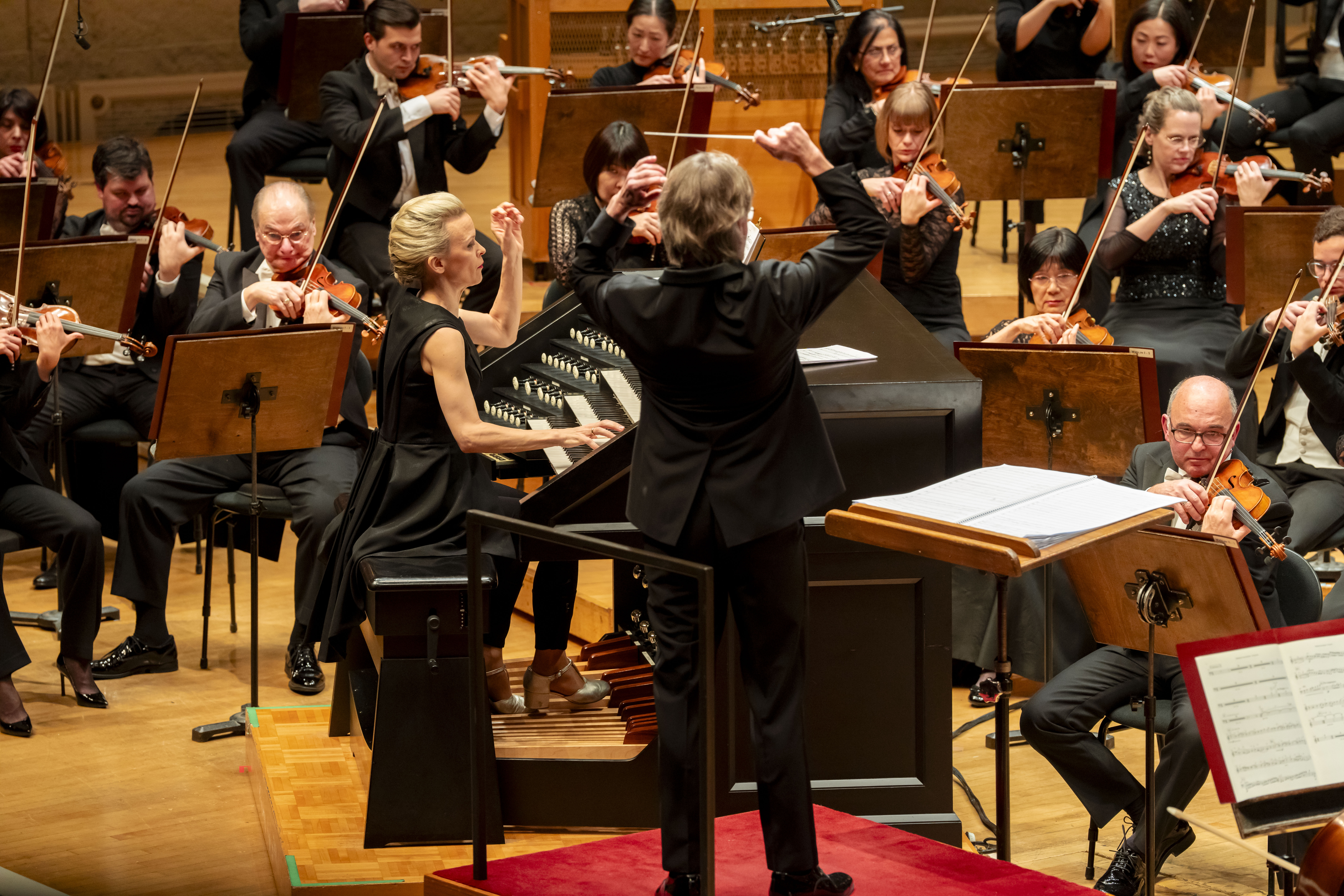
Organist Iveta Apkalna makes her CSO debut in the CSO’s first performance of composer and conductor Esa-Pekka Salonen’s Sinfonia concertante for Organ and Orchestra. Photo Credit: Todd Rosenberg
The Chicago Symphony Orchestra has returned home to Orchestra Hall after a successful tour through Florida, New York and Oklahoma, launching an anticipated two-week residency with conductor Esa-Pekka Salonen. Salonen, a dynamic force in contemporary music, steps onto the Chicago podium at a transitional moment in his career, following his well-publicized decision to not seek a new contract as music director of the San Francisco Symphony over creative differences. In his current lineup in the Windy City, the Finnish maestro will guide the CSO through a compelling lineup, including Bartók staples, Beethoven’s buoyant Symphony No. 2, and a performance of Salonen’s own Sinfonia Concertante for organ and orchestra.
The first program of Salonen’s residency focused on three orchestral showpieces, with his own Sinfonia Concertante framed by Richard Strauss’ Don Juan and Béla Bartók’s Concerto for Orchestra. While Salonen’s work was a new addition to the orchestra’s repertoire, the Strauss and Bartók pieces have a storied history with the CSO, particularly through its landmark recordings with Fritz Reiner. The orchestra’s first RCA recording of the Concerto for Orchestra is widely regarded as one of the definitive interpretations. Reiner’s deep understanding of Bartók’s music—coupled with the orchestra’s balance, precision, and virtuosity in the recording—shaped Bartók’s popularity in America and contributed significantly to the CSO’s growing reputation as a world-class ensemble.
Gods and mythology long influenced music, especially during the Baroque and Classical periods. This era saw a cultural shift, drawing greater and greater inspiration from pre-Christian societies. The larger-than-life characters of mythology offered spectacle and theatricality, especially for Baroque opera. They provided dramatic material for the genre, fueling its growth. But beyond entertainment, these stories also offered allegory and moral lessons, appealing to audiences seeking philosophical themes. This realm of gods, myth, and magic formed a loose programmatic thread through the January program of Chicago’s Music of the Baroque. The evening in Harris Theater off the city’s Michigan Avenue featured three pieces from different music “gods” and Marc Minkowski’s debut with the orchestra.
Esa-Pekka Salonen joins the CSO for a two-week residency focusing on Bartók. In week one, Salonen pairs the Concerto for Orchestra with his own Sinfonia Concertante for organ and orchestra, while in week two Bluebeard’s Castle shares the stage with Beethoven’s Second Symphony. As of this afternoon, there are still ample tickets available for Bluebeard’s Castle, and anyone who can go should.
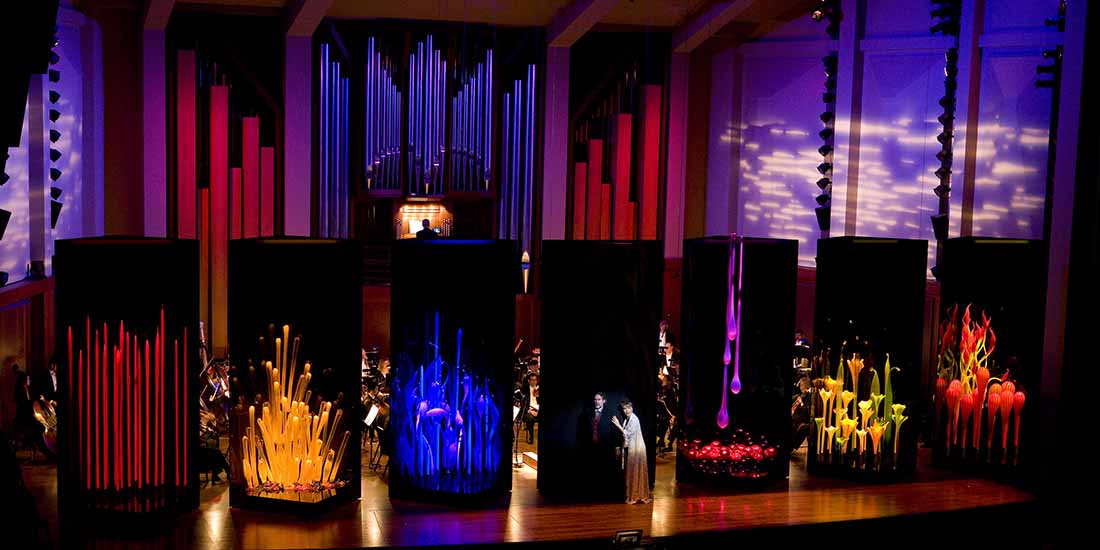
It is one of the spookier pieces of music out there, and Bartók’s vocal writing is excruciatingly demanding. I’ve seen it staged on a double bill with Schoenberg’s expressionist masterpiece Erwartung. But, it was my first experience with the opera, a semi-staged concert performance in Seattle that is firmly planted in my memory. Gerard Schwarz pulled out all of the stops to make it a memorable evening. Schwarz’s production was unforgettable, partially thanks to Charles Simonyi’s support, which enabled the creation of glass sculptures by Dale Chihuly representing six of the seven doors opened by Judith and Duke Bluebeard. This striking production has since traveled to other venues, undoubtedly thrilling audiences.
While Chicago’s performance won’t feature Chihuly’s vibrant sculptures, it boasts its own impressive draw: Esa-Pekka Salonen conducting, alongside soloists Ekaterina Gubanova and Christian Van Horn.
James Dixon, Himie Voxman, and Dimitri Mitropoulos, 1952. Photo Credit: University of Iowa
For over a century, the Quad City Symphony Orchestra (QCSO) has stood as a cultural gem nestled between the major Midwestern cities of Chicago, Minneapolis, Milwaukee, and St. Louis, just a few blocks from the banks of the Mississippi River. Throughout the 20th century, as musicians, soloists, and orchestras embarked on regional tours, the QCSO often served as a strategic and welcoming stop. It provided a platform for artists en route to more renowned venues, enriching the local cultural scene and solidifying the orchestra’s role as a significant hub in the Midwest’s music circuit. This legacy helped foster a deep tradition, making the QCSO a cherished institution in the region.
One of my most treasured keepsakes from this era with the QCSO is their cookbook titled Standing Ovations. It’s a quintessential Midwest cookbook, filled with hearty recipes and straightforward preparations. What truly makes it a keeper, however, are the contributions from the QCSO’s frequent guest artists, such as baritone Robert Merrill (Cheese Pancakes), cellist Leonard Rose (Steak With a Kick), and the Contiguglia Brothers piano duo (Fusilli with Creamy Zucchini), among others.
If classical music had its own sacred pilgrimage, the Berlin Philharmonic would undoubtedly be its ultimate destination—a place where music reaches its zenith. Attending one of their concerts isn’t just hearing an orchestra; it’s an experience akin to standing in awe at the Vatican or Mecca. No matter what they’re playing, you simply need to hear them. I’ve been fortunate enough to witness their majesty twice, both times in Chicago. The first was Mahler’s 7th Symphony, and more recently, Bruckner’s 5th Symphony.
Bruckner’s 5th is often regarded as one of the composer’s most challenging works to comprehend. It unfolds gradually over three movements, creating the impression of an extended prelude. Much like the nearly two-hour Act I of Götterdämmerung, this prelude seems to build toward something profound and otherworldly. By the time listeners reach the fourth and final movement, the stage is ready for something monumental. Bruckner delivers a masterful synthesis of earlier themes. This is woven into a fusion of forms and structures. It approaches his vision of the heights music can reach.
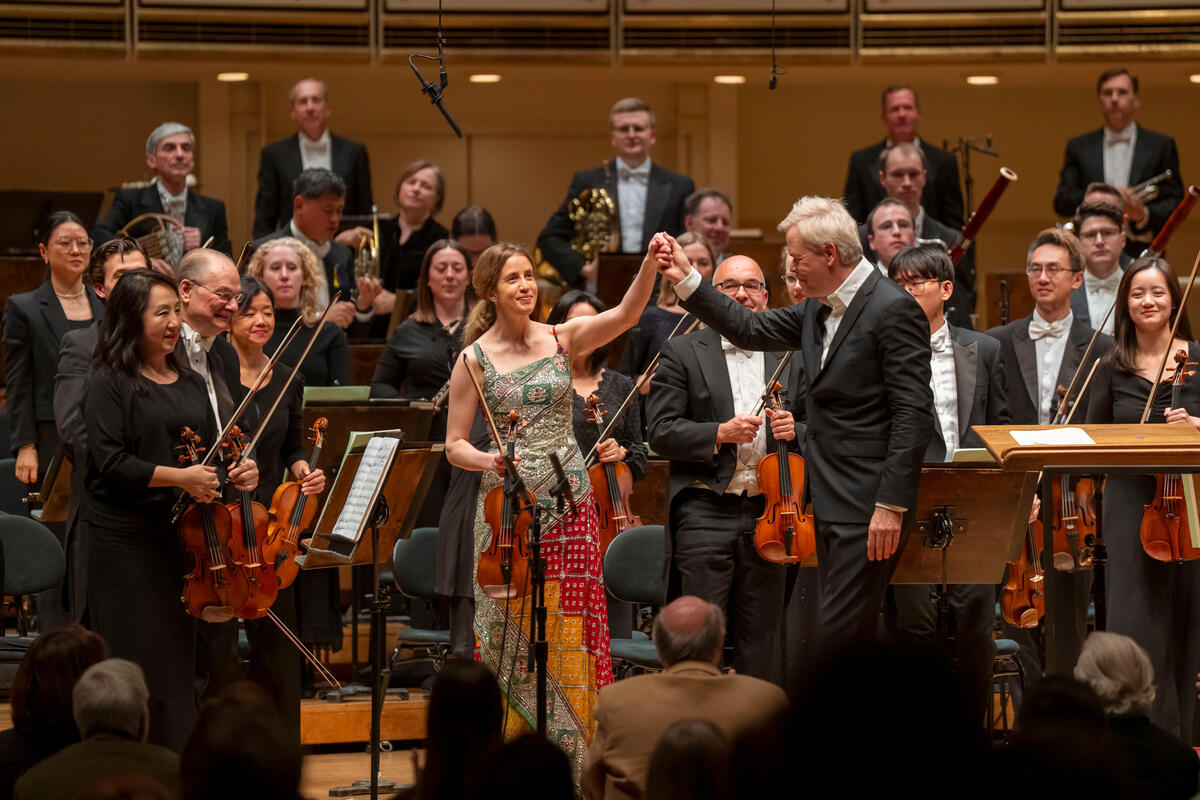
Conductor Hannu Lintu congratulates soloist Vilde Frang following her CSO debut performance of Stravinsky’s Violin Concerto with the Chicago Symphony Orchestra. Photo Credit: Todd Rosenberg
Chicago’s first snowfall of the season also marked the return of Hannu Lintu to Orchestra Hall, though an afternoon rise in temperature meant that, by the time the maestro ascended the podium, snow had transitioned to rain and a steady melt. The meteorological pivot in some ways mirrored the contrasts the Finnish conductor was bringing to the Chicago Symphony Orchestra.
On his earlier visit to Chicago, Lintu balanced the familiar and the unexpected, pairing well-known crowd-pleasers by Shostakovich and Tchaikovsky with seldom-performed works by Saariaho and Mussorgsky. For this current engagement, Lintu—joined by the Norwegian violinist Vilde Frang, a rising star with an already formidable reputation—brought a program just as intriguing, with contrasts between pieces that exuded entertaining push-and-pull tension.
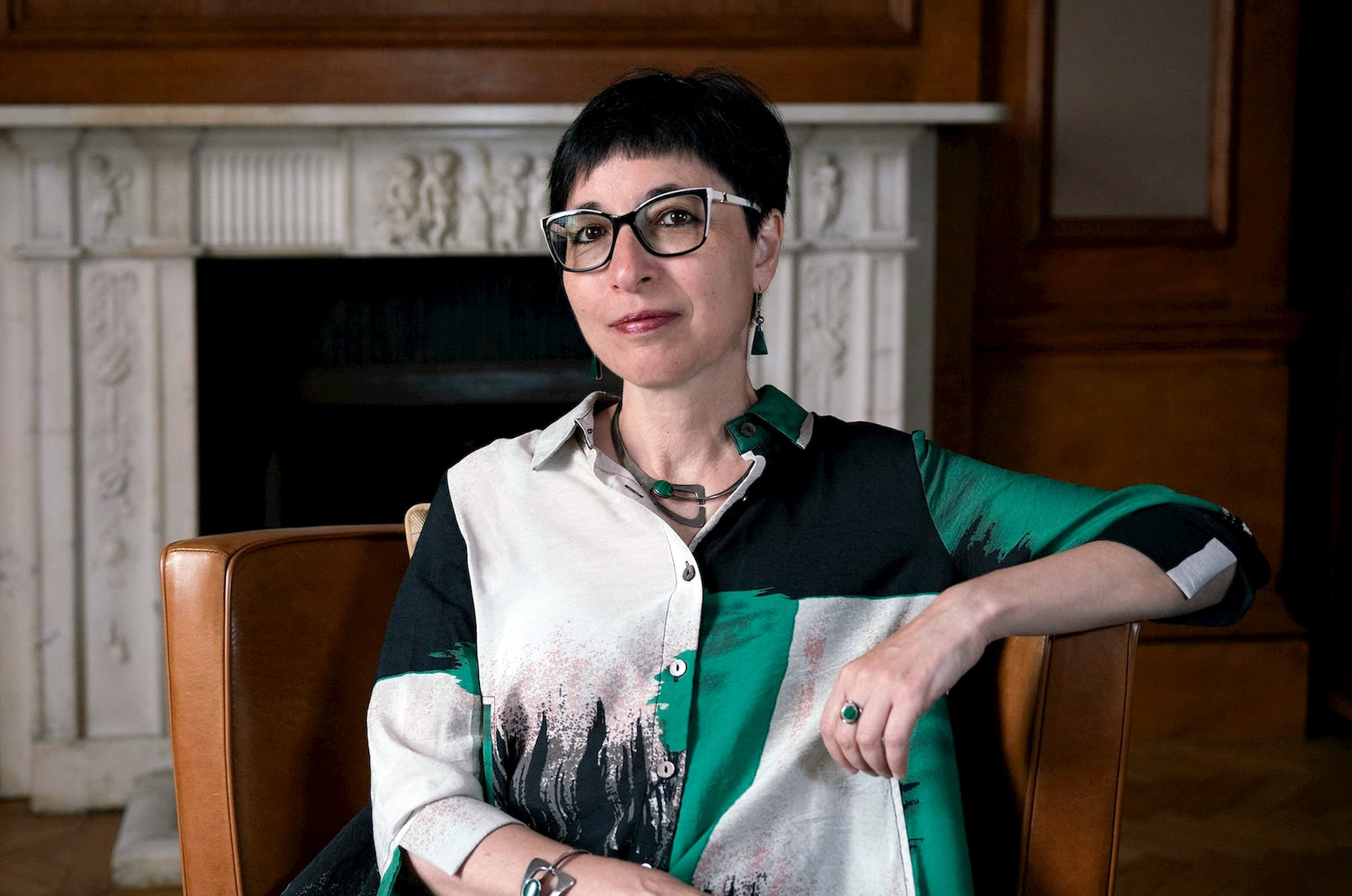
Fantastic news from the Netherlands: Elena Dubinets has been named Artistic Director of the Concertgebouw Orchestra. Dubinets was a transformative force during her time at the Seattle Symphony, and now Amsterdam is about to see why.
During her Seattle days, Dubinets brought fresh ideas to programming that made the Symphony not just good but great. Remember when they commissioned John Luther Adams’ Become Ocean? That wasn’t just any new piece—it won the Pulitzer Prize and it helped reestablish the Seattle Symphony’s relevance.
I first encountered Dubinets’ work during my time as a student at the University of Iowa, though I didn’t realize it then. In the fall of 2000, she curated a Russian contemporary music festival, which Taruskin covered for The New York Times. I sat in the audience, captivated and wide-eyed, as I absorbed the unfamiliar sounds. Our paths crossed again years later when I briefly served on the board of the Seattle Chamber Players and later assisted her and the Seattle Symphony with visa applications for a group of artists who had limited experience performing in the United States.
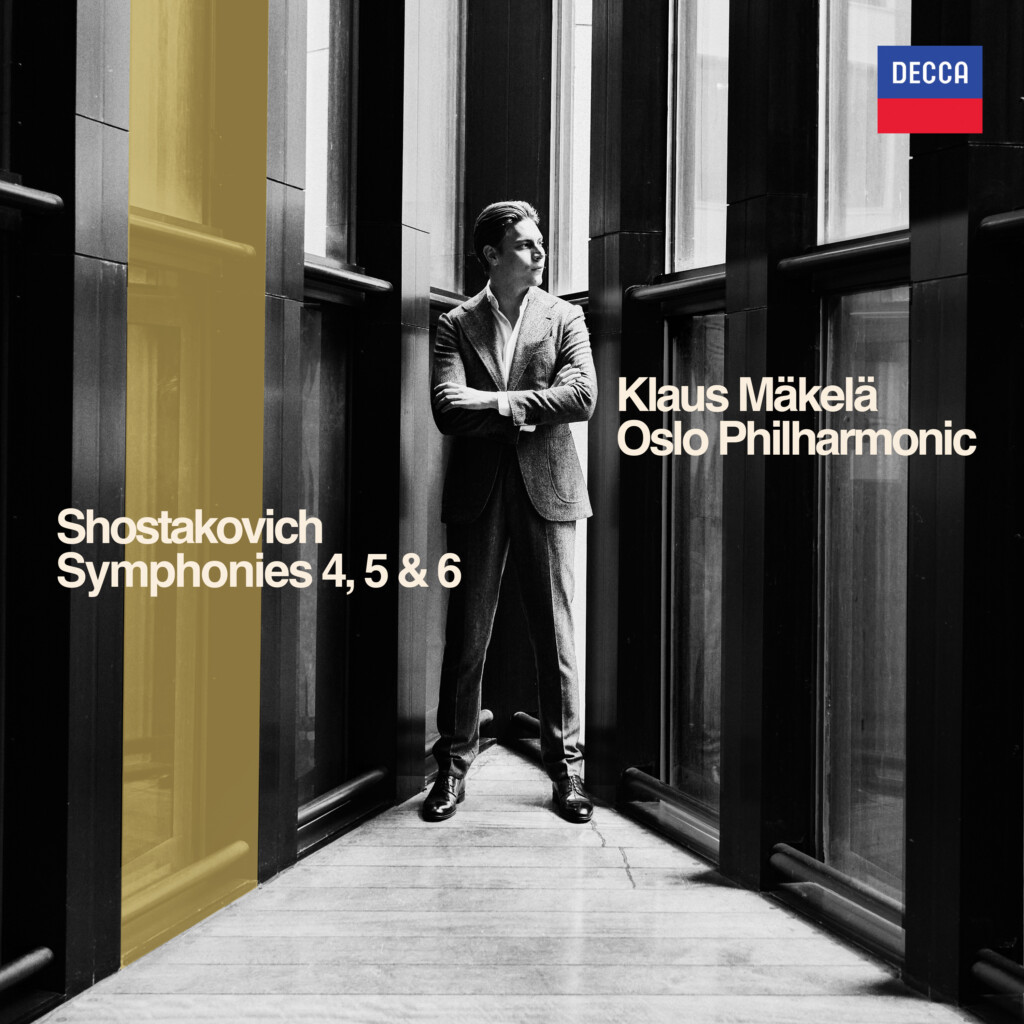
She left Seattle during the pandemic—a loss for Seattle—and spent the last few years doing brilliant work with the London Philharmonic. Now, she’s heading to Amsterdam to work with Klaus Mäkelä, the Concertgebouw’s incoming music director. Mäkelä is already being hailed as one of the most exciting young conductors in the world and pairing him with Dubinets feels like a good match.
The election last week has been, to put it mildly, numbing. I made it through about a year of the first Trump administration before the despair set in. It was the Jesuits—thank you, St. Joseph and Seattle University—who helped keep my soul intact, offering me a lifeline of reflection and community. And, surprisingly, Leif Ove Andsnes’ Sibelius recital album also played its part.
It’s been four months since J and I arrived in Seattle. We’re still settling in, but we’re growing fond of Chicago’s concert and classical music venues. We’re both old enough to have heard dozens of Chicago Symphony concerts in Orchestra Hall already or spent a lazy summer evening sprawled out on the lawn in front of the Jay Pritzker Pavilion listening to the Grant Park Orchestra. But they are ours now. In time, maybe they’ll even be something of a third place for us the way Benaroya Hall and McCaw Hall were. Helping us form an even deeper love for music as we march further into middle age. Enjoy some of my favorite photos of Orchestra Hall, Fine Arts Building, Jay Pritzker Pavilion and Civic Opera House.


 Gathering Note