Originally published on Seen and Heard International
Chicago’s classical music scene is undeniably shaped by the towering presence of the Lyric Opera and the Chicago Symphony, institutions that draw crowds with their scale and prestige. Against this backdrop, the Chamber Music Society of Lincoln Center’s series at the Harris Theater stands out as a quieter, yet equally vital, counterpoint—offering an intimate alternative that feels both rare and refreshing in a city where chamber music isn’t the first thing on most concertgoers’ minds. Tuesday’s CMS performance drove that point home, showcasing the unique appeal of small-ensemble playing in an intelligent program of Schubert, Mozart and Wilhelm Friedemann Bach.
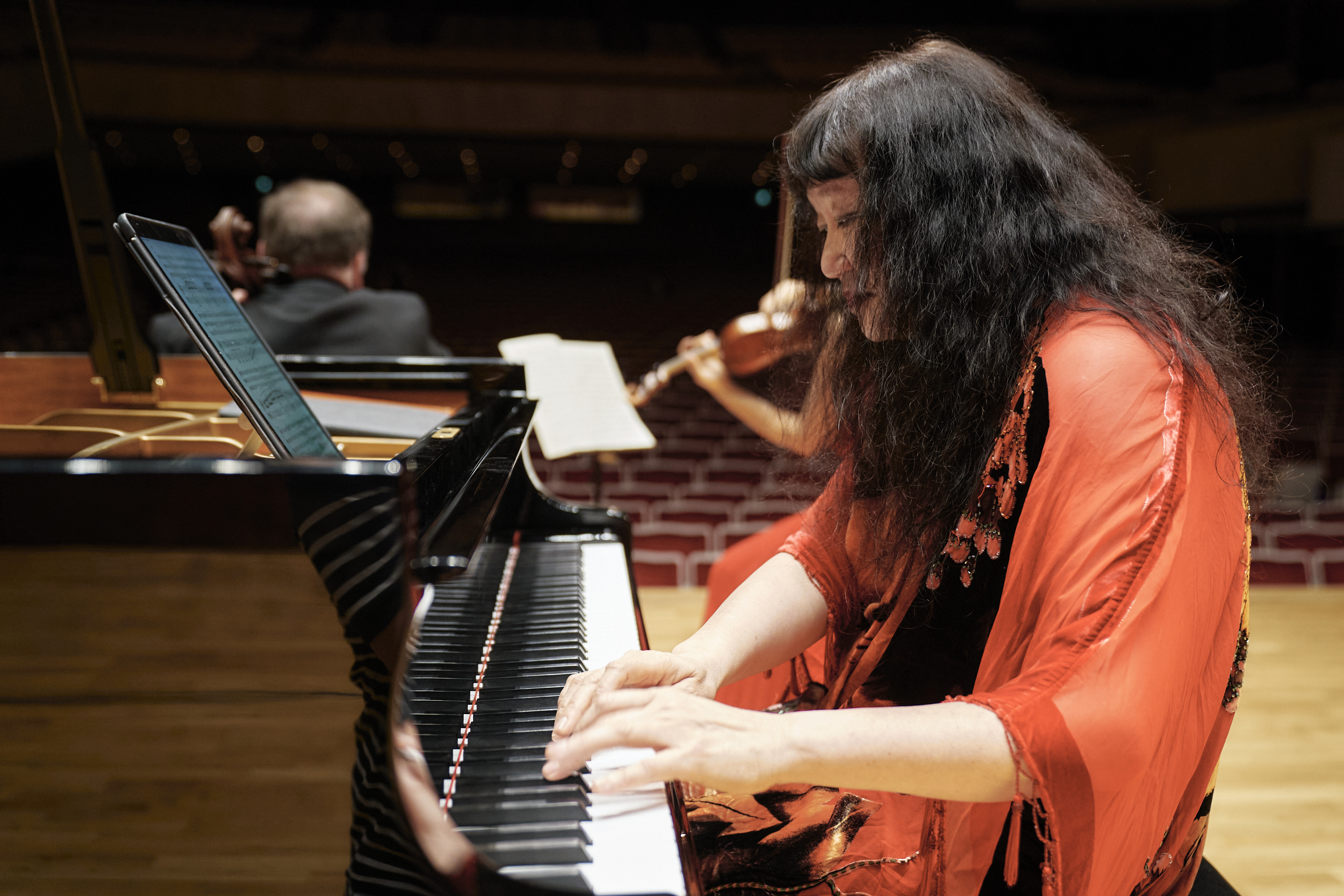
Before the music began, co-artistic director Wu Han stepped out to greet the audience, striking a relatable note by admitting she’d heard some subscribers chose to spend their evening at the Lyric Opera’s La Boheme instead. With a wry smile, she turned the moment into a pivot to the future, announcing the dates for next season. Her co-director and husband David Finkel, will announce next season’s program at CMS’s final Chicago concert in April.
This particular program was five years in the making. Wu Han explained that she’d wanted to perform Mozart’s Piano Quartet No. 2 in E-flat Major once the pandemic ended, and Tuesday’s concert marked that moment. She paired it with Schubert’s Trout Quintet, a “party piece” known for its good humor and unusual instrumental lineup. But to open the evening, she chose two concise string fugues: W.F. Bach’s Fugue in F Minor, arranged by Mozart, and Mozart’s Adagio and Fugue in C Minor. Together, they clocked in at just 10 minutes but set the tone by highlighting individual instrumental voices—a core element of chamber music.
The opening fugues might have seemed like minor preludes to the bigger Mozart and Schubert works, but they proved their worth. Wu Han, in a Playbill Q&A, said that hearing how the different musical voices in a fugue interact can teach you how to listen to chamber music—tracking both the horizontal lines and the vertical harmony. W.F. Bach’s fugue, played by violist Paul Neubauer, violinist Arnaud Sussman and cellist Sterling Elliott, was a delight, its four minutes weaved together seamlessly by the musicians. Mozart’s Adagio and Fugue, with its rougher, more modern edge, hit harder. The fugue itself was more ferocious than academic, with Neubauer, Sussman, violinist Julian Rhee and double bassist Anthony Manzo delivering its shadowy accents with precision and emphasizing the work’s jagged contours.
Mozart’s Piano Quartet No. 2 is a cornerstone of the form he helped define, with the piano emerging as a distinct voice in the ensemble. Compared to his darker G minor quartet, the E flat Major is brighter and more approachable. Wu Han’s playing imbued it with a concerto-like energy, while also staying balanced with the strings. The piece thrives on this interplay—her piano would introduce a theme, and the strings, led by Neubauer’s warm, flexible tone, would answer. In the Larghetto movement, the piano took center stage with a tender melody that hung in the air, while the strings responded with a soft, velvety blend. The ensemble’s chemistry gave the piece a spontaneous, conversational quality that set an uplifting tone heading into intermission.
Schubert’s ‘Trout’ Quintet, performed in the second half, is a natural companion to the Mozart. Its unique instrumentation—no second violin, but a double bass—gives the piece a rich, almost orchestral texture. The five movements alternate fast and slow, with rhythms that evoked dance.
The fourth movement, based on Schubert’s song Die Forelle (‘The Trout’), was especially effective. The ensemble played the theme and its variations with a balance of lightness and melancholy. Wu Han, Rhee, Neubauer and Manzo brought the movement to life, letting the tune twist through variations. Wu Han’s touch was both nimble and fluid, guiding the ensemble through the variations with natural ease. Notably, there was a touch of sadness in the downward shifts of the melody, revealing a melancholy I hadn’t noticed before. The musicians balanced this darkness with the piece’s inherent lightness, making it a highlight of the night.
Discover more from Gathering Note
Subscribe to get the latest posts sent to your email.
 Gathering Note