The weekend in classical music: Schumann, Stravinsky, and Hagen

Clara and Robert Schumann

To hear pianist David White tell the story of one of the most famous clove triangles in the history of music, Johannes Brahms and Robert Schumann’s music wouldn’t exist as we know it without the presence of Clara Schumann — friend to Johannes, wife of Robert, accomplished pianist, and gifted composer. it is hard to disagree with this sentiment. Robert tended to be at his best with Clara as his muse, and the durability of Brahms music today — especially his piano music — depends to some degree on Clara’s advocacy.

In honor of the 200th anniversary of Robert Schumann’s birth, the Onyx Chamber Players presented a two night mini-festival of music by these three 19th Century icons. I was only able to make it to Sunday evening’s performance of C. Schumann’s Piano Trio, Brahm’s Op. 101 Piano Trio, and R. Schumann’s Piano Quintet.

Due to a mistake by the Seattle Times, Sunday’s performance was delayed by 30 minutes. A preview which ran in the Times noted an incorrect start time of 7:30 pm — instead of 7 pm. When I make a mistake like this, I get carping emails from publicists. When the Seattle Times messes up, concert start times get moved. Oh well. A few people straggled in between when the concert was supposed to start and when it actually did. Not enough to warrant a change though.
Continue reading The weekend in classical music: Schumann, Stravinsky, and Hagen
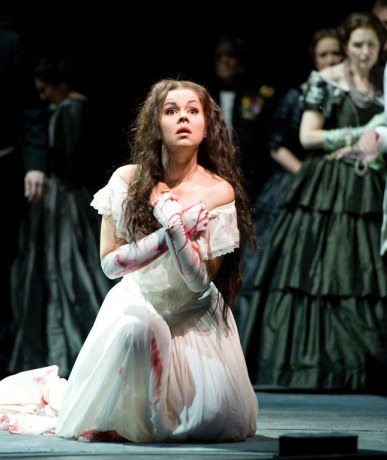
“Lucia di Lammermoor returns to Seattle Opera

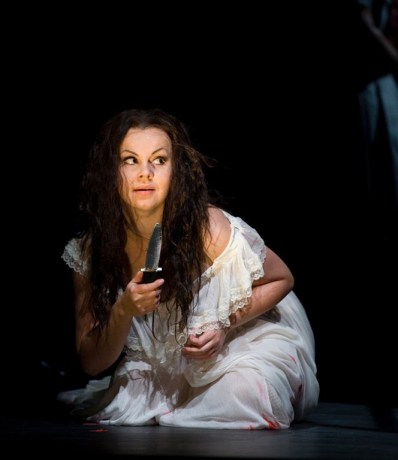
Aleksandra Kurzak as the mad Lucia. Photo: Rozarii Lynch.

By R.M. Campbell

When Speight Jenkins, general director of Seattle Opera, was not in his usual seat just prior to the beginning of Donizetti’s “Lucia di Lammermoor” Saturday night at McCaw Hall, there were worries: the soprano had a sore throat, the tenor a bad back, the baritone, a sour stomach. But, as Jenkins quickly explained when he stepped in front of the curtain, he had no bad news. He wanted to dedicate the performance to Joan Sutherland, who died, at 83, Oct. 11 in Switzerland. She was, as anyone who knows anything about music over the past half century, was one of the greatest singers of the 20th century, famous for the beauty and size of her voice, a stupendous technique, creamy legato, evenness of her registers and a vast palette of colors, among her many attributes. It was her performance in “Lucia”, in 1959, at Covent Garden — the first time the opera had been done at the house since 1925 — that catapulted her to the fame, and huge admiration she enjoyed the rest of her life. The soprano made her Metropolitan Opera debut, in 1961, in the title role of “Lucia,” causing a 12-minute ovation at the end of the Mad Scene, according to the New York Times obituary. Five years later she made her debut at Seattle Opera in Delibes’ “Lakme,” returning several times in different roles but never Lucia.
Continue reading “Lucia di Lammermoor returns to Seattle Opera

From Russia with love

The Odeonquartet’s fall concerts brought back pieces the group has played before, and injected a premiere of a piece they played on their recent trip to Russia. Heather Bentley, the group’s violist posted about their Russian tour on TGN.

Each of the two concerts — the first one on Vashon Island and last Monday’s performance at the Good Shepherd Center’s Chapel Performance Space — ended with Alexander Galzunov’s Op. 39 String Quintet; it is a big, romantic wet kiss. Glazunov’s moments of genius came across as heartfelt. For my ears, the highlight of the concert came at the very beginning of the night’s program.
Continue reading From Russia with love

Quarter notes

The past two weeks have been a classical music pile up. Orchestras, ensembles, and soloists crashing into one another. This weekend is poised to be busy too. Jane Harty kicks off a season of Music Northwest in West Seattle with a tribute to Chopin. Onyx Chamber Players are doing Schumann on Saturday. Geoffrey Larson and the Seattle Metropolitan Chamber Orchestra are back for a new season. Their season opener is at the PACCAR Pavilion. Stravinsky’s Octet and Beethoven’s Second Symphony are on the program.  Opus 7 performs choral works of Barber, Schuman, and Schumann on Saturday. Music of Remembrance does Bloch, Schulhoff and Schonefield’s Sparks of Glory for their first free concert of the season. The early music Gallery Concerts series kicks off this weekend too.  FINALLY, the Tudor Choir does a themed concert ‘Songs of War and Heaven’ at the Moore Theater.

Stephen Wadsworth is getting praise for his last minute contribution to the new Met Opera production of Boris Godunov.  The Met chose Mussorgsky’s revised version for this production.  In Detroit, the strike continues with the DSO canceling more concerts.  Drew McManus has a nice round up of the strike/social media/Sarah Chang situation.  In case you haven’t been following, Sarah Chang had planned on doing a solo recital in Detroit, but after pressure from musicians and their union she canceled.

I’ve been remiss to mention the passing of Joan Sutherland, but Seattle Opera has a nice tribute, and they even posted a video of Sutherland performing Lucia’s famous ‘mad’ scene.

Bruno Cinquegrani: Donizetti expert?

Aleksandra Kurzak as Lucia. Photo courtesy Seattle Opera.

Bruno Cinquegrani doesn’t consider himself a Donizetti expert, even when posed with a long list of experiences with the composer’s operas that suggest the contrary. “I’m not exactly an expert,” he remarked to me last week when I talked with him at the Seattle Opera’s rehearsal space in the South Lake Union neighborhood.
Continue reading Bruno Cinquegrani: Donizetti expert?

RVW’s Job receives Seattle premiere; two orchestras look for conducting leadership

RVW

Uncertainty faces at least two of Seattle’s community orchestras this season. The untimely passing of George Shangrow has left Orchestra Seattle hanging on. In spite of the fine music making by the group, Orchestra Seattle was always driven by George’s personality and his own vision for the group. He founded the orchestra. Philharmonia Northwest is another local orchestra which is also experiencing change at the podium.

After years leading the Philharmonia, conductor Roupen Shakarian decided the commute from the islands had become too much. Other projects beckoned. With Orchestra Seattle conductor less, Shakarian has been recruited back to Seattle to fill in at the podium for that orchestra’s partial season.  Try as he might, Shakarian can’t seem to get away from having orchestral responsibilities in Seattle.
Continue reading RVW’s Job receives Seattle premiere; two orchestras look for conducting leadership

The Gathering Note joins Tumblr

I’ve started a Tumblr version of The Gathering Note as a forum for readers to add their own content.  I will periodically pluck compelling audience reviews, photos, videos, etc for further commentary or for stand alone posts over here.  Anonymous posts are okay — provided they aren’t scurrilous.  No good commentary will be excluded.  If no one contributes, then there will be no posts.  I hope that isn’t the case of course.  I know this community’s musicians, composers, music lovers, and others have a lot on their mind an plenty of opinions.  Please share!

For the PR professionals out there, posting your press releases as a comment will not help your cause.  Save your ink (and time) about the Mozart effect and the latest crossover pop artist for someone else OR if you must send a press release, because your clients demand it send them to: press@gatheringnote.org

Here is the entirety of the first Tumblr post.

Continue reading The Gathering Note joins Tumblr

Listen to This: Alex Ross comes to Town Hall

Alex Ross, the New Yorker’s classical music critic, is out with a new book.  It follows on the success of The Rest is Noise, a wide reaching historical survey of classical music in the 20th Century.  The new book more or less eschews one narrative that runs from beginning to end in favor of a collection of essays drawn from his time at the New Yorker.  Many of the essays have been substantially enhanced, amended, or edited.  One essay — Chaconna, Lamento, Walking Blues– is brand new for the book.  This essay forms the basis of his talks on the fall book tour, including the one at Town Hall this Tuesday evening.

Ross took time between travels to Long Island and travels to other parts of the country to answer a few questions about the new book.  If you are planning on going to Town Hall for the reading, be sure to watch the video posted below.  It is a snapshot of the talk Ross will be giving.

Continue reading Listen to This: Alex Ross comes to Town Hall

Better classical audio made easy

By Sebastian Mitchell

In a departure from the stalwart items of The Gathering Note, I’d like to present this simple guide to understanding and getting good sound quality for recorded classical music.

Things can get far more sophisticated than what I intend to explain here, as some (or most) super-audiophiles might (more likely will) tell you. If you’re searching for the non-plus-ultra of aural experiences then perhaps this isn’t for you; on the other hand, if you want moderate improvements in sound quality without too much effort then read on!

Now, one thing to recognize is that you have complete control over how you listen to recorded classical music, as opposed to when it is performed live. You can alter every step of the process, from the source to the output. I hope this sends a pulse of megalomania through you! So, to start off on a good footing, I strongly encourage you to seek out the best quality recordings you can. The effect of everything else in your hi fi setup is reliant on the foundation of a high quality source for the music.

Continue reading Better classical audio made easy

Spano and Hamelin charge through Gershwin and Ravel Thursday night

George Gershwin: American revolutionary?

A last minute decision at the Seattle Symphony transformed this week’s subscription concert from ordinary to extraordinary. The program, which features competing halves, was initially arranged with the crowd favorites (Copland’s Appalachian Spring and Gershwin’s Rhapsody in Blue) falling first, while the lesser known pieces (Stravinsky’s Symphony in Three Movements and Ravel’s Concerto for Left Hand) coming after intermission.

The Seattle Symphony’s audience has demonstrated a general distrust of music unknown to them. Last week’s concert is an example. As it was reported on this site by Mr. Campbell and by others I have spoken with since the concert, the orchestra level was only 60% – 70% full. Dvorak’s Seventh Symphony anchored a program of Debussy, Bloch, and a new piece by Aaron Jay Kernis. Only Dvorak’s Seventh comes close to being an immediately familiar piece.

For opening night of this week’s concert, Taper Auditorium was full. I wondered out loud to a few people before the concert if Gershwin and Copland would be enough to dispel any misgivings for Stravinsky and Ravel. “Never underestimate the pull of Rhapsody in Blue,” a long-time observer of the symphony wisely advised. Even if Gershwin could generate a robust audience, there was a risk that after the audience heard Rhapsody and Appalachian Spring there would be an exodus at intermission. This was a genuine risk. It happened last spring for Adams’ Harmonielehre.
Continue reading Spano and Hamelin charge through Gershwin and Ravel Thursday night