Don Juan—er, Don Giovanni—is alive and well in the 21st century

By Philippa Kiraly

Mozart knew what he was about when he chose the Don Juan story for his opera “Don Giovanni.” The character lives, today as much as he has through the ages, the seductive rake without conscience or regard for the consequences of his actions.

The opera is invariably popular. The current production, mounted by Seattle Opera’s Young Artists Program and performed at the Theatre at Meydenbauer Center, is set today, in a seedy little cafe somewhere in Southern Europe, where the entertainment is old, very old, movies from the silent era which play much of the time on the back screen.
Continue reading Don Juan—er, Don Giovanni—is alive and well in the 21st century

Don Quichotte takes the Seattle Opera stage

By R.M. Campbell

A 101 years since its premiere in Monte Carlo, Massenet “Don Quichotte” finally made its way to the exotic Northwest where Seattle Opera opened a new production of this “heroic comedy” this weekend at McCaw Hall.

Although the company has traversed a good share of the Massenet canon, plus a couple of rarities thanks to Joan Sutherland and Richard Bonynge, it had never approached his last work, written only a few years before his death in 1912. It did not attempt to break new ground; rather it presented a production that was often subtle, often striking and allowed the luxurious perfume of the composer’s music a chance to breathe. Two excellent casts were assembled for performances Saturday night and Sunday afternoon, continuing through March 12.
Continue reading Don Quichotte takes the Seattle Opera stage

Seattle Opera Young Artists and Viva la Mamma!

By Philippa Kiraly

There can be only have been one really good reason for Seattle Opera Young Artists Program to perform Donizetti’s “Viva la Mamma!” or to give it its full Italian name “Le convenienze ed inconvenienze teatrali.”

That reason lies in the person of baritone Daniel Scofield, who undertakes the role of the aforementioned Mamma! in drag (as it was originally written), and succeeds triumphantly and hilariously as well as musically to hold the stage whenever he is on it.

“Viva” is an unevenly written farce, a frothy romp with so little substance and so disjointed a plot that there is little to hold onto, while the music comes from before Donizetti has really found his own distinctive voice. It only works if there is excellent acting and staging, and thank goodness, this production has both, thanks to the young singers and to stage director Jeffrey Marc Buchman. Half the fun is that all of the roles are instantly recognizable to anyone who has been backstage during a production.
Continue reading Seattle Opera Young Artists and Viva la Mamma!

“Lucia di Lammermoor returns to Seattle Opera

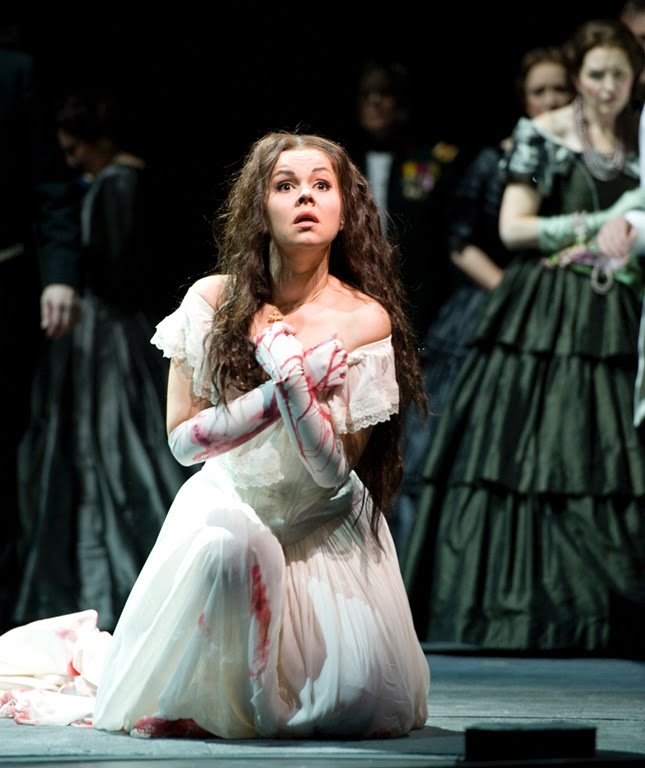
Aleksandra Kurzak as the mad Lucia. Photo: Rozarii Lynch.

By R.M. Campbell

When Speight Jenkins, general director of Seattle Opera, was not in his usual seat just prior to the beginning of Donizetti’s “Lucia di Lammermoor” Saturday night at McCaw Hall, there were worries: the soprano had a sore throat, the tenor a bad back, the baritone, a sour stomach. But, as Jenkins quickly explained when he stepped in front of the curtain, he had no bad news. He wanted to dedicate the performance to Joan Sutherland, who died, at 83, Oct. 11 in Switzerland. She was, as anyone who knows anything about music over the past half century, was one of the greatest singers of the 20th century, famous for the beauty and size of her voice, a stupendous technique, creamy legato, evenness of her registers and a vast palette of colors, among her many attributes. It was her performance in “Lucia”, in 1959, at Covent Garden — the first time the opera had been done at the house since 1925 — that catapulted her to the fame, and huge admiration she enjoyed the rest of her life. The soprano made her Metropolitan Opera debut, in 1961, in the title role of “Lucia,” causing a 12-minute ovation at the end of the Mad Scene, according to the New York Times obituary. Five years later she made her debut at Seattle Opera in Delibes’ “Lakme,” returning several times in different roles but never Lucia.
Continue reading “Lucia di Lammermoor returns to Seattle Opera

Bruno Cinquegrani: Donizetti expert?

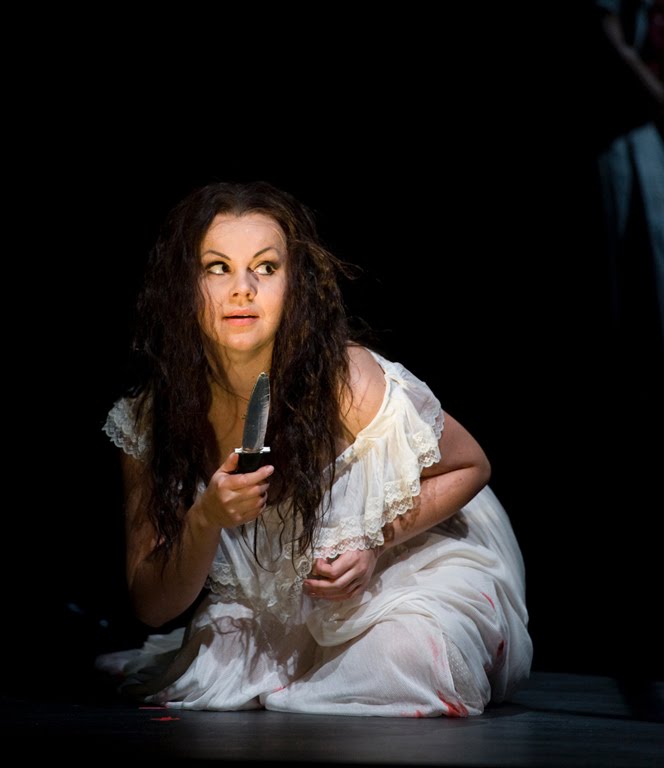
Aleksandra Kurzak as Lucia. Photo courtesy Seattle Opera.

Bruno Cinquegrani doesn’t consider himself a Donizetti expert, even when posed with a long list of experiences with the composer’s operas that suggest the contrary. “I’m not exactly an expert,” he remarked to me last week when I talked with him at the Seattle Opera’s rehearsal space in the South Lake Union neighborhood.
Continue reading Bruno Cinquegrani: Donizetti expert?

New production of “Tristan” opens Saturday at McCaw

Annalena Persson (Isolde) and Margaret Jane Wray (Brangäne). Rozarii Lynch Photo

By R.M. Campbell

Wagner’s monumental “Tristan und Isolde”  is not a stranger to Seattle Opera: it has never been approached lightly. The opera is too important, too central to the Wagner canon, too demanding to be treated with anything less than awe and respect. The last time the company mounted the opera, in 1998, it had an all-star cast (Jane Eaglen and Ben Heppner singing the roles for the first time together ) and a production team, headed by stage director Francesca Zambello. The set, designed by Alison Chitty, was as massive as the opera itself. Magnificent really, especially the first and second acts.

Continue reading New production of “Tristan” opens Saturday at McCaw

Grimsley sings Kurwenal again in Seattle Opera’s new production of Tristan

Greer Grimsley as Kurwenal in Seattle Opera’s 2010 Tristan und Isolde. Photo by Rozarii Lynch.

By Philippa Kiraly

It was Speight Jenkins, general director of Seattle Opera who persuaded bass-baritone Greer Grimsley that he should sing Wagner. That was for the 1994 production of “Lohengrin,” and Grimsley has sung in nearly every Wagner production here since.
Talking with him as he prepares to sing Kurwenal in “Tristan and Isolde” which opens Saturday at McCaw Hall, you are immediately struck by his speaking voice, as sonorous as his singing one.

Continue reading Grimsley sings Kurwenal again in Seattle Opera’s new production of Tristan

Road report: Twilight of the Gods, LA Ring

Hagen and Alberich. Photo courtesy LA Opera

By Jonathan Caves

On the last night of the first complete Ring Cycle at Los Angeles Opera Symbolism took the lead: from the moment the curtain dissolved and the stage lights came up we were presented with an array of symbols from across the whole cycle. Loge: hanging over the stage foreshadowing the inferno to come. The Tarnhelm: reminding us that no one is exactly as they seem. Nothung: a symbol of power that is ultimately impotent. These symbols remained in place all night as a constant reminder of the grand themes of the Cycle. There was a rising tension and a sense of inevitability about this production of Götterdämmerung – it was thrilling to watch. When Act I of Götterdämmerung flies by you know you are in for a great night at the theatre.

The Norns told their tales with minimal fuss and some great singing – my only issue was the rather strange costumes – if one of them fell they wouldn’t have stopped until they took out the cello section in the pit.
Continue reading Road report: Twilight of the Gods, LA Ring

Road report: Siegfried; LA Ring

Wotan and Erda; LA Ring. Photo courtesy of the Los Angeles Opera.

By Jonathan Caves

Siegfried is a problem child: the character can be one of the most annoying characters in all of opera and all too often this opera is the weak link in a Ring Cycle. This was definitely the case last night at The Chandler Pavilion. After the excellent production of Die Walküre (the more I reflect on this production the more I like it) I was ready for an equally impressive production of Siegfried. Unfortunately I didn’t get what I was expecting and I am still trying to work out exactly why.
Continue reading Road report: Siegfried; LA Ring