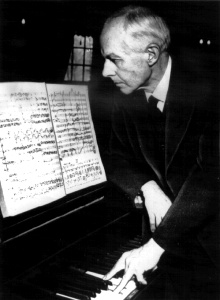
Mandarin and Lousadzak featured by Seattle Symphony and Dennis Russell Davies

Like Bluebeard’s Castle – which was performed earlier in the year by the Seattle Opera – Bartok’s Miraculous Mandarin is a musical setting of love with ghastly consequences.  The Miraculous Mandarin was paired with Alan Hovhaness’s Lousadzak, a concerto for piano and strings.  The pieces were the focal point of Dennis Russell Davies first concert with the Seattle Symphony during his two week stay with the orchestra.

The tale of the Miraculous Mandarin revolves around a woman.  In this case, a woman who is being held captive and used as a decoy for a group of thieves.  The thieves set up their operation in a badly appointed room located in the slums of a city.  The thieves force the woman to sit seductively in the window of the room and draw in suitors who the thieves will rob.  At first these criminal efforts aren’t successful.  Patrons come, but they are forced away because they are poor.

It is only when a strangely dressed man with East Asian origins eyes the woman that the thieves finally find someone worth seeing their ploy through to the end.  Except, the Mandarin proves to be a hard target.  First the woman rejects his icy advance then  the thieves attack, stabbing him, but he doesn’t die.  Instead, he stays fixated on the woman.  Relenting, the woman embraces the Mandarin, who eventually dies.

Bartok’s music is violent; pushed along by unrelenting rhythm.  The suite begins with the music wildly undulating in the strings, reminiscent of horror movies past and present, before the rest of the orchestra joins adding pointed edge that seldom subsides over the course of the suite.

Miraculous Mandarin; Neemi Jarvi and the Philharmonia Orchestra; Chandos

Similarly, Lousadzak is also driven by rhythm but in a way that predicts future developments like minimalism and chance.  Like the chant melodies it is modeled after, the music is repetitive but religiously ecstatic.  Lousadzak is attractive, interesting rhythmically, but without an underlying idea to make it a great piece of music.  Lousadzak was helped by the adroit fingers of Maki Namekawa who was warmly received by Thursday’s audience.  She rewarded us with an arrangement by Fasil Say of Paganini’s 24th Caprice.

Lousadzak; Dennis Russell Davies and the American Composer’s Orchestra; Nimbus

Dennis Russell Davies has built a reputation on bold programing.  Filling the second half of a concert with Bartok’s Mandarin suite and Lousadzak is bold indeed.  Neither is particularly revolutionary by today’s standards or even the music that was composed a few decades later in the musical time line.  They do, however, require the patience and attention of the audience, in the case of Lousadzak the ability to focus on repeated ideas that change ever so slightly, and for Bartok a high tolerance for thrashing, uncomfortable musical ideas.  Together Lousadzak and the Miraculous Mandarin pair nicely.

Both evolved from the composers’ interest in indigenous music.  But they contrast as well.  Lousadzak is reflective; inward looking.  The Miraculous Mandarin is extroverted and brash.  These pieces aren’t for everyone.  In fact, I would guess most people attending Thursday’s SSO concert preferred the first half of the night which featured a heavy handed and uninspired performance of Robert Schumann’s 4th Symphony.  Davies wasn’t as comfortable with Schumann’s Romantic idiom as he was with Hovhaness and Bartok.  That’s fine by me.  You don’t go to hear Davies conduct Schumann.  I’d rather hear Davies lead the orchestra in pieces like the Miraculous Mandarin and Lousadzak, pieces considerably different than the Romantic warhorses classical audiences have grown used to.

Tickets for the remaining performances of the Miraculous Mandarin and Lousadzak can be purchased at www.seattlesymphony.org.  Be sure to read RM Campbell’s review of Thursday’s concert here.

American String Quartet Closes Beethoven cycle Wednesday night at Nordstrom Recital Hall

To celebrate the 10th anniversary of the opening of Benaroya Hall this season, the Seattle Symphony Orchestra came up with all sorts of ideas. One of the best, which did not involve the orchestra itself, was the presentation of a cycle of the complete Beethoven string quartets.

The some 16 quartets would not be played by a single ensemble but by six: Half (Pacifica, Ying and American) would be from the United States, and the rest from Canada (Borealis), the Czech Republic (Talich) and France (Ebene). The first concert was in October and the last Wednesday night. This sort of international festival of superb quartets would not have been possible in another day. There are now so many in North America and Europe we must be in some sort of golden age.

Nordstrom Recital Hall — the smaller of two halls in the Benaroya complex — was the venue. Although there have been all sorts of concerts by chamber music groups and chamber orchestras in the hall, the string quartet has not been particularly well-represented, in part perhaps because it has such a long history at Meany Hall on the University of Washington campus. This series proved decisively how well Nordstrom does acoustically. Certainly it is an unforgiving hall, but when musicians appreciate its acoustical properties –as some have not in the past — the results are remarkable.

A case in point was the American String Quartet. Who could not admire its cool tonal beauty as well as its passionate embrace of the music at hand — early, middle and late Beethoven? Nothing was strident or overweening, even in the most fortissimo and emphatic passages. Instead there was lucidity, transparency, balance. One heard everything.

The quartet was founded in 1974 when its original members were students at the Juilliard School in New York. That long breath of experience informs every aspect of the American’s conception and execution. This is maturity at its best: when carefully considered and thought-out but still fresh. From the opening passages of the Op. 18, No. 5, it was easy to discern those attributes. Nothing is too small to be discussed, resolved and put into action. This attention to detail has not led to staleness and lack of spontaneity but a curious kind of freedom.

The Opus 18, No. 5, for instance, seemed to be particularly free from the opening Allegro to closing Allegro. These fast movements had spirit and energy and focus, although none more than the Opus 59, No 2. Although the three quartets of the Opus 59 follow the six of the Opus 18 by only a few years, they push all sorts of boundaries., so much so audiences and musicians at the time resisted them. The American gave full life to these new impulses of Beethoven — their boldness, their daring and sheer scale.

Written in 1826, the Opus 131 comes near the end of Beethoven’s life. The 32 piano sonatas, indeed, all of music for the piano, including the concertos and chamber music. as well as symphonic music were at an end, but he carried on with string quartets. The Opus 131, about 40 minutes length, is played without a pause. The American kept its concentration, as well as sustained the immense variety and often dramatic temperament in the work. Everything — the small, telling phrases, the great paragraphs — were strikingly coherent.

These concerts have been well-attended, but this house was sold-out for the American, with added seats put on the stage.

Getting from here to there

Next year Seattle Opera is premiering Daron Hagen’s new opera Amelia.  The following is an essay on Hagen’s work to complete the opera, the struggles, and the solutions.  It is an interesting look at the creative process.  The essay is reprinted with permission from the composer’s own blog www.daronhagen.com.

At the end of Act Two, scene two of the opera I am working on with my librettist Gardner McFall right now called Amelia, pregnant Amelia, surrounded by hospital staff and her husband, awakens from a coma, in the early stages of labor. Everyone’s been discussing her as if she weren’t there; she cries, ‘Who said anything about dying?’ and, after a brief exchange with her husband and doctor where she insists on natural childbirth, she is wheeled to a birthing room. The next scene begins a few hours later, with Amelia laboring to one side, and a conversation between her Aunt and her doctor on the other.

I have executed this tricky sequence of events several ways, now. The first time, before in real life my wife had our baby and together we went through the process of natural labor, and before the opera was workshopped, I determined to track Amelia’s joy and apprehension from the moment she regained conscious. She did so suddenly, with no preparation but an upward roulade in the orchestra and entry on a high G on the word ‘Who’ — big stuff for a mezzo. It was terrible. What I perceived as a dramatic shift from one psychological state to another came off as unprepared, the roulade was melodramatic because it telegraphed for three precious awful seconds that something ‘big’ was about to happen, and the high G sounded ridiculous blurting, as it did, suddenly from the mouth of someone prone on a hospital bed. Worst of all, the music I thought was joyous, a little giddy, and apprehensive all at once sounded like the quirky underscoring in a cartoon. It rankled.

Although Gardner’s words were perfect, the musical tone was wildly off; it seemed ham-fisted, like a man’s complete misapprehension of the dynamics of the situation. It ended with quiet burbling in the orchestra as she was wheeled out on a gurney. Here the tone seemed right. The production design was at that point such that the curtain would not close but rather the set would reassemble itself; Amelia would never leave the stage, but she would move behind a scrim and the next scene, between her Aunt and the doctor, would begin, about twenty seconds later. There would be a brief exchange, and the balance of the scene would be performed in pantomime, with the drama moving forward in the orchestra, utilizing themes from the opera associated with the characters in the scene as they came and went — very filmic and, I think effective. In this scenario, the scenelet where Amelia awoke became the transition in the course of the larger drama. This was another error in judgment on my part: demoting it to transitional status served to undercut the drama of the moment, to trivialize it, even.

Six months later, the second draft, after the workshop, an intense work session with Gardner and with Stephen Wadsworth, our stage director and story man, and after having helped my wife through her Birth Story, was more realistic, and more responsible, I think. Since the scene falls at the critical 11:30 spot in the book, it was important to begin tying up, once and for all, the various motives that had been unspooling for the previous ninety minutes. A neat solution presented itself: I backed up from the moment of Amelia’s recovery of consciousness and imbedded a motive in the timpani (an S-O-S rhythmic tattoo also associated with her disappeared pilot father and the famous aviatrix in her dreams) that became a musical manifestation of her contractions. This grew until it served to wake her up, and remained, rising and falling in volume, throughout the scenelet between Amelia, the doctor, and her husband. All the joy was muted, the apprehension ratcheted up by stripping out most of the orchestral flourishes. Appropriately enough, since it was already parlando in the extreme, I needed to change very few notes of the text setting.

My collaborators and I decided to throw in fragmentary comments for the men, snatches of phrases that Amelia would ‘step on’ musically; this highlighted her centrality and position of power, diminished theirs, and kept the focus on her and her contractions. I was able to grab little swatches of music from her dream aviatrix’s final plunge into the ocean and place them in the orchestra to complete the identification in her mind. The transition remained the same, and the next scene unfolded unchanged.

After a year, word came from Seattle that the production team needed three minutes to change the set and that my worst fear would be realized: a closed curtain — which could bring the whole story to a screeching halt at the very moment forward momentum was most needed — would be required. Although it felt like a lifetime was being asked for, what it meant practically was that ten seconds were needed for the curtain to come down, another two and a half minutes for the set change, and another ten seconds for the curtain to rise on the next scene before the exchange between Amelia’s Aunt and the doctor could begin. This required yet another rethinking of the reawakening scenelet and the ensuing scene. My concern from the start had been that, once Amelia awakens, there is drama only in the rapid, successive tying up of the various stories in the opera, the emergence of the healthy baby being the most important.

The final scene drove forward entirely to the instant when the baby is held aloft by the doctor, and placed on Amelia’s chest, at which point the orchestra, which had been telling the story through underscore, would drop out, and the voices carry the opera alone to its coda, dropping out sensibly as characters left the birthing room, until we heard only Amelia, her husband, and, haloing her in her mind, the voices of her aviatrix and her dead mother. An orchestral interlude of at least 150 seconds’ length would need to be wedged between the moment Amelia was wheeled out and the nearly five minutes of filmic underscoring that would serve as an apotheosis of the opera’s various musical ideas.

The third solution that resulted, executed nearly two years after composing the initial musical sketches of the scene, required backing up again, only this time from the moment Amelia was wheeled out of the room, and introducing into the scenelet solo strings here and there playing held clusters, up-bow, from quiet to very loud, that sound to me like what spasms of pain might feel like. These would then carry into the transition, where I would solidify Amelia’s relationship to another character in her dreams with whom she identifies, Icarus, by recapitulating an ensemble set piece from a few minutes earlier in the course of which the boy in the next room ‘who had fallen from a great height’ had just awoken to seizures and received sedation.

The trickiest measures were the introduction of a rising figure in the strings under Amelia’s cry, ‘I can do this!’ over the S-O-S tattoo in the timpani and the spasms in the solo strings. Then it was smooth flying (or not) as the orchestra revisits for forty seconds the boy’s seizure, his sedation, and a reminder of two motives associated with ‘near-death’ in the opera, the ‘sound’ of a heart monitor in the orchestra and a swooping motive in the low strings that was a musical manifestation of what the blips on a heart monitor ‘look’ like, first introduced as we met Icarus an hour earlier in the opera. The effect was that we were now tracking Amelia as she labored offstage.

A very important dramatic cadence took shape just after the heart monitor’s return and the begininng of the upward phrases: to me, this is Amelia’s crucial ‘I can’t do this’ moment. This moment, where the music grinds to a halt, counterbalances her earlier optimistic ‘I can do this’ moment, reveals her to have achieved (offstage, during events transpiring between scenes) the emotional state required for the final stage of labor. What follows are ‘rising lines’ from the original beginning of the last scene — themselves based on the S-O-S rhythm, and associated earlier in the opera with the aviatrix’s plane taking off — atop the heart monitor figure. Amelia is heard to have found musical closure: she has moved past her intense identification with the boy, with Icarus, and with the aviatrix, rejected their fates and embraced the ‘rising line’ of her own Birth Story.

This last solution served to make Amelia’s awakening scarier, more psychologically sound. The transition between scenes now served a purpose: to track Amelia’s progress as she labors during the hours between the last two scenes of the opera, increasing the drama of the colloquy and events that follow and, I think, enhancing the dramatic effect of the vocal nonette that unfolds like a montage of kisses when the baby emerges and our story ends.

Baroque flutist Courtney Westcott talks about the Baroque flute

Baroque flutist Courtney Westcott is a Seattle resident and longtime member of Seattle Baroque Orchestra.  Westcott will playing Baroque flute in the B Minor Orchestral Suite in this weekend’s Seattle Baroque Orchestra performances.  She talked with me about Seattle Baroque’s coming performance and the history of the Baroque flute.

This weekend’s Seattle Baroque Orchestra concerts with Courtney Westcott will be led by master Baroque violinist Stanley Ritchie. Concerts are Sat. Apr. 18 at 8 pm, and Sun. Apr. 19 at 3 pm, in Nordstrom Recital Hall at Benaroya Hall. Tickets and more info at www.seattlebaroque.org.

Marty Ronish talks with Courtney Westcott

Upcoming

Leon Fleisher, one of classical music’s most enduring pianists, is coming to Tacoma for a recital.  April 19 is the day.  Pantages Theater is the place.  Fleisher is out with a new CD of Mozart piano concertos – his first “two hand” recording in 40 years.  Fleisher lost the use of his right hand for many years because of focal dystonia.  He returned to playing two-hand repertoire only recently.  This will be a very special recital.  Readers of The Gathering Note can enter to win a pair of tickets to the recital (courtesy of the Tacoma Philharmonic) and his new CD of Mozart piano concertos (courtesy of Sony) by signing up to receive Twitter updates.  All you have to do is click here and follow the instructions for joining Twitter.  Or, over on the right side of this page, you can use the Twitter widget to join.  Updates will be delivered to your e-mail or cell phone.  Or neither.

Dennis Russell Davies kicks off a two week residency with the Seattle Symphony next week.  In addition to conducting the orchestra, Davies will also be performing a recital of music for two pianos with Maki Namekawa including Bernstein’s Symphonic Dances from West Side Story and Brahms’s Piano Quintet as arranged for two pianos.

On April 17, Simple Measures begins their Spring series of shows.  The Simple Measures gang is joined by acclaimed harpist Yolanda Kondonassis.  Simple Measures is chamber music at its most intimate.  This is one of next weekend’s most appealing events because of the chance to hear and see Kondonassis play up close and personal.  The Simple Measures crew also produced a video previewing the concert.  You can watch the clip below.

Music of Remembrance musicians will play Steve Reich’s Different Trains at the Good Shepherd Center in Wallingford on April 18.  The concert is free and this compelling and engaging piece for quartet and tape will be played by some of my favorite musicians: Walter Gray, cello; Elisa Barston, violin; Mikhail Shmidt, violin; and Susan Gulkis Assadi, viola.

Down in Tacoma, the Tacoma Symphony will bring to life an orchestral suite from Bizet’s opera Carmen and Richard Strauss’s wicked Dance of the Seven Veils from Salome.  The concert concludes with Carl Orff’s most popular composition Carmina Burana.

Finally, the Lake Union Civic Orchestra is bringing even more music for the harp to Seattle audiences by performing Ginastera’s Harp Concerto with Alexis Odell playing the harp.  This hard-working community orchestra is also playing Hindemith’s Symphonic Metamorphosis on Themes by Carl Maria von Weber.  Cleverly, Chagnard begins the concert with Weber’s overture to Der Freischutz.

Swan Lake Returns to Pacific Northwest Ballet for the First of 10 performances Thursday at McCaw Hall

“Swan Lake” is almost as welcome to ballet companies as “The Nutcracker,” enchanting audiences, good performances or bad, and giving multiple opportunities for dancers to expand their horizons.

Thus it is little surprise that Pacific Northwest Ballet’s production of one of the most celebrated ballets in the repertory is never far from the stage. Since the current’s production’s premiere in 2003, it has been revived twice, the most recent opening Thursday night at McCaw Hall. It has a run of 10 performances.

It has never looked more splendid.

The ballet has played a central role in the the history of the company in its some 37 years of existence. Four years after Kent Stowell and Francia Russell arrived in Seattle from Frankfurt to take over the struggling ensemble, it mounted “Swan Lake.” The year was 1981. The production was borrowed from Frankfurt Ballet, where Stowell and Russell had been in charge of the company. The remarkable thing about the affair was that it managed to be credible. So nervous was the company about this bold statement that it was grown-up now, it imported two ballet stars for opening night, both newly fired from American Ballet Theatre. They added glamor as well as all sort of difficulties to the enterprise.

Seattle audiences grew up on “Swan Lake,” as it did many PNB dancers. When the Opera House was renovated
to make room for McCaw Hall, PNB chose to mount a new production for its opening gesture. The choreography is, like most versions of the ballet, cobbled together from several sources Most importantly, there are the original contributions of Marius Petipa and Lev Ivanov, without which “Swan Lake” is not “Swan Lake,” plus the substantial work of Stowell who enhanced and embellished where he saw fit, leaving the genius of Petipa and Ivanov generally alone. The result is a blend of many elements, an organic whole, at once lyrical, tragic and theatrical, even amusing, on occasion. Mime has been reduced to a minimum.

Ming Cho Lee did the decor. PNB has used him a lot, too much really. His set design for “Swan Lake” is serviceable at best, suggesting some grandeur and some magic, with a little stylization coupled with naturalism. Nothing is to be gained by questioning any of its several parts. Certainly, there is plenty of room for the dancing. Paul Tazewell’s costumes are another matter. They are filled with rich color and a myriad of details. In this regard Lee’s sets work well because they are such a neutral backdrop to Tazewell’s flights of fancy. The third component is Randall G. Chiarelli’s lighting design. It is apropos, bright as sunshine or dark and atmospheric.

Six ballerinas will dance the dual role of Odette/Odile and five men, Prince Siegfried. On Thursday, Kaori Nakamura and Lucien Postlewaite took the leading roles. Nakamura is an old hand at this amazing part, and her experience was in evidence. Given the edge and precision of her technique, I would have thought her Odile would have been the more persuasive of the two. It is the rare ballerina who is equally successful in both parts. Technically, she was, predictably, superb, giving a full expression to all the challenges set before her. However, it was her Odette that was more memorable, tender and long-limbed and poignant.

Postlewaite’s Prince was not the usual Prince in that his very youth is so apparent. At first, he seemed astonished to be the center of so much attention. One is accustomed to someone more readily assured. But what made Postlewaite’s convincing was that very freshness, the innocence, if you will. After all, the Prince is only 21. The personality then leads, in Act II, to sheer wonderment at Odette, intoxication at Odile in Act III, and utter despair in Act IV. It is all believable, and one does not often see that change of character. By nature Postlewaite is a lyrical dancer, and he put that natural predilection to good use.

There is no question the most dynamic dancer Thursday night was Jonathan Porretta as the Jester. This is a role he has done before and done brilliantly, consuming the stage with his ebullient technique. He has amazing resources and oozes personality. Olivier Wevers invested a small role, Baron von Rothbart, with as much energy and character as one will ever see. And Jordan Pacitti made Wolfgang a witty character, not too much silliness but enough and just over the top elegance to be funny.

Smaller roles abound. There is the pas de trois in the first act. With Maria Chapman, Lesley Rausch and Benjamin Griffiths, it sparkled. These are all dancers who have matured with the PNB, and we are seeing the results in every performance. Griffiths returned in the third act with Jodie Thomas for the Neapolitan Dance, one of several character dances. It had plenty of flavor and technical assurance. In the Act II, the pas de quatre was danced with genuine aplomb by Nicole Ciapponi, Leane Duge, Abby Relic and Liora Reshef. The pas de trois, with Maria Chapman, Kylee Kitchens and Sarah Ricard Orza, was also worth noting.

The corps de ballet in “Swan Lake” is all important, and my memory may fail me, but I cannot remember when it has looked better, more accomplished, more breathtaking. Russell has been in charge of these swans since the first “Swan Lake,” and a brava to her for her work and skill in making these 24 women seem so as one.

The PNB Orchestra, led by Stewart Kershaw, made his substantial contributions, including the solo trumpet, the solo violin, and all the strings collectively.

There are those who have missed story ballets these past couple of seasons. They will be rewarded next season with three: Jean-Christophe Maillot’s “Romeo et Juliet,” Ronald Hynd’s “Sleeping Beauty” and Balanchine’s “Coppelia,” in its local premiere. Those are in addition to “The Nutcracker” at Christmas. There is also an program devoted to the work of Ulysses Dove, as well as a Balanchine mixed bill (“Serenade,” “The Four Temperaments,” “Square Dance”) and works of Jiri Kylian, Val Caniparoli and Jerome Robbins joined by “Mopey.”

Seattle Symphony offers free tickets for students

Are you a student?  Do you like Alan Hovhaness’s misty, Northwest inspired music?  Then you should snatch one of the free tickets being offered by the Seattle Symphony for next weekend’s concert.  Hovhaness’s piano concerto Lousadzak is on the program.  Hovaness’s widow is making the free tickets possible.  Students must call the Seattle Symphony box office (206) 215-4747 to get a free ticket for either the April 16 or the April 18 show.

Join the Gathering Note Twitter feed for a chance to win

image003

Join The Gathering Note Twitter feed by clicking here and you will be entered for the chance to win two tickets to hear acclaimed pianist Leon Fleisher play a recital in Tacoma, WA on 04/19/2009 at the Pantages Theater and Fleisher’s new recording of Mozart piano concertos on Sony.  The recital is part of the Tacoma Philharmonic’s 2008/2009 season.  You can learn more about the recital and the Tacoma Philharmonic here.  Fleisher’s new Mozart disk is the first two-hand concerto album the pianist has recorded in forty years.

You can also join Twitter by clicking “Follow” on the widget in the right hand column of the page.

Twitter is a free micro-blogging service where users can receive updates through RSS (subscription feed), SMS (text messages on your cell phone), or by reading them at Twitter.

Only people currently following The Gathering Note and those who sign up before April 15 are eligible to win this Fleisher package.

Two Concertos Are the Focus of the Seattle Symphony Concert

It is a rare night for a symphony concert to host two concertos, and Thursday night at Benaroya Hall was a rare night.

The unfamiliar work was Sam Jones’ Trombone Concerto, “Vita Accademia,” and the familiar, Brahms’ Violin Concerto, both given stellar performances by Ko-ichiro Yamamato, SSO principal trombone, and violinist Vadim Repin.

Jones, composer-in-residence at the Seattle Symphony since 1997, is no stranger to writing for brass instruments. The trombone concerto is his third, the first being for tuba and the second, French horn. He has a gift for bringing out the virtuosity of each instrument, their tonal qualities and  dramatic breadth. His tuba concerto was astonishing for what it asked the soloist to accomplish. Who would haver thought a tuba, even in the right hands, could move so fast and sound so convincing in lyrical passages? The trombone concerto was perhaps not quite so surprising because we know the instrument better, but still, one marveled at its dynamic range and beauty of tone.

The composer did not just fashion a set of exercises to demonstrate the many lives of the trombone but created a real concerto, with all sorts of interests. Its bits of contrived collegiate nostalgia must have put a smile on many peoples’ faces. The subtitle, “Vita Accademia,” is quite justified. The work’s wit was the leavening agent for the passagework which could be heard throughout the piece, as well as its full-blooded romanticism. The work is one of his most persuasive. His duet for trombone and tuba was especially effective.

A major factor in the concerto’s success was Yamamoto, one of the symphony’s most respected figures. One does not normally hear the full range of an orchestra’s principal trombonist’s abilities. This concerto was a first-class opportunity to do so. Yamamoto did not disappoint. He has a big technique, seemingly capable of doing anything, but certainly anything Jones put before him, which was considerable. He swam through those treacherous waters with enormous confidence, no doubt justified by a lot of work. Yamamoto possesses a big, generous tone and a dramatic sensibility. He can also turn a phrase eloquently and vividly.

Repin’s assignment was wholly different: to bring a great work of art, ubiquitous to say the least, to life once again, to give it perhaps a fresh viewpoint. The Siberian violinist began his brilliant career very early — winning the gold medal at the Wienawski Competition at the age of 11. He has not stopped since then. He made his Seattle debut about a decade later at the Seattle International Music Festival where his technical and musical abilities were a revelation. All young virtuosos today have fingers; otherwise they would not be on any major concert platform. However, Repin seems to go one step further with his bravura and bravado. Not only does he play every note but every note accurately and with clarity,. The effect was often electrifying Thursday night at Benaroya. A mere technician he is not. He molds everything he does — fast and slow, soft and loud — into something musically coherent and provocative, Little is simply played as just notes: Repin makes every phrase count and come to life,  sometimes in an amazingly muscular way — really theatrically in the best sense of the word —  and sometimes softly lyrical. He can romance the music with a tone that is sweet but never cloying and always penetrating. Undoubtedly his 1736 Von Szerdahely Guarneri del Gesu violin makes a significant contribution.

Not surprisingly, Gerard Schwarz held everything together skillfully from the podium and with empathy for the soloists.

The evening began with David Diamond’s “Rounds.” There was a time when the Seattle Symphony heard a lot of David Diamond — too much. “Rounds” is one of his better pieces, even if it runs on too long. The strings played in a splendid fashion.

Drums Along the Pacific: Strange, Beautiful Music

lou-and-cage-small

In the late 1930’s two young composers – Lou Harrison and John Cage –  found themselves teaching at Seattle’s Cornish College of the Arts.  It is doubtful many people knew who these twenty-something composers were.  Neither stayed in Seattle long, but during their stay, each pioneered new instruments, systems of notation, and sounds.  Last Thursday through Sunday, Cornish brought Harrison and Cage’s music to the forefront through the college’s Drums Along the Pacific festival.  The festival commemorated the 70th anniversary of a series of percussion concerts lead by Cage and Harrison that their mentor Henry Cowell dubbed “drums along the Pacific.”   In the process, musicians from around Washington and the country gave a convincing argument for the seldom heard music of two pioneering American composers.

Festival events were spread out over four days.  The first night devoted to Cage and Harrison’s mentor Henry Cowell.  The Seattle Chamber Players and the Pacific Rims Percussion Quartet handled a selection of Lou Harrison’s music, including his ebullient Concerto in Slendro.  The focus of the entire festival, however, was Saturday.  Beginning early in the afternoon combinations of musicians came together and played four hours of John Cage’s music – encompassing his entire output.  This four hour marathon, interrupted only by a brief dinner break, is probably the first (and maybe the last) time so much Cage was played live in Seattle.  The fourth day, presented Gamelan music by Cage and Harrison.

Of the two composers, Lou Harrison is the easiest on the ears.  Like Cage, Harrison dabbled in sound, just not as much.  The pieces on Friday night showed this experimentation.  Double Music is a product of both Cage and Harrison and is played on “found” instruments that included brake drums, thunder sheers, and tam tams to name a few.  In May Rain the prepared piano and percussion played a supporting role to baritone John Duykers.  Of course, Harrison’s “tack piano” is used in the Concerto for Slendro.  Violinist Mikhail Shmidt led two tack pianos, celesta, and an assortment of percussion in a vigorous performance that sounded larger on stage than the assembled musicians.

The new sounds produced by these instruments were never overwhelming.  Their sounds were punctuated and precise and fit well with the constant rhythmic pluck, push, and pull of Harrison’s music. It is in rhythmic invention where Harrison really excels.  Unfortunately, his music doesn’t do much more.  Perhaps that is why Lou Harrison is easier to hear than John Cage and why by the end of the night Harrison’s cascading rhythms seemed pat.

The same was not true for the next night – the Cage marathon.  We know John Cage because of his experimentation with noise as music and chance in music.  Flipping coins, found objects, and of course, the prepared piano are all associated with Cage. Less so, are Cage’s works for more traditional sounds and instruments.  The pieces chosen for the Cage marathon encompassed the composer’s entire output and balanced what is common knowledge about the composer with what is not.

I was surprised by a number of pieces over the course of the evening.  The Seasons, a piece for piano played by Cage expert Stephen Drury, teemed with tangible life even though the piano is so ordinary compared to some of the other instruments being used.  Imaginary Landscape 2 was a clattering good time.  Who knew the conch shell is played by blowing into it?  Third Construction was just as fun.  Except, twenty seconds into the piece one of the percussionists stopped and announced his cans (literally empty coffee cans turned upside down were out of order).  He switched a few around and started playing again.  The audience had a nice chuckle.  A few days later, when I explained what happened to a friend, he responded, that maybe the mistake and the interruption were intentional?  If it was intentional, the Pacific Rims Percussion Quartet played it well.  Two pieces for closed piano and voice –  A Flower and The Wonderful Widow of Eighteen Springs –  made me reassess how I think of the piano as an instrument.  Finally, Root of an Unfocus for prepared piano, stirred so many new sounds out of the instrument I was rapt.

If I were generalizing John Cage’s output, I would say his best music is music where instruments and notation are out of the ordinary.  Crumpled paper and tin cans.  Chance run amok with the help of clearly defined parameters for the musicians.

John Cage and Lou Harrison are not everyone’s cup of tea.  In fact, I would guess very few people prefer the sweet bitterness that is Cage’s music.  But, last weekend’s Cowell, Harrison, Cage festival – Drums Along the Pacific – exhibited the best and worst of these composers.  The performances were exceptional, from some of the leading advocates of this music in the country, and the experience unforgettable.  I have been told the festival organizers are maneuvering to take some or all of the festival on the road, replicating the original Drums Along the Pacific concert tour.  If that happens, Seattle would be lucky to get a repeat performance of this beautifully strange music.

You can read a replay of the The Gathering Note’s live blog of the John Cage marathon portion of the festival here.