Watch Met productions on your computer

met_player2
While in New York, I learned that the Met has launched a new thing called Met Player so that you can now watch Met productions – some in HDTV – on your computer when you want. The Met has made 13 High Definition videos and 39 historic TV performances available. Right now you can take advantage of a 7 day free trial. I guess that means that you can watch as many operas as you can stand for 7 days before you have to pay anything. Afterwards, you can try one of several rental options.

Click here to find out more about Met Player.

Koh on fire in Brahms concerto with the Oregon Symphony

jennifer-koh1

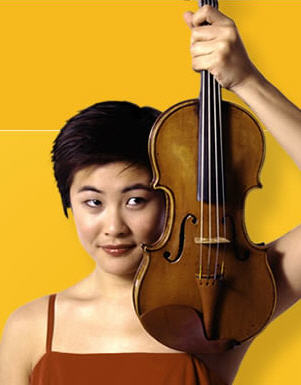
Jennifer Koh gave one of the best-ever performances of the Brahms Violin Concerto on Saturday night with the Oregon Symphony. She played this demanding work with passion, understanding, technical precision, and uplifting artistry, making us hear the music as if we were hearing it for the first time. Continue reading Koh on fire in Brahms concerto with the Oregon Symphony

Upcoming

Tonight the Biava Quartet continues Joshua Roman’s Town Music series at Seattle’s Town Hall.  On the program – Grieg, Janacek, and Mozart.

Thursday, the Seattle Symphony plays Tchaikovsky, Rachmaninov, and Sibelius under the baton of Vasilly Sinaisky with pianist Evgeny Sudbin.  Sudbin made his Seattle debut last year as part of the University of Washington President’s Piano Series.

Continue reading Upcoming

"Going to a symphony concert is like going to a pop concert"

Gustavo Dudamel

At least that’s what I think.  I tell folks all the time going to hear your symphony play should be like going to the movies.  Or, like a multitude of other entertainment options at our disposal.

Charlottee Higgins dissects for the reader, Dudamel’s lessons for the UK classical music scene.  After reading the entire piece, Higgins’s suggestions are as true for American orchestras as they are for the British.  My favorite is:

Remember: it’s supposed to be fun.
Dudamel’s introduction to music was via his trombonist father’s salsa band as much as through his orchestral playing. The unabashed, party-time pleasure Venezuelans take in salsa leaks into their attitude to classical music. Experiencing music should be about having a brilliant time – even though a journey with the masterpieces of classical music may take you to the darker places of the soul.

As I get older, I am repelled by the formality of the live concert experience.  The younger me liked the rules.  Now, I just want to go and listen to music.  Conventions for clapping, silence and dress straitjacket the audience’s enjoyment of the music being played.  I’ve seen people so concerned about when they are “supposed” to clap that they miss the music right in front of them.

I haven’t always had this opinion.

Previously, stray sounds and clapping were enough of a bother that I would give a menaced glare to the offender – I was one of those people.  With time, I realized my offense distracted my own listening.

“Demonic character and boiling energy”

It took Simon Trpceski three encores, but Tuesday’s Meany Hall audience finally got their fill of the young, Macedonian pianist Simon Trpceski. Trpceski was in town as part of the President’s Piano Series. Seattle holds a special place for Trpceski, it was, after all, the location for his North American debut. His fondness for the city was evident in an interview I did with him for Seattle Sound Magazine. “Their [Seattle’s] appreciation and reaction for my art is certainly a great motivation for me.” Given the audience’s response last night, we should expect to see much more of Trpceski in the years to come.

Continue reading “Demonic character and boiling energy”

There’s always a but

A little vacation to Seattle afforded me the opportunity to 1) visit my dear friend; 2) check out the Seattle landscape and its associated environs; and 3) hear the always-in-the-news Gerard Schwarz do his thing. To be honest, I was excited to do those things in that order. After having read so many things about the Music Director of the Seattle Symphony Orchestra, most of it not very favorable, one can hardly blame me for not being too excited about hearing him and his orchestra go through the motions one more time. But this was going to be different. After all, one doesn’t get to hear a major orchestra put on such an imposing and austere piece as Johann Sebastian Bach’s Mass in B minor. In today’s world of overflowing, post-romantic orchestra rosters, always with at least 100 members down to hecklephone, it would be insane to have an orchestra put 80% of its staff on vacation as only a baroque orchestra is needed. And yet, that is what Schwarz was able to do for his performance of the Mass on Maundy Thursday.

Continue reading There’s always a but

The pity of war

The music of the Twentieth Century echoed through Seattle’s concert halls this weekend. Michael Stern and the Seattle Symphony started the weekend with performances of Edgard Varese’s rarely heard Integrales, Victor Herbert’s equally rare Cello Concerto No.2 and the romantic longing of Rachmaninov’s Symphony No.3. However, the real treat of the weekend was Benjamin Britten’s War Requiem. George Shangrow and his talented, home-grown Orchestra Seattle and Seattle Chamber Singers played the Requiem. By most accounts the piece has not been heard in the Puget Sound for almost thirty years.

Two themes ran through both performances. On the one hand, Varese and Britten were deeply impacted by the carnage of war. Varese was conscripted into the army before he fell ill and made his way to the United States. Similarly, Benjamin Britten was a staunch conscientious objector who crafted his Requiem for the dedication of the rebuilt Coventry Cathedral. Britten also dedicated the piece to four friends who died during World War II. The pessimism and renewal that follows a period of war are found in both pieces.

Conversely, while Britten and Varese were taking music in new directions. Varese exploding harmony and line in favor of “sound masses,” rhythm and timbre and Britten later explored traditional forms in inventive ways, Sergei Rachmaninov and Victor Herbert seemingly clung to the old-fashioned, idioms of the past.

Roughly 60 years separates the earliest work, Herbert’s Cello Concerto No.2 (the earliest work) and the War Requiem (the latest). The separation in time is not obvious. Rachmaninov’s symphony sounds as if it were composed contemporaneously with Herbert’s concerto. In fact, forty years separate the works. Similarly, Varese’s musicial idiom is so jarring that I suspect most listeners would not place the composition at the start of the last century. Britten’s War Requiem is just as elusive.

Herbert’s concerto seems obsolete in comparison to the work of his contemporaries (Debussy, Mahler, and Sibelius). Nonetheless, as evidenced by his almost constant swaying and humming (?), guest cellist Lynn Harrell enjoyed the piece and so did the audience. Harrell luxuriated in the work’s artifice and the audience eagerly joined him on the ride. Rachmaninov’s Symphony No.3, composed less than a decade after Varese’s uncomfortable Integrales, clings to the romantic sentiment that was being jettisoned by composers in Europe and America.

Michael Stern is building a formidable career with the Kansas City Symphony by conducting pieces usually overlooked by larger, more well known orchestras. This year alone, Stern is conducting excerpts from Berg’s Wozzeck, Stephen Dankner’s The Apocalypse of St. John, Lou Harrison’s Concerto for Pipa and String Orchestra and Tchaikovsky’s Symphony No.1, Winter Dreams. His recent release on Naxos of Gordon Shi-Wen Chin’s Double Concerto has been favorably reviewed by music critiques.

The collision of red state Missouri and Kansas is an unusual place for new and forgotten classical music to find an audience. It’s a development that should give Seattle pause.

Britten’s War Requiem ties the past and present together. His dissonance is counterbalanced with haunting moods and abundant atmosphere. Britten’s affinity for vocal composition is credited with restoring English operatic and choral tradition. The War Requiem synthesizes all of these traits into a profound piece of music.

Britten juxtaposed the traditional mass for the dead alongside the anti-war poetry of Wilfred Owen. Discord and placidity coexist side by side. Notably, the sheer volume of the forces used and their placement (the boys chorus and chamber organ are off stage) are designed to create a three dimensional musical experience not unlike Stockhausen’s Gruppen.

At a time when our own country is fighting two wars, Britten’s music is as relevant now as it was in 1962 when the world was rebuilding from the catastrophe of the war to end all wars.

Shangrow has a knack for tackling difficult works. In December, he drew out a fine performance of Monteverdi’s forward looking 1610 Vespers. Later this year, he takes on Mahler’s Symphony No.4. Shangrow’s Britten was no different.

For almost ninety minutes, Shangrow had the piece unfold naturally. The Northwest Boy’s Choir was angelic. I sat in the balcony where I was close to the crisp singing of the choir. This may have been a mistake, since I did not get to experience how the choir sounds as it was intended. Shangrow’s tempos were patient. He let the music unfold naturally, allowing the secular and sacred to become one. The performance was satisfying from start to finish, culminating in a mesmerizing Libra me.

The orchestra generated an unexpectedly full and somber sound. I shouldn’t be surprised, Shangrow has nurtured his orchestra building it into one of the better community orchestras in Seattle. At times the brass had balance problems, drowning out the chorus, soloists and the orchestra. The effect was powerful albeit distorted.

Even though this weekend’s performances were dominated by music of the Twentieth Century, Seattle depends (heavily) on the talent of visiting conductors and orchestra’s like Orchestra Seattle to expose audiences to fare different from Brahms and Beethoven. Without George Shangrow’s steady vision of musical possibility, works like the War Requiem would never be heard.

When Michael Stern took the microphone to introduce Integrales he gushed over Seattle’s openness to modern music. Peering out in the Benaroya Hall audience he had to see that there were plenty of empty seats. If he had eyes in the back of his head he would have seen what I saw, restless thumbing of program notes during the Varese. With a little bit of forethought and audience conditioning modern music can work in Seattle.

Modern music need not be relegated to fifteen minutes at the start of program. Shangrow’s Britten proved this.

“Love and tragedy” no more

Some months back, this weekend’s Seattle Symphony concert was dubbed “Love and Tragedy.”  Back in September the program featured two Brahms works – the Tragic Overture and the Symphony No.1.  But, Schoenberg’s Pelleas und Melisande was also on the program.

However, the program has been considerably revised.  First, the Tragic Overture is out.  Perhaps there was too much Brahms.  Taking the place of the overture is Symphonic Fragments from Le Martyre de Saint Sebastien.  Debussy’s  Le Martyre de Saint Sebastien is an odd work of incidental music which includes opera, cantata and orchestral music.  Debussy’s amalgam was both his last attempt at composing for the stage and a flop.  Also jettisoned from the program is Schoenberg’s Pelleas und Melisande.  In its place: Verklarte Nacht.  The piece is one of Schoenberg’s earliest and is probably his most popular.

Verklarte Nacht is a musical setting of Richard Dehmel’s poem.  The poem’s narrative is pretty simple.  A couple is strolling through a forest.  The woman confides in her lover that she is pregnant with the child of another man.  Rather than rejecting her, the woman’s lover graciously embraces the circumstances, promising to make the child his own.

The “love and tragedy” are still there: martyrdom, the love of a woman and a child and the “tragedy” of Brahms difficulty composing his symphony.

“I sit like Glen Gould”

For almost twenty years Judith Cohen has been the artistic director of the Governor’s Chamber Music Series. In a parlor off of the main entry of the mansion, musicians from Washington and elsewhere have dazzled packed rooms with performances of familiar classics and new favorites.

In a series of firsts, last night was the first time I had been in the Washington Governor’s Mansion (which, when you consider my work as part of the legislative and political process in Olympia is lamentable), the first time I attended a Governor’s Chamber Music Series concert, and the first time I heard Seattle pianist Judith Cohen perform. In just over an hour, Cohen and her co-performers presented a concert that was more cohesive than I was expecting and well played. Surrounded by the elegance of the Governor’s Mansion it is easy to understand why the Governor’s Chamber Music Series has become so popular.

Cohen was joined by the prominent and much loved George Shangrow. Shangrow has built a reputation in the Northwest and abroad as a fine interpreter of an enormous swath of music. Shangrow has also helped build Orchestra Seattle and the Seattle Chamber Singers. But, Shangrow is also a well regarded pianist who has performed with the likes of the Seattle Symphony and the Kronos Quartet.

It was Shangrow’s ability as a pianist that brought him to Olympia last night. To open the concert, Shangrow and Cohen performed Gershwin’s immediately recognizable Rhapsody in Blue. The version Shangrow and Cohen performed was a reduction, for two pianos, of the orchestral version Gershwin and composer Ferde Grofe assembled when Gershwin was a mere twenty six. The reduced Rhapsody was as enjoyable as the orchestral version audiences are familiar with. The two piano version, and Shangrow and Cohen’s performance portrayed the rhythm and buoyancy of the work in a way the richly orchestrated version sometimes does not.

Gershwin’s most popular piece was a smartly chosen lead in for the rest of the concert. Jackson Berkey, a Juilliard trained musician, composer and pianist for Manheim Steamroller was the focus of the remaining two thirds of the program.

Berkey’s music reminded me of a cross between the Neo-Romantics, John Adams, and Alan Hovhaness. Both Berkey’s Nocturne #22 and his Suite for Two Pianos were fairly tuneful, atmospheric and depended on a sustained feeling of movement and forward motion.

I was surprised by the introspection in Berkey’s Suite for Two Pianos. The suite was commissioned to remember the death of a young woman who was killed by a drunk driver. In Berkey’s explanation, each movement illustrates a different aspect of life. The first movement, “Flying High,” crashes on itself depicting life’s onward march. The second movement, “Rainydark and Firelight” is dark and introspective. Cohen and Berkey’s pianos and fingers ruminated over the unexpected tragedy that too often interferes with life. The final movement, “Fading Memories,” was intentionally loose and inconclusive, ending with whispering chimes.

Last night’s evening of firsts was a delightful change of pace for a city known primarily for politics and bureaucracy. Judith Cohen is doing Washington proud by bringing well played music into the Governor’s Mansion. Any trip to Washington’s capitol should endeavor to include a concert in the Governor’s Mansion in the itinerary.