Last October, on vacation in Amsterdam, I slipped into the Concertgebouw to hear Klaus Mäkelä lead the Royal Concertgebouw Orchestra. He had not yet assumed his full duties as music director there, but the relationship already felt settled and purposeful. The program paired Andrew Norman’s Play with Richard Strauss’ Don Juan and Rosenkavalier waltzes, a combination that showed both Mäkelä’s ambition and his curiosity. Norman’s sprawling, high-voltage score came off better than expected; the Strauss, lush and heroic by nature, felt less fully shaped. Still, the concert offered a useful snapshot of a conductor in the midst of defining himself, drawn to contrasts and willing to take risks.
This week, Mäkelä brought a similar philosophy to Orchestra Hall, standing before the Chicago Symphony, another orchestra he is soon to lead. Once again, old and new were placed in close proximity. Schumann and Beethoven formed the spine of the program, flanked by two modern works: Unsuk Chin’s subito con forza and Jörg Widmann’s Con brio – both receiving Chicago Symphony premieres. The effect was not novelty for its own sake but a deliberate attempt to focus Beethoven’s familiar music through a modern lens.
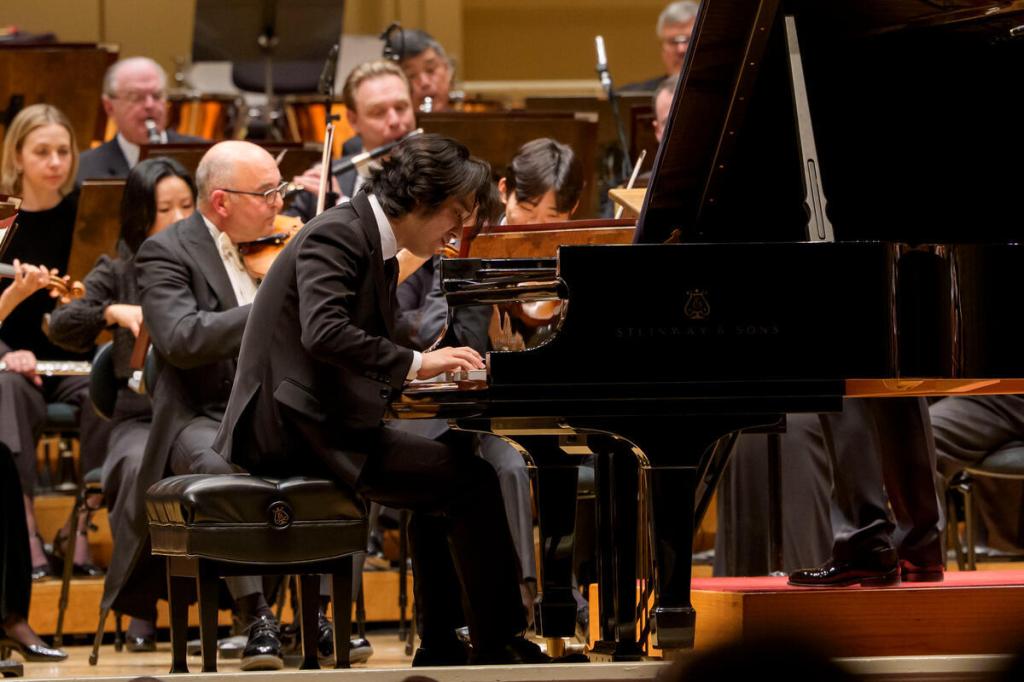
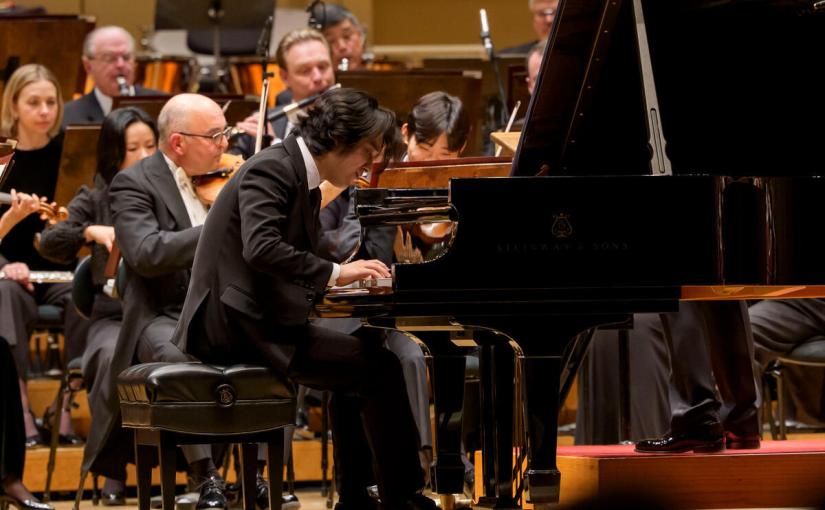
The evening’s centerpiece was Schumann’s Piano Concerto, with Yunchan Lim as soloist. Lim, the South Korean pianist who became the youngest winner of the Van Cliburn International Piano Competition in 2022, has quickly transformed early acclaim into global fame. His victory performance of Rachmaninoff’s Third Concerto that year rightly marked Lim as a musician of rare command, but Schumann asks for something different in his concerto. The work has a restless spirit, its drama turned inward. It is also lopsided. The piano dominates, while the orchestra acts less as an equal partner than as a responsive, almost confessional presence.
Lim proved an ideal guide. In the concerto’s more extroverted passages, he dispatched the figurations with power and clarity, never sounding rushed. What lingered longer were the quieter moments. Here, Lim moved through Schumann’s phrases with a kind of poetic patience, letting lines breathe and dissolve. Mäkelä and the Chicago Symphony were attentive partners. The exchanges between Lim and the wind players had the intimacy of chamber music, a balanced conversation rather than a contest for attention. Lim lived up to his reputation, but, more important, he suggested an interpretive depth that goes beyond youthful brilliance.
The program’s surprises came at its edges. Chin and Widmann, both European modernists, write music that largely sidesteps traditional tonality and melody in favor of abstraction and gesture. Chin’s subito con forza, opened the first half with a jolt. Its opening gesture echoes Beethoven’s Coriolan Overture, a reference that quickly fractures into a barrage of color and texture. Over the next five minutes, the orchestra seemed to detonate continuously, with Beethoven’s presence felt everywhere without ever fully materializing.
Widmann’s Con brio, which opened the second half, continued the conversation. Now one of the most frequently performed works of the twenty-first century, it channels Beethoven’s energy without quoting him directly. Widmann calls for an array of extended techniques: winds breathing into their instruments to create ghostly, colorless sounds and other effects that rub against more traditional playing. The result is a kind of modern fury, full of pulse and momentum. Mäkelä kept the tension taut, allowing the work’s Beethovenian drive to carry the audience forward rather than overwhelm it.
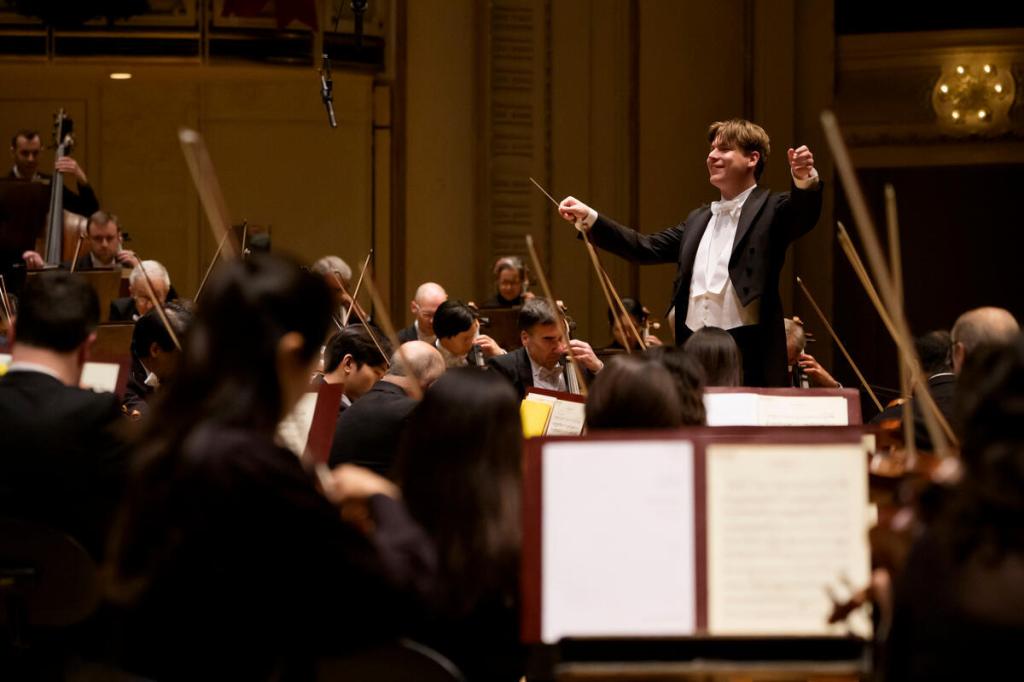
Beethoven’s Seventh Symphony closed the program. Conducting without a score, Mäkelä shaped a performance that was both driven and carefully weighted, its energy tightly coiled from the opening bars. He had a firm grasp of the symphony’s pulse, not just in the outer movements but in the second movement as well, whose steady, dirge-like tread unfolded with a grim and beautiful patience, accumulating weight until it felt almost inexorable. In the finale, he pressed ahead with abandon, urging the music forward as the orchestra responded with precision and force. The playing took on a steely intensity that swept the hall, bringing the audience to its feet the instant the final notes landed.
There was much to admire in the evening, and more than a hint of what the future may hold under Mäkelä’s leadership. Though the Beethoven thrilled, it was the Schumann that lingered into the next morning. Lim’s feeling for the music was unmistakable, confirmed by a generous encore—Chopin’s Waltz in A minor, Op. 34, No. 2. Just as striking was Mäkelä’s sensitivity at the podium and the orchestra’s willingness to meet him there. His ease and evident pleasure in collaboration may be the most encouraging sign of all as he prepares to take the helm of two of the world’s great musical institutions.
Originally published at Seen and Heard International
subito con forza
Con brio
Elsewhere
“Both were exceedingly well-crafted performances of well-crafted pieces. But what sold Mäkelä’s programming was the Beethoven itself. Instead of treating “subito con forza” and “Con brio” as mere molds — one-way streets of inspiration — his Beethoven 7 thoroughly dialogued with both. A nattering open E string in the second violins in the first movement and teasing trills in the Presto seemed directly indebted to “subito con forza’s” sassy flourishes. Later, strings played the finale’s dotted engine super-secco, recalling the arid extended techniques in Widmann.”
Chicago Classical Review, Lawrence A. Johnson
“Led by Mäkelä’s animated and inspirational direction, the CSO musicians sounded positively unleashed Thursday night with playing of galvanic fury and surprising intensity that brought Widmann’s symphonic heavy metal to spellbinding life. Kudos to all, especially timpanist Vadim Karpinos for his turn as rock drummer on the sides on the kettledrums. Let us hope that Mäkelä continues to bring equally rewarding new works to Chicago in future seasons.”
“While the pianist brought all the necessary punch and power to the big moments, he was most impressive in the slow, inward sections of the expansive opening movement. He invested them with suppleness, introspection and depth, qualities nicely matched in responsive, searching solos by assistant principal clarinetist John Bruce Yeh.”
“From the underlying Fantasy material in the allegro, through the string-rich beauty of the intermezzo, with its duet between soloist and cellos, moving attacca into the noble, free finale adorned with oboes, this was a consummate performance. Most absorbing was the choreography between the Conductor and all the musicians.”
Postscript
Twenty-three years ago, I attended an all-Beethoven program by the Quad City Symphony Orchestra and wrote a review that now embarrasses me. Not because I was wrong about the tempos, but because I was so certain of my judgment. I had recently discovered John Eliot Gardiner’s period-instrument Beethoven cycle and was evaluating that concert through my understanding of those lean, urgent performances. I mistook my enthusiasm for knowledge.
I’m thinking about that review now because of Klaus Mäkelä’s now concluded final program with the CSO before the end of the year. Watching his career unfold has forced me to reckon with how easily we critics declare someone finished before they’ve really begun. Which has been the case in some quarters for Mäkelä. At only twenty-nine, He has time to become something his naysayers can’t yet imagine.
What actually matters about that Quad City concert isn’t what I wrote at the time. What matters is that it moved me enough to argue with it two decades later. Most performances evaporate the moment they end. The ones that stay with you are the ones worth the argument.
This is why Mäkelä matters. His Mahler Third in Chicago last season recalibrated my understanding of the piece. His Strauss in Amsterdam in October struck me as unpersuasive. But I couldn’t stop thinking about either one. They made me listen harder and question more. In an art form that frequently favors predictability and politeness, Mäkelä forces engagement.
We should want this from classical music. We should want conductors to provoke us, to make us question what we thought we knew. Mäkelä will change: he’ll deepen and refine, abandon some tendencies while adding others. But right now, he’s doing something increasingly rare: making people pay attention.
That’s enough for me.
Discover more from Gathering Note
Subscribe to get the latest posts sent to your email.
 Gathering Note