Before Chicago Opera Theater’s recent production of Antonio Salieri’s Falstaff began, the General Director Lawrence Edelson posed a question to the audience in the Windy City’s famed Studebaker Theater: How many people had heard an opera by Antonio Salieri? Fewer than six hands went up. The question was pointedly rhetorical. The Italian-born Viennese composer is opera’s most notorious footnote, a composer whose reputation was tarnished not by his music but by rumor, innuendo, and a playwright’s imagination. Peter Shaffer’s celebrated work for stage, Amadeus, and its subsequent film adaptation cast Salieri as a villain, a mediocre counterpoint to Mozart’s genius.
Shaffer was only the latest to forge art out of innuendo surrounding Salieri’s relationship with Mozart. But, history has been less kind than it should have been. Luckily for Windy City ears, Chicago Opera Theater has made a practice of excavating works that deserve better than obscurity, and this season’s opening production made a strong case for one of Salieri’s comedic operas. Falstaff, based on Shakespeare’s The Merry Wives of Windsor, may be the only Salieri opera scheduled to be staged in the United States this season. The company’s new production, transplanting the action to a modern day tropical resort, proved that Salieri’s score is more than a curiosity. It is genuine, enjoyable theater.
The opera opens at Windsor Beach Resort, a tropical paradise where Salieri’s overture bubbles up from the pit. The comic action unfolds at a brisk pace, clocking in at a little over two hours, including an intermission. Though Shakespeare’s play has multiple intertwined plots, Salieri’s opera smartly streamlines this, focusing on Falstaff and the three pranks while tightening the action into a two-act structure that never drags.
Falstaff, an aging and uncouth womanizer devises a half-baked “plan” to woo Mistresses Ford and Slender. Falstaff sends the women identical love letters, which the ladies immediately recognize as part of a scheme. They decide to take revenge by drawing Falstaff into a series of pranks.
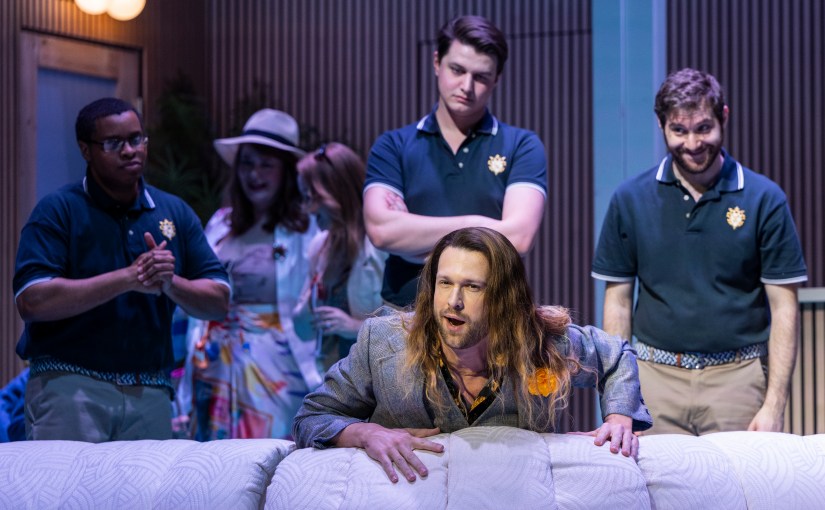
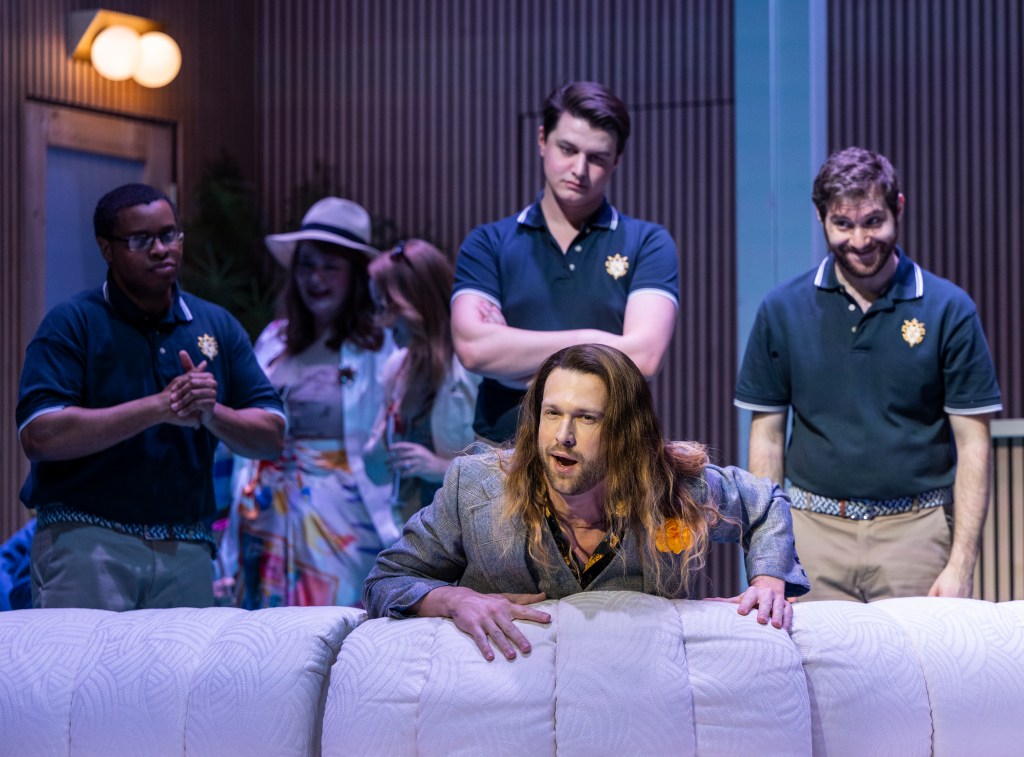
The tricks escalate with satisfying theatrical logic. First, they fool Falstaff into hiding in a laundry hamper, from which he is dumped into the resort’s pool. Next, he gets tricked into wearing women’s clothing, stumbling across the stage in heels. The final humiliation takes place at night in a park, where Falstaff is persuaded to appear in a fantastical costume, believing he will finally enjoy a romantic triumph at a midnight masquerade. Instead, the resort staff dress as fairies and mythical creatures. Descending on him, they mock and torment him, and then reveal their true identities, forcing him to admit his folly.
Christine Brandes led the orchestra with lightness, providing solid support for her cast while driving the comic action forward. The conductor, who impressed me in a 2023 production of Handel’s Alcina with the Seattle Opera, is a real talent at the podium. Hopefully, Brandes will have more opportunities to showcase her talents to Chicago audiences.
The Studebaker Theater’s relatively small size was an asset. Projecting was less of an issue than clarity, flexibility, and comic timing. Christian Pursell, as Falstaff, was humorous and pitiable, striking just the right balance for this role. He led with a strong voice that at the same time conveyed vulnerability as needed. Vanessa Becerra and Tzytle Steinman – Mistresses Ford and Slender, respectively – were delightful coconspirators, delivering pointed wit. Andrew Morstein, as Master Ford, was at his best alone, delivering his part with jealous abandon, though his middle range disappeared in ensembles. His performance grew more memorable as the opera progressed, anchoring the second act. As Falstaff’s servant Bardolfo, Peter Morgan set the tone for the afternoon with a dark-hued voice that combined humor with frustration. The remaining cast dazzled when given the chance, especially Denis Vélez, with her smooth-voiced soprano as Betty, a resort staff person.
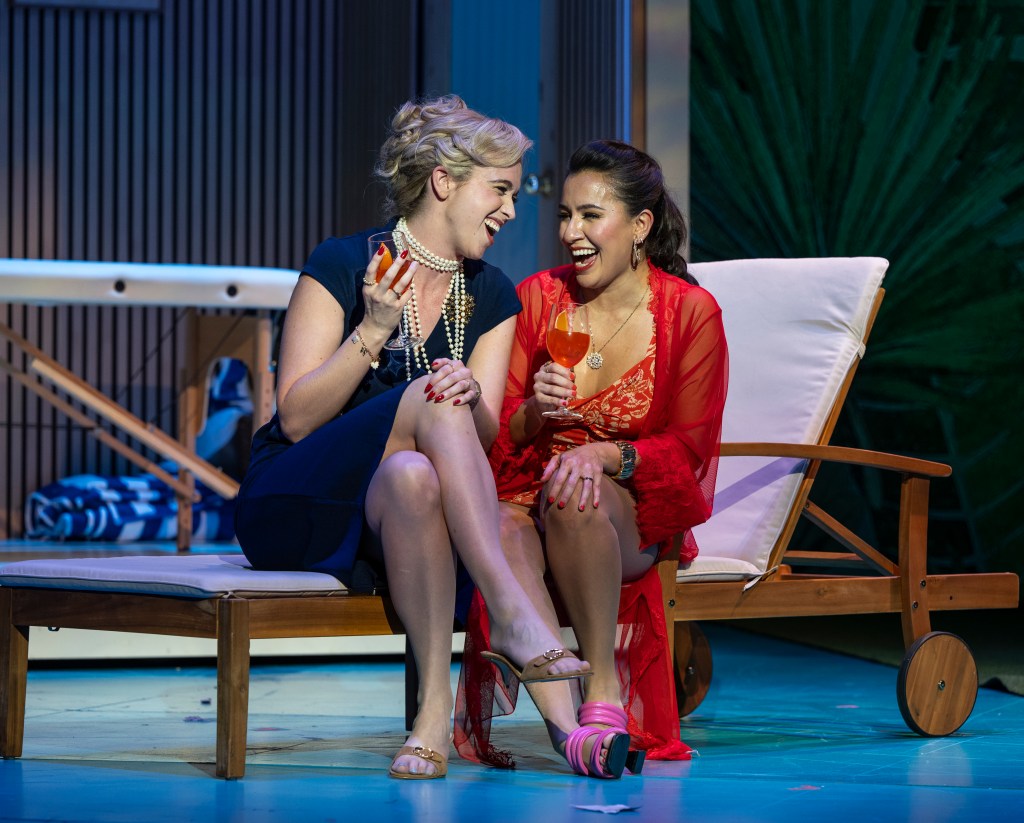
Andrew Boyce’s set placed the action in a lush, modular resort of palm fronds and bright hues that was visually light and endlessly adaptable. Jessica Pabst’s costumes leaned into playful modernity: guests in tropical prints and a chorus decked in khaki shorts and polos. The concept flirted with whimsy, but stopped short of parody. The world onstage felt coherent, even plausible, for Salieri’s mix of mischief and manners. Only the supertitles, updated linguistically for modern eyes, were a distraction, as they occasionally pressed too hard to translate 18th century content for a 21st century audience. Stray pop-culture nods didn’t always land, and the production’s humor didn’t need help, Salieri’s timing was already doing the work.
For most opera lovers, Falstaff conjures Verdi’s final masterwork – wise, self-aware, and suffused with melancholy. Salieri’s version could hardly be more different. His Falstaff is a farce, a musical comedy of errors built on rhythm and contrast rather than psychological depth. But in this truthful, quicksilver staging, that comic immediacy became its virtue. The score may never lodge in the memory the way Mozart’s music does, yet scene by scene it sparkles. Its ensembles hum with character, and its recitatives snap with conversation. Under Brandes’s direction, every note felt in service of theater, rather than a display.
Chicago Opera Theater’s rendition of Salieri’s Falstaff reminded its audience that fun need not apologize for itself. If Verdi’s version is prestige television, Salieri’s is a nimble, tightly scripted network comedy. The laughter it earned was spontaneous and sincere. In a world that burdens Salieri with envy and rumor, this production served as a light-hearted corrective. Here was an artist whose sense of stagecraft and humor stood entirely on its own.
Originally published on Seen and Heard International
Elsewhere:
Chicago Classical Review, John von Rhein
“So skewed has been our estimation of Salieri’s gifts as a composer by the play and film Amadeus that it will surprise many audience members to discover what an inventive delight his score is. Many passages sound like they could have been composed by Mozart, even if they lack the latter’s emotional depth. The five main characters are nicely characterized through their music. Salieri’s colorful music enables the action to move briskly and pointedly, with dry recitatives driving home key narrative elements (fine work from Yasuko Oura at the harpsichord continuo).”
“This “Falstaff” is essentially a buddy comedy, and Becerra and Steinman play off one another exceptionally well. Becerra’s turn as the title role of last season’s “Leonora” was already a high bar, but she outdoes herself as Mrs. Ford, in a performance of infectious enthusiasm and firecracker vocal dazzle. Steinman is usually her lower partner in duets, together creating a gleaming composite instrument. On her own, she’s a gifted character soprano, able to warp her voice while retaining its essential luster.”
Discover more from Gathering Note
Subscribe to get the latest posts sent to your email.
 Gathering Note