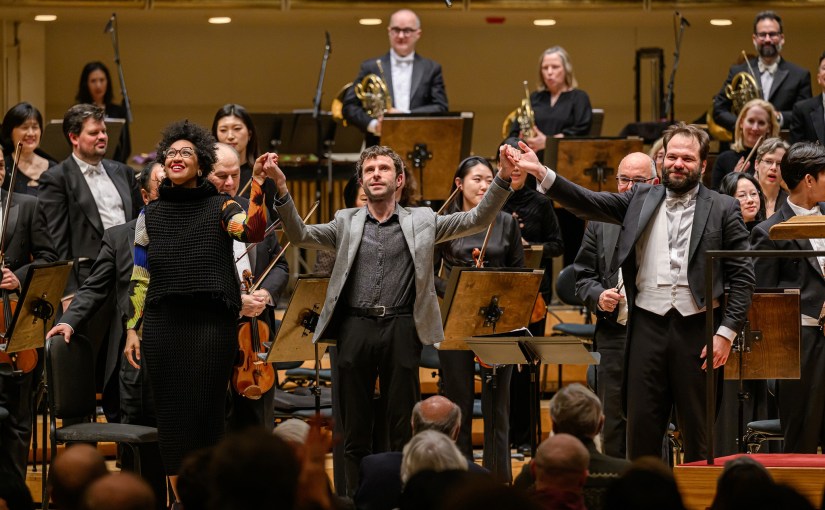
Some works arrive at exactly the moment they’re needed. Matthew Aucoin’s Song of the Reappeared, receiving its world premiere with the Chicago Symphony Orchestra this week, is one of them.
The piece draws from Raúl Zurita’s INRI, a book-length poem born from Chile’s darkest chapter. After Pinochet’s dictatorship disappeared thousands—bodies dropped from helicopters, lives erased from memory—Zurita imagined those lost souls rising from sea and mountains. It was a memorial and a vision, anchored in grief but turned toward rebirth.
Written for soprano Julia Bullock, the work speaks to our present with unsettling clarity. In a city still reckoning with the effects of mass detentions that tore families apart, the title’s promise of return carries weight. This collaboration between Bullock and Aucoin represents both artists at their most potent. Aucoin has found new balance in his writing: vocal lines that connect immediately, layered over orchestral passages of startling power. Bullock herself describes it as some of the most exciting work the composer has produced.
After these Chicago performances, there are no plans set for the piece. That alone makes these four nights essential. Don’t let the chance to hear this new work work pass.
Information and tickets for remaining performances

Elsewhere:
“Heartache comes in the inner movement — a call-and-response between Bullock and Scott Hostetler on English horn, the orchestra’s eternal wanderer — before shuddering with pent-up energy at its middle. A furious, mixed-meter marionette dance blazes across the last movement.
The work gains emotional immediacy — if not always emotional specificity — as it goes on. And Bullock’s voice, shaded enough as to sound nearly mezzo-like, also gained mettle as it went on, after a first movement mostly subsumed by the orchestra. Some weaning from the score likely would have helped with projection; Bullock was still reliant on it on Thursday.”
Chicago Classical Review, Lawrence A. Johnson
“Matthew Aucoin’s Song of the Reappeared is a most impressive achievement—powerful, well-crafted and deeply and sincerely felt. Early on the high writing for the soprano soloist is a bit relentless but the vocal line becomes more varied and nuanced in the latter two sections. While Aucoin’s work calls for large forces, the score is balanced skillfully with the most unbridled orchestral climaxes kept to standalone sections without the soloist.”
A wide ranging interview by Michael Schell
Discover more from Gathering Note
Subscribe to get the latest posts sent to your email.
 Gathering Note