Classical music has an uneasy relationship with youth. The very word “classical” suggests age, tradition, dust on velvet seats. Yet the field periodically becomes infatuated with young conductors, as if a twenty-something on the podium might rescue an art form everyone agrees is perpetually dying. The counterargument is equally familiar: conducting requires life experience, the emotional depth that only comes with years. You cannot truly understand Mahler at twenty-five, or so the thinking goes.
I confess to having held both views. As a younger concertgoer, I wanted the gerontocracy swept aside. Now, middle-aged myself, I care less about the conductor’s biography than whether the performance moves me. Still, there’s something instructive about watching how one era’s young lions become the next era’s establishment.
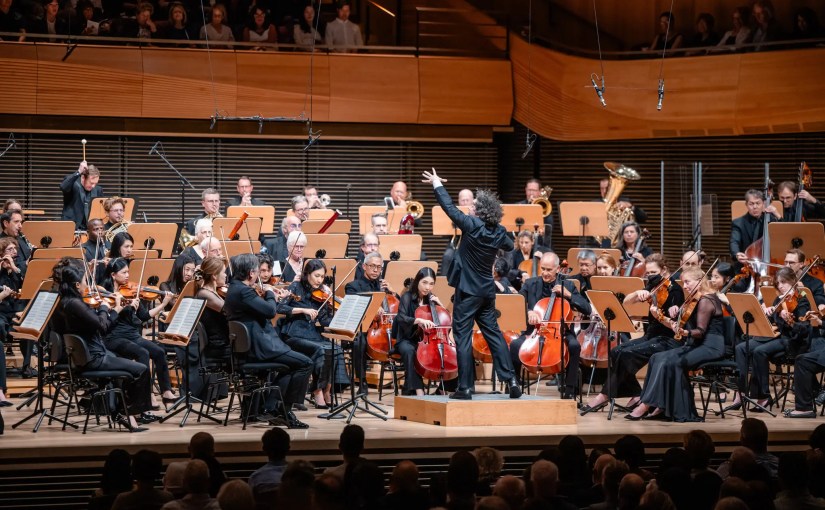
Last September in New York, two evenings illustrated this progression perfectly. At Geffen Hall, Gustavo Dudamel led the New York Philharmonic through Beethoven’s Fifth and John Corigliano’s First. Later that week at the Met, Yannick Nézet-Séguin conducted Mozart’s Don Giovanni.

Both men arrived as phenomena. Dudamel captured international attention in the early 2000s with Venezuela’s Simón Bolívar Youth Orchestra. There was a BBC Proms performance of Bernstein’s Mambo that went viral before we had a word for that. Here was a twenty-six-year-old with unruly curls and irrepressible energy, and suddenly everyone wondered if he might be classical music’s savior. It was absurd, of course, but impossible not to get caught up in it.
Nézet-Séguin’s rise was quieter but no less remarkable. Working with Montreal’s Orchestre Métropolitain, where he became music director at twenty-five, he drew extraordinary performances from ensembles nobody expected extraordinary things from. There was something subversive about this young French Canadian working outside traditional power centers but clearly destined for them.
The buzz has naturally subsided. Dudamel has spent almost two decades with the Los Angeles Philharmonic. Nézet-Séguin divides his time between Philadelphia and the Met. They’re no longer novelties. The question is what kind of artists they’ve become.
For Dudamel, the answer is complicated. His early recordings of standard repertoire were curiously unsatisfying. The ideas were there, but they didn’t cohere. His Eroica is a case study: tempos that lurch between sluggish and hurried, phrasing that obscures rather than illuminates. Beethoven wrote young man’s music, and Dudamel somehow made it sound elderly.
Then something unexpected happened. Dudamel began championing contemporary music and proved exceptional at it. His recording of Charles Ives’s symphonies, made just before the pandemic, is genuinely thrilling. Ives’s tangles of competing hymns and marching bands emerge with startling clarity. The same is true of his Thomas Adès Dante, ninety minutes of dense music Dudamel navigates with complete assurance.
This split personality was evident at Geffen Hall. Beethoven felt studied and cautious, the Philharmonic sounding gaudy. But the Corigliano, that harrowing AIDS memorial, revealed Dudamel at his best. The score erupts repeatedly into fierce dissonance, creating overwhelming anguish. This is the conductor Dudamel has become: someone who excavates meaning from contemporary scores in ways that can elude him with older repertoire.
At the Met, Nézet-Séguin demonstrated different maturity. Don Giovanni is Mozart’s most morally slippery opera. The title character is a monster, a serial rapist trading on charisma, yet Mozart refuses to let the music simply condemn him. It’s seductive even depicting evil, exhilarating even dramatizing damnation.
Nézet-Séguin conducted with the transparency and precision that have become his signature. The performance was shapely, clean, perhaps slightly impersonal. But his approach allowed the singers to work, particularly Ryan Speedo Green, whose Don moved fluidly between Mozart’s contrasting registers. This is what Nézet-Séguin does now: he creates space for music and musicians, subordinating his ego to the larger enterprise. It’s not the approach that generates breathless reviews, but it sustains long careers.
Both conductors have, in middle age, returned to their essential selves. Dudamel remains physically animated, though that matters less now than his interpretive choices. Nézet-Séguin favors well-proportioned readings that let ensembles shine. These aren’t the qualities that make someone seem like a savior. They’re simply the qualities of good conductors.
Which brings us to Klaus Mäkelä, the twenty-nine-year-old Finn who represents the current wunderkind iteration. He’s secured positions with four major orchestras, including Chicago’s and Amsterdam’s Royal Concertgebouw. Critics are divided. Musicians, apparently, are not.

I heard Mäkelä recently in Amsterdam conducting Andrew Norman’s Play alongside works by Strauss. His programming tends toward the oversized, which may be compensatory or may reflect his taste. In Norman’s organized chaos, a forty-five-minute exploration of orchestral manipulation, Mäkelä was superb. He conducts moment to moment, sometimes losing the forest for the trees, but Norman’s score rewards exactly this granular attention. The Concertgebouw provided its legendary polish, and the result was the best Play I’ve encountered.
Strauss was less successful. Don Juan needs bravado, but Mäkelä gave it careful deliberation, slowing everything to showcase the Concertgebouw’s golden sound. It was beautiful but oddly enervated.
Watching Mäkelä, I kept thinking he’s learning in public, which must frustrate some listeners but strikes me as honest. Dudamel did the same in Los Angeles. A friend once described his early work as full of ideas without a clear sense of how to organize them. Mäkelä has that same quality, someone working out in real time how to become the artist he wants to be. If he’s fortunate, he’ll eventually arrive at the hard-won maturity Dudamel and Nézet-Séguin now possess. It won’t make him a savior. But it might make him an artist worth listening to for decades.
Discover more from Gathering Note
Subscribe to get the latest posts sent to your email.
 Gathering Note