Not long ago, while spending a week in New York, I found myself walking through Central Park after a concert by the New York Philharmonic, wondering which composers belong to which American orchestras. It is a parlor game without definitive answers – New York might claim Gershwin or Ives – but Chicago’s answer came to me immediately: Brahms. Or, more broadly, the music of Central Europe. The Chicago Symphony Orchestra’s history is inseparable from the great European Classical and Romantic traditions, shaped by towering figures like Fritz Reiner and Georg Solti. When the orchestra recently offered an evening of Kodály, Dvořák and Brahms – works squarely in its wheelhouse – the performance felt like a homecoming.
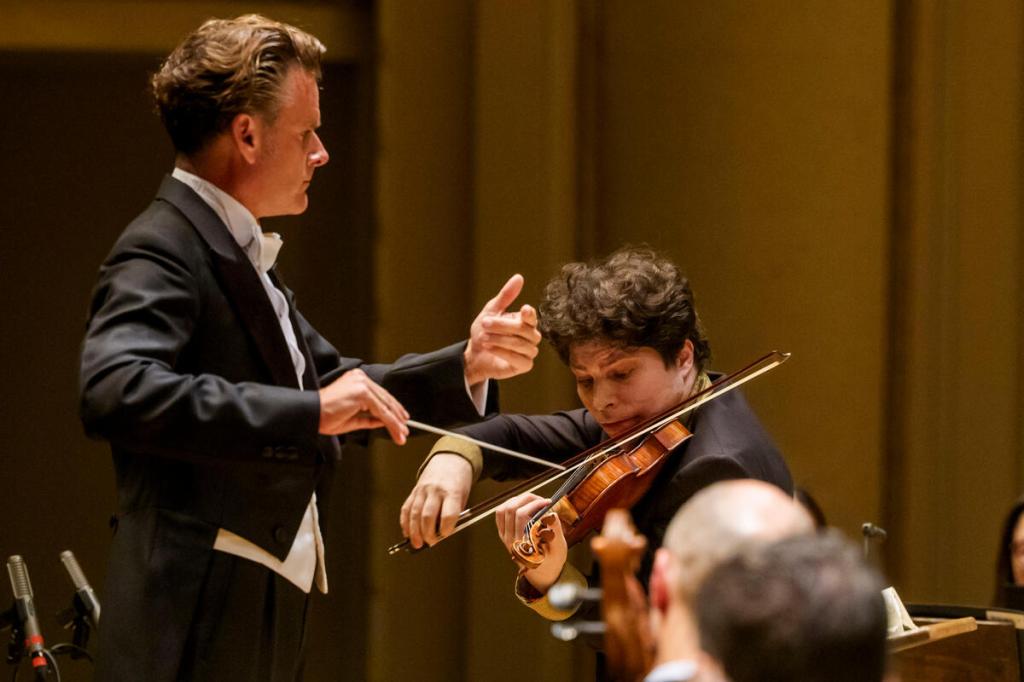
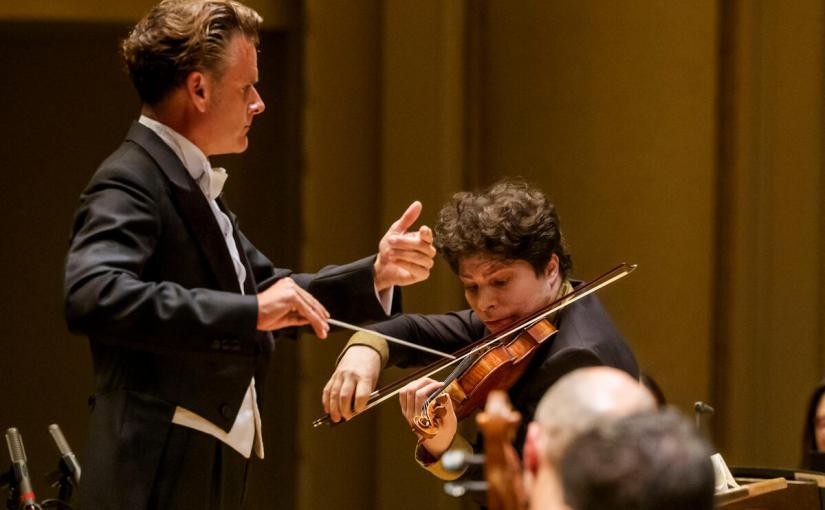
Orchestra Hall audiences are still waiting, with some patience, for Klaus Mäkelä to assume the music directorship in a few years. In the meantime, guest conductors like Philippe Jordan are holding down the fort and, on this occasion, the quality of playing and interpretation suffered not at all. Jordan was joined by violinist Augustin Hadelich, who has matured from a dazzling early-career musician – I remember him from his regular appearances at the Seattle Chamber Music Society – into one of the essential violinists of our time. His performances feature both immaculate technique and genuine interpretive insights to a familiar repertoire.
The concert opened with Kodály’s Dances of Galánta, a work whose title is somewhat misleading; it functions less as a sequence of dances than as a short tone poem with a loose narrative arc. The clarinet dominates the proceedings and Stephen Williamson, one of the orchestra’s many remarkable principals, spun effortless, swinging lines tinged with Gypsy inflections. The entire wind section had its moments to shine, and Jordan wisely kept them front and center while the strings added their own sonorous, tobacco-hued support. Williamson’s playing was captivating – he seemed to conjure the villages and moods of Central Europe with every phrase.
Dvořák’s Violin Concerto followed. It lives in the shadow of the composer’s more famous Cello Concerto, in part because the violin work doesn’t achieve quite the same level of emotional heft. Still, it is far from a throwaway piece. The first movement bursts forward with Romantic, symphonic grandeur; the second shifts toward introspection; and the finale showcases the composer’s Czech roots with a bright, folk-inflected energy. The Chicago Symphony gave the U.S. premiere of the work in 1891 under Theodore Thomas, and there is a certain historical pride to hearing it played in Orchestra Hall.
Hadelich’s performance offered his usual polish, though in the first movement I found myself hoping for more fervor to match the orchestra’s power. What he delivered instead was tidy, clearly articulated and rhythmically incisive — all admirable qualities, if not quite electrifying. But the second movement more than made up for this. Here, Hadelich demonstrated timbral depth and a genuine sense of the music’s melancholic character, and his work in the violin’s lower register was some of the finest playing of the night. In the Finale, Hadelich shaped the Bohemian tunes neatly and arrived at the finish line with grace. Jordan proved a sympathetic partner throughout, though at times I wished he had pressed the tempos a bit more to give the performance the full rusticity this work deserves.
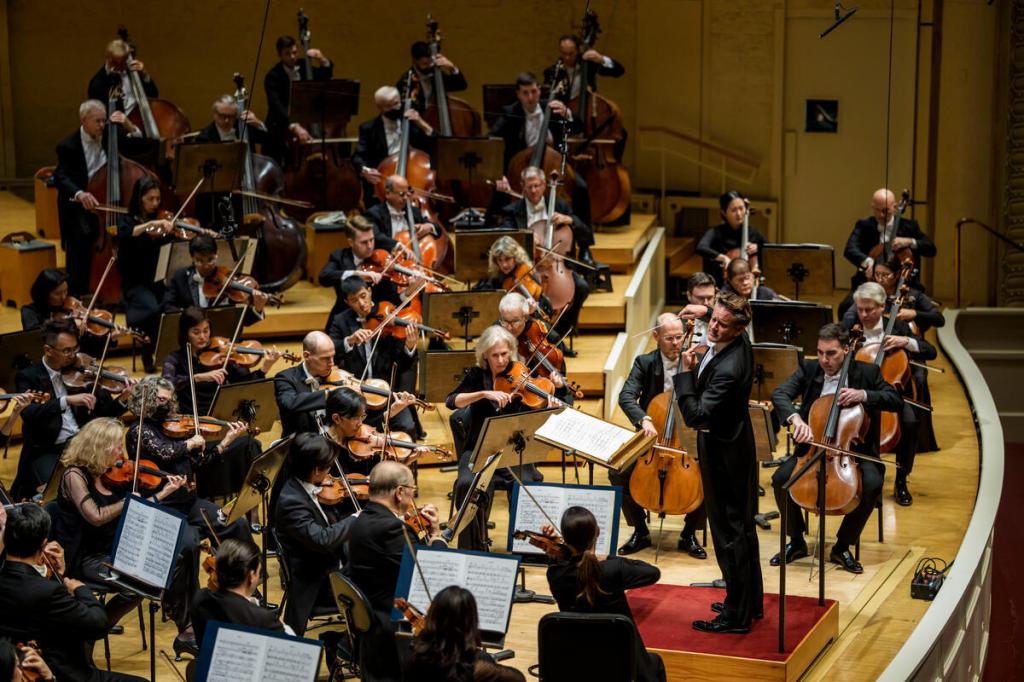
The concert concluded with Brahms’s Symphony No.2. Unlike his First Symphony, which was the result of decades spent grappling with Beethoven’s legacy, the Second was composed relatively quickly. While often characterized as a pastoral work, it strikes me differently. It certainly is lyrical with expansive and engaging melodies, but brooding undercurrents subtly persist beneath the surface. It lacks the overt bucolic nature of Beethoven’s Sixth Symphony. For me, the interplay of lightness and darkness in the Second Symphony perfectly encapsulates the Brahms idiom, even more so than his other symphonies which may possess more obvious drama but less of this specific fusion of seemingly effortless Romantic expression and structural clarity.
Jordan seemed to share this view. His approach was flexible, guiding liquid phrases and using dynamic shifts to signal changes in emotional weather: optimism one moment, nostalgia the next, relief elsewhere. At times, especially in the finale, the brass felt a touch too forward, even by the Chicago Symphony’s standards. But overall, the playing was remarkably clear, fluid and full of depth.
Brahms’s Third and Fourth Symphonies are scheduled for Orchestra Hall in the coming months, and while these works can be accused of being overplayed, performances like this one make a strong case for their continued presence. As long as the Chicago Symphony maintains this level of artistry, audiences will be happy, and the orchestra’s Central European legacy will remain intact.
Originally published at Seen and Heard International
Elsewhere:
“Jordan clearly knows something about this much-played repertoire, and this was richly idiomatic and distinguished Brahms by any measure. The conductor directed a well-paced opening movement that nicely balanced the bucolic qualities with dramatic weight. He showed a sure sense of the movement’s scale—the repeat observed in exemplary fashion, bringing a degree of mystery before the recapitulation that heightening expectation and momentum. The pastoral Brahms was there, but also the restiveness, both qualities conveyed by the superb playing of the orchestra with especially fine work from principal horn Mark Almond.”
Discover more from Gathering Note
Subscribe to get the latest posts sent to your email.
 Gathering Note