
On Wednesday evening at Guarneri Hall, Nova Linea Musica opened its 2025–26 season with a recital by Conrad Tao, the pianist-composer who has become something of a shapeshifter in the classical music world. The Illinois native was back by popular demand. Last season featured one of his compositions, and this time he performed a program called “Echoes and Algorithms.” Nova Linea itself has doubled its offerings from last year, a modest sign that Chicago’s appetite for the new and the unexpected is holding steady.
Tao’s title proved apt. What he assembled was less a tidy recital than a set of experiments, blending piano, electronics, and computer interjections and blurring the distinctions between them. The pieces often felt more like commentary instead of argument, collisions more than resolutions. The evening explored the ongoing negotiations between technology and society, artists, and Tao himself.
For me, the evening felt particularly charged, a feeling amplified in part by news of the assassination of Charlie Kirk, who some view as both a product and driver of the social and technological churn that felt so central to Tao’s program. Tao’s performance became for me a sort of meta-commentary, a play-within-a-play about the digital echoes that define our modern existence.
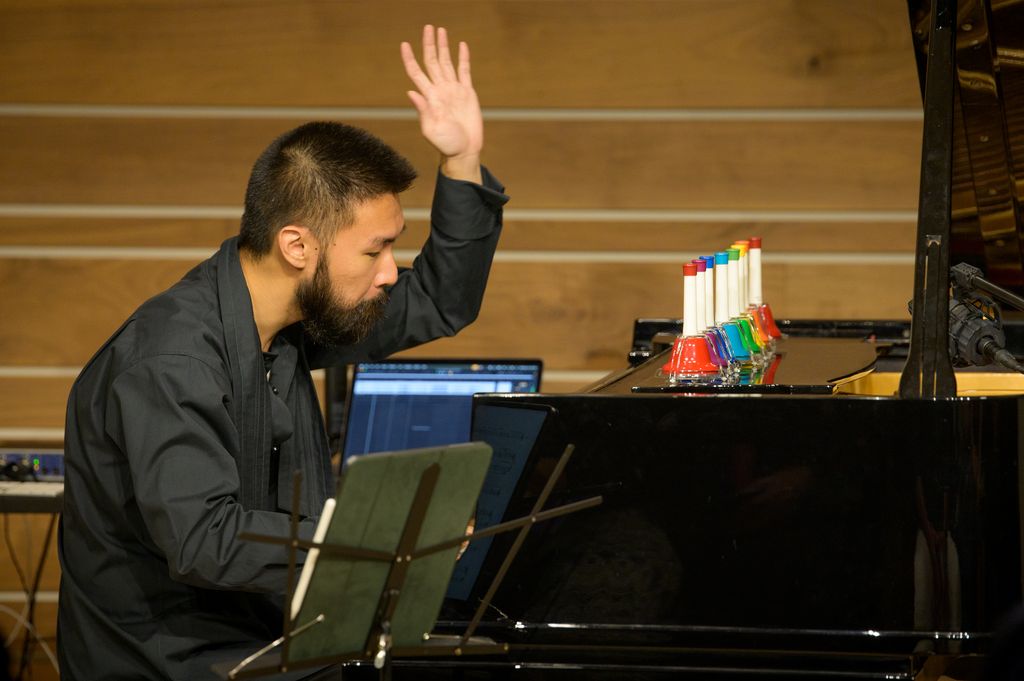
The first half of the program unfolded as a triptych on the uneasy combination of piano and electronics. First was Ben Nobuto’s Tell me again, a work for piano, handbells, and electronics that plunged the audience into a chaotic soundscape. The handbells, perched on the piano, rang out like mobile device notifications. Pinging alerts of new ideas, conversations, or outrages. Tao, in a dual role, was both the trigger and the respondent, his keyboard playing a reaction to the digital noise, a tense push and pull between human impulse and technological intrusion. It was a piece that captured the frenetic, fragmented nature of our digital lives, where fleeting moments of peace are constantly interrupted by the next alert.
Chris Mercer’s new work Impromptu: Fluorescing followed. It offered a more integrated, though no less complex, vision. Here, the piano held a more central position, its insistent opening statement slowly giving way to electronic manipulations. The computer programming, Mercer explained to the audience beforehand, even provided directions to Tao as the piece progressed, creating a collaborative stress. Yet, as the work evolved, a sense of rectification emerged. The piano turned tender, the digital fragments hanging in the air like a shimmering aura, not an antagonist. The electronics augmented the piano’s percussive voice, a testament to the potential for harmony between man and machine.
This theme was further explored in John Supko’s One Hundred Thousand Billion Pieces, a work Tao himself commissioned. Supko describes the work as “provocatively incomplete,” with the computer’s sonic contributions deliberately leaving gaps for the live performer to fill. It was a powerful statement on the role of the artist in an age of automation. No matter how sophisticated the algorithm, the human touch remains essential for meaning and lyricism. Supko’s composition posed a profound question, and Tao’s performance provided the resonant answer: Technology is a remarkable tool, but human creativity is what makes it special.
If these first three works mapped a thesis about art and technology, the program’s second half retreated into more traditional territory. Jürg Frey’s Extended Circular Music No. 2 unfolded slowly, almost ritualistically, its lines circling toward stillness. Tao’s own Hot Air, by contrast, raced forward with darting rhythms, fractured melodies, and a piano bristling with energy. In both, the electronics were subtler, and the focus returned to the raw power of the instrument and the virtuosity of the performer. Tao was reminding us that the piano itself, in human hands, remains the most versatile machine of all.
Now in his early thirties, Tao has outgrown the label of prodigy, though he continues to disrupt the role it assigned him. Once he astonished audiences by playing violin and piano concertos on the same program; now he toggles between major stages like Orchestra Hall and experimental sanctuaries like Guarneri. His career resists the binaries that “Echoes and Algorithms” itself sought to dissolve.
Classical music, facing its own questions of survival and relevance, will need figures like Tao: Artists unafraid to use technology as foil and tool, to complicate our listening even when the results are unsettled. His recital didn’t resolve the tensions it raised, but then again, neither does the world outside the concert hall.
Originally published at Seen and Heard International
Discover more from Gathering Note
Subscribe to get the latest posts sent to your email.
 Gathering Note