Originally published at Seen and Heard International
The life of Florence Price is both remarkable and uniquely American—one of early triumph, quiet persistence, eventual rediscovery and a posthumous, lasting fame.
Born in Arkansas and educated at the New England Conservatory of Music, as a young woman Price moved to Chicago in the 1920s, part of the Great Migration that brought thousands of Black Americans to northern cities in search of opportunity and reprieve from racist violence. In 1933, during Chicago’s World’s Fair, her Symphony No. 1 was premiered by the Chicago Symphony Orchestra, marking the first time a major American orchestra had performed a work by a Black female composer. It was a milestone performance that seemed to herald a long and promising career.
Instead, it became a high-water mark. Despite the significance of the premiere, Price’s career plateaued and then faded into relative obscurity. During her lifetime and for decades after her death in 1953, she remained largely absent from concert halls.
That began to change in 2009. A trove of manuscripts—including works that were long thought to be lost—turned up in an abandoned house the composer once owned in rural Illinois. Among the materials were full scores of her Symphony No. 4 and Violin Concerto No. 2, along with numerous chamber works and songs. The discovery sparked renewed interest in her music, and since then, Price’s name has appeared on programs of major orchestras around the country.
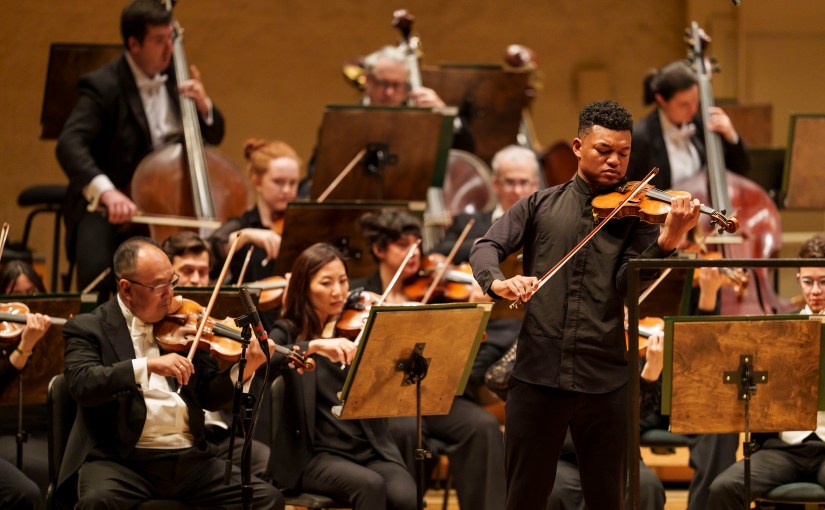
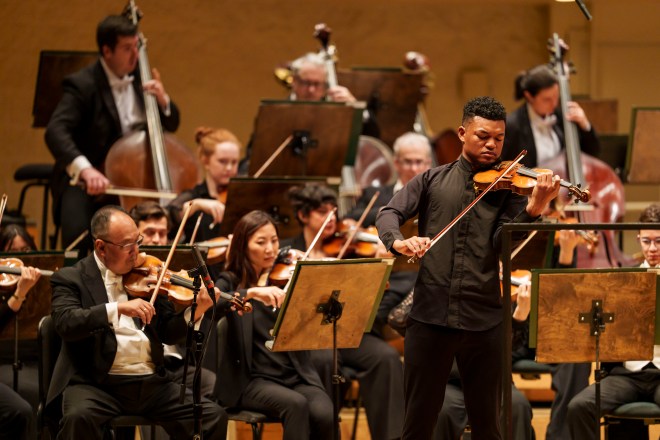
In the final weeks of the Chicago Symphony Orchestra’s 2024–25 season, Price’s music returned to Orchestra Hall in a deeply symbolic homecoming. Randall Goosby made his debut with the orchestra performing the Chicago premiere of Price’s Violin Concerto No. 2. The performance was not only a milestone for Goosby, a rising star in the violin world, but also for Price—whose music, nearly a century after her lauded CSO premiere, continues to find new life in her former home.
Price’s concerto is a compact, 15 minute work, but it covers a great deal of expressive territory. After an arresting opening, the concerto unfolded with melancholic grace in Goosby’s hands. His tone was luminous and fluid, his phrasing both refined and emotionally attentive. The work doesn’t rely on dazzling technical fireworks, but rather draws the listener in with its lyrical directness and tonal glow. Goosby, who has the chops to dispatch even the toughest passages with ease, excelled in the piece’s more introspective corners.
Price’s musical language is distinctive: rooted in the Romantic tradition but inflected with the spiritual and folk idioms of Black America. The concerto is built less around development than reflection. Its themes aren’t transformed so much as meditated on. The result is music that feels more personal than theatrical, more ruminative than declarative. It’s the kind of voice Antonín Dvořák might have imagined when he called for American composers to create a new national style.
Still, the work is not without its shortcomings. Like some of Price’s larger symphonic efforts, the concerto can feel static at times, its ideas circling without always gathering momentum. Its impact rests on the performer’s ability to shape its lyrical materials into something coherent and compelling. Goosby succeeded on those terms.
After the concerto, Goosby returned to play Price’s Adoration, a short hymn-like work arranged by him for solo violin and string orchestra as an encore. The piece, just four minutes long, distilled the essential qualities of Price’s voice – dignified, heartfelt, and unmistakably American – showcasing the expressive range of both Goosby and the CSO strings.
The evening opened with Prokofiev’s Symphony No. 7, a seldom-performed work and a fitting complement to Price’s introspective concerto. Written late in Prokofiev’s life, the symphony—his last—is bittersweet and restrained, far removed from the biting wit or motoric energy of his earlier works. Cast in four movements, its shape loosely resembles Shostakovich’s Fifth Symphony, but its tone is gentler, more wistful.
Prokofiev struggled to navigate the demands of Soviet cultural life. His late works reflect the toll of that struggle. Works like the Seventh eschew confrontation in favor of subtle beauty. The CSO played with refinement, with warm strings and careful dynamic control. Conductor Sir Mark Elder’s decision to split the violins and center the cellos brought out the music’s delicate counterpoint and gave the ensemble a more balanced sound. After a spring filled with large, muscular works, Prokofiev’s Seventh was a welcome pivot toward a quieter, restrained, and more intimate experience.
The concert concluded with orchestral excerpts from Wagner’s Die Meistersinger von Nürnberg, arranged by Elder into a suite that favored musical shape over narrative sequence. Beginning with the Prelude to Act III and ending with the more familiar Prelude to Act I, the suite also included the “Dance of the Apprentices” and “Procession of the Meistersingers.” Elder’s reordering paid off: the suite built naturally toward a rousing finish without feeling disjointed.
The CSO played with its trademark polish, but Elder kept the interpretation lean. There was no bombast here—just careful attention to texture, clarity, and pacing. The repositioned strings again played a role in bringing transparency to Wagner’s thick orchestration. And when the full orchestra was called upon in the final prelude, they responded with surging energy and precision.
Elsewhere:
Lawrence A Johnson at Chicago Classical Review:
“Elder led an alert and incisive performance of Prokofiev’s Seventh Symphony—amazingly, the CSO’s first in 38 years. He brought poised expression to the recurring opening theme, and a touching piquancy to the playroom music-box elements without neglected the passing grotesqueries. Elder was especially inspired in conveying the lurking valedictory feeling of the symphony, which was particularly manifest in the tick-tock coda, the conductor observing Prokofiev’s original quiet ending.”
Discover more from Gathering Note
Subscribe to get the latest posts sent to your email.
 Gathering Note