Originally published on Seen and Heard International
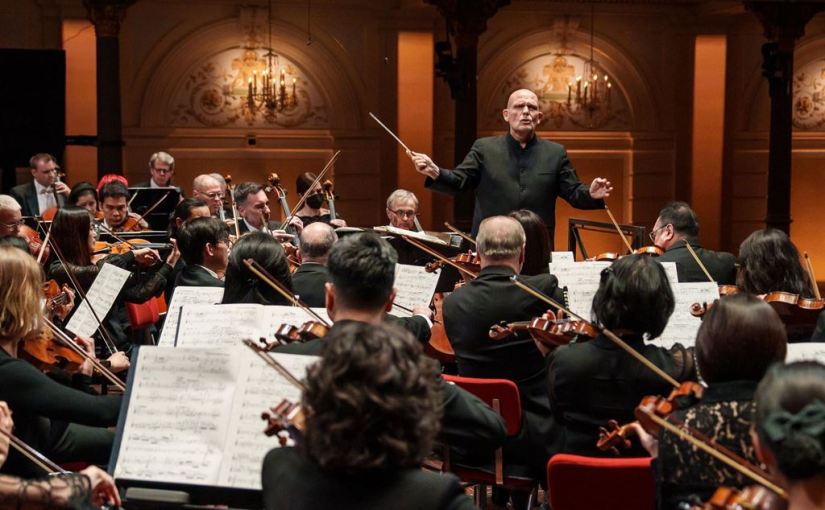
A palpable buzz filled Orchestra Hall on the afternoon of May 9th, as the Chicago Symphony Orchestra, led by Jaap van Zweden, launched into Mahler’s formidable Sixth Symphony. The Friday matinee had drawn a full house, and the performance that unfolded was a gripping study of control, power, and clarity. When the final movement’s infamous hammer blows fell, they did so with unflinching and devastating precision. The performance neither overstated Mahler’s deep ironies nor softened his stark vision.
This concert carried added weight: it marked the CSO’s final performance before their European tour, which included showcasing the Sixth and Seventh Symphonies at the prestigious 2025 Amsterdam Mahler Festival.
Held only three times in its century-long history, the Amsterdam festival remains a touchstone for any orchestra seriously engaged with Mahler. The city’s connection to the composer is profound. Through the efforts of Willem Mengelberg and the Concertgebouw Orchestra, Amsterdam became a second home of sorts for Mahler and for his music. An invitation to perform there is a distinction few ensembles receive. For the CSO, the first North American orchestra to perform at the festival, it represented both recognition and challenge. And it is offering CSO fans an opportunity to ask not only what the CSO has become as a Mahler orchestra, but how it got there.
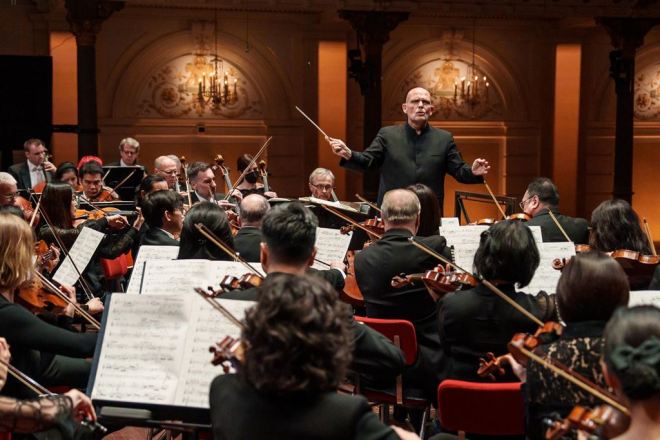
Unlike some ensembles that have defined their Mahler identity through a single figure—Leonard Bernstein with the New York Philharmonic, for example—the CSO’s Mahler tradition is more diffuse, shaped over generations by a variety of conductors and music directors. It may explain why the CSO has over time approached Mahler with flexibility—one of the orchestra’s great strengths. It has enabled the Chicago Symphony Orchestra to speak Mahler’s vast, multivalent language with fluency and nuance.
The CSO’s Mahler lineage stretches back over a century. Frederick Stock, the orchestra’s second music director, conducted the U.S. premiere of Mahler’s Seventh Symphony on April 15, 1921, just a year after he heard it in Amsterdam. Though he cut eleven minutes from the score, the performance—the only U.S. premiere of a Mahler symphony to be done by the CSO—was enthusiastically received by the local press. The Chicago Evening Post praised the ensemble’s capability, writing that “there was nothing Mahler could write which they could not play.” Stock’s bold choice was an early sign of serious engagement with a composer still on the margins of the repertory.
The tradition deepened under Fritz Reiner, whose recording of the Fourth Symphony remains a model of taut, transparent Mahler interpretation. Rather than lean into the composer’s expressive extremes, he sensitively displays a “cool” objectivity in comparison to Leonard Bernstein’s more emotional style. Reiner revealed Mahler’s vision through precision, orchestral clarity and tightly controlled climaxes—qualities that endure within the CSO’s musical DNA today.

Sir Georg Solti brought a different kind of energy to Gustav Mahler’s music. During his tenure, the CSO returned the symphonies to their active repertoire and recorded a complete cycle. Solti’s recording of the Eighth Symphony, made during the orchestra’s first European tour, captured a blend of scale, fire, and polish that became synonymous with how the orchestra played Mahler under his baton. This potent combination of the conductor’s high-energy interpretation and the orchestra’s formidable technical skill created a Mahler sound that was distinctive, by demonstrating how power and precision could overshadow emotional exploration.
Yet even during the Solti years, the CSO showed its Mahler finesse with other interpretations. Carlo Maria Giulini, principal guest conductor during the Solti years, offered a luminous reading of the First Symphony in 1971 that was the opposite of Solti. The Chicago Daily News critic at the time commented that his interpretation “was of a stature, an integrity, an electrifying grandeur that relegated even those landmark performances to the shadows. It seemed to take all the virtues of every interpretation, heard or merely conceived, and fuse them in a new, flawlessly projected and proportioned unity.” Giulini and the CSO would go on to record the symphony for Angel and later win a Grammy. Even today, it remains a benchmark recording.
The orchestra demonstrated remarkable adaptability and sustained excellence under subsequent conductors. Daniel Barenboim, Bernard Haitink, and Pierre Boulez each brought distinct interpretive perspectives—warm, refined, analytical—while still leveraging the ensemble’s inherent strengths. This ability to maintain the highest technical standards while accommodating diverse artistic visions speaks volumes about the resilience of the CSO’s institutional mastery of this demanding repertoire. The ensemble could embrace divergent perspectives without ever losing its center: tonally powerful, flexible, and responsive.
This was fully evident during the 2024–25 season, which featured three Mahler symphonies conducted by artists offering sharply contrasting viewpoints. Klaus Mäkelä, the CSO’s music director designate, led the sprawling account of the Third Symphony marked by clarity and restraint. Eschewing melodrama, he delivered a careful reading. The opening movement was notable for its refined textures and exceptional solo work by trombonist Tim Higgins. The fourth movement, with mezzo-soprano Wiebke Lehmkuhl, was tenderly shaped, and the finale glowed with muted radiance. If the performance lacked a sweeping emotional arc, it made up for it in musical integrity and interpretive freshness.
In contrast, van Zweden brought a more direct, propulsive energy to Mahler’s Seventh Symphony. Avoiding indulgence in the work’s phantasmagorical episodes, he propelled the music forward with relentless momentum. This no-nonsense approach gave the work a surprising cohesion—its notorious eccentricities harnessed to a larger purpose.
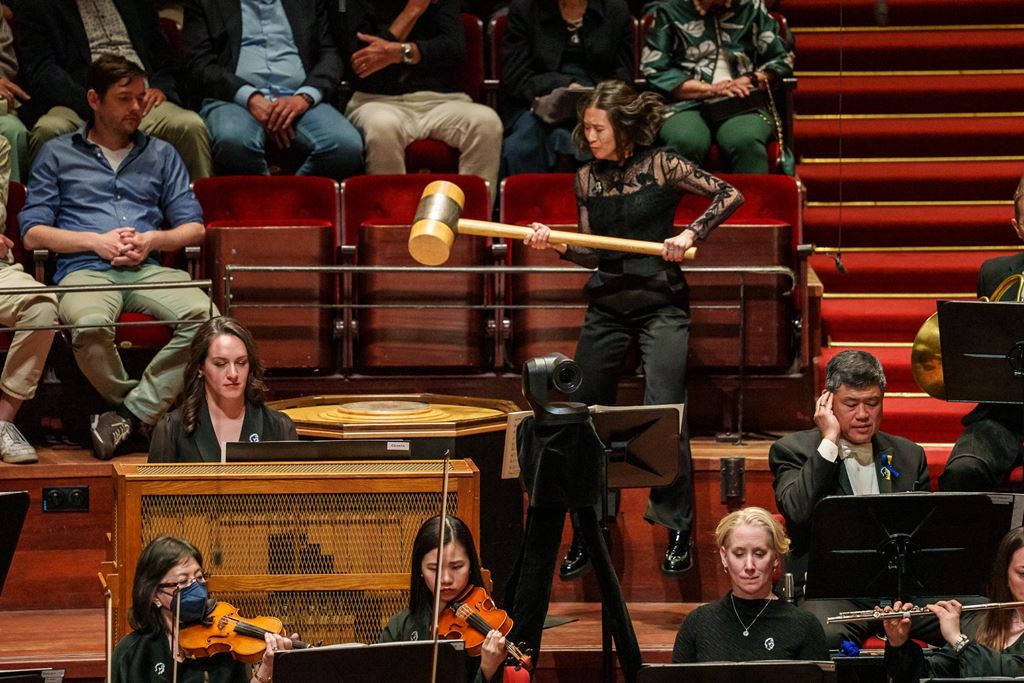
But it was the Sixth Symphony that stood out as the CSO’s most compelling Mahler statement of the season. The orchestra responded to van Zweden’s exacting leadership with stunning concentration. The first movement balanced gravity with kinetic energy; the Scherzo bristled with menace, delivered with clean articulation from the low strings and percussion. The Andante unfolded with tender lyricism; its emotional depth rendered without sentimentality. And in the finale, van Zweden achieved something rare: a sense of nihilism that made the hammer blows feel devastating, yet integrated. The shocks were brutal—but earned, not imposed.
For van Zweden, the pairing of the Sixth and Seventh was a statement of intent. Describing them as opposites that belong together to Kyle MacMillan in a post for CSO.org, framing the two symphonies as a journey from despair to affirmation. And it is precisely that pair that the CSO took to Amsterdam. There, at one of the most storied Mahler festivals in the world, they joined an elite circle of ensembles that have shaped how we hear this composer.
Though van Zweden holds no formal title with the CSO, his Mahler collaborations with the orchestra have been frequent and fruitful. His rapport with the musicians is unmistakable—built on shared values of clarity, balance, and formal rigor. His interpretations may not seek the theatrical, but in their sharp contours and inner conviction, they honor Mahler’s voice in another way: by trusting the score and trusting the orchestra.
The CSO’s Mahler tradition—over a century in the making—is not bound by performance dogma. That may be the point. What emerges instead is an interpretive ecology: diverse, evolving, rooted in excellence. What unites it all is the orchestra itself—and the sound cultivated since the time of Reiner and Solti. In 2025, both at home and on the world stage, the CSO reaffirmed its place not only in Mahler’s history, but in his living present.
Elsewhere:
Hannah Edgar for WBEZ has been providing excellent dispatches from the festival.
“My second ever concert with the CSO, we were playing Mahler’s Fifth Symphony,” recalled percussionist Cynthia Yeh. “We started it, and maybe 16 measures in, the conductor stopped and asked, ‘Do we need to rehearse this?’ And [a musician] raised his hand and said, ‘Nope.’ It’s as if Mahler is in this orchestra’s blood.”
Frank Kuznik writing for Bachtrack.
“One way to look at the symphony is as a series of dramatic contrasts, and in that the conductor showed himself to be a master craftsman, building propulsive marches into percussive explosions, then smoothly segueing to a soft murmur of strings and soothing woodwinds. His skill with dynamics gave the music a compelling through line, an organic feel of many disparate elements fitting neatly together in a riveting narrative.”
My colleague James Zychowicz reviewed the symphonies for Seen and Heard International
Sixth Symphony; Third Symphony and Seventh Symphony
Discover more from Gathering Note
Subscribe to get the latest posts sent to your email.
 Gathering Note