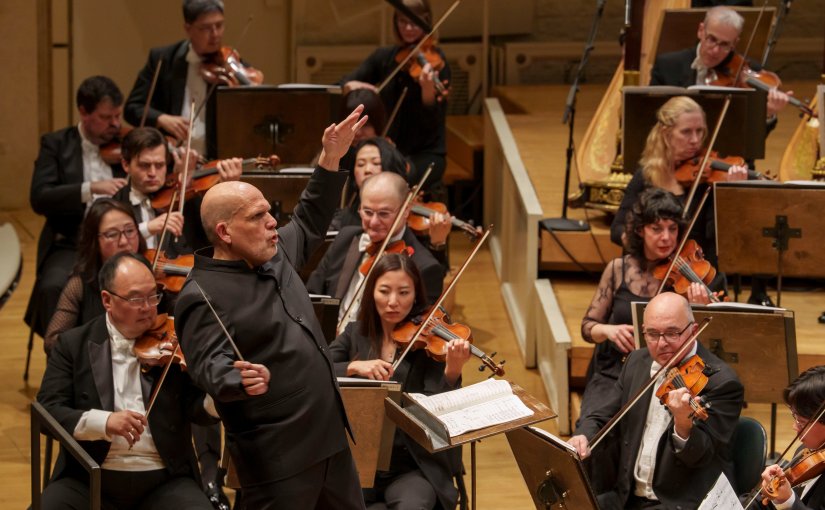
Jaap van Zweden returned to Orchestra Hall this week to lead the Chicago Symphony Orchestra in two commanding performances of Mahler’s Sixth Symphony. Whether by design or coincidence, this symphony has become something of a calling card for the Dutch maestro during his visits to Chicago. Van Zweden was on the podium the last two times the orchestra played the piece, and this time he not only led the work at home, but will also take it on tour to Amsterdam for the third Mahler Festival.
Mahler’s Sixth has long been shrouded in biographical myth—its popularity fed by the image of the composer as a death-haunted artist. This lens, while perhaps oversimplified, finds a potent anchor in the work’s unsettling musical language. The mythology would be nothing without the work’s infamous hammer blows in its final movement—strikes that have become almost synonymous with Mahler’s fatalism.
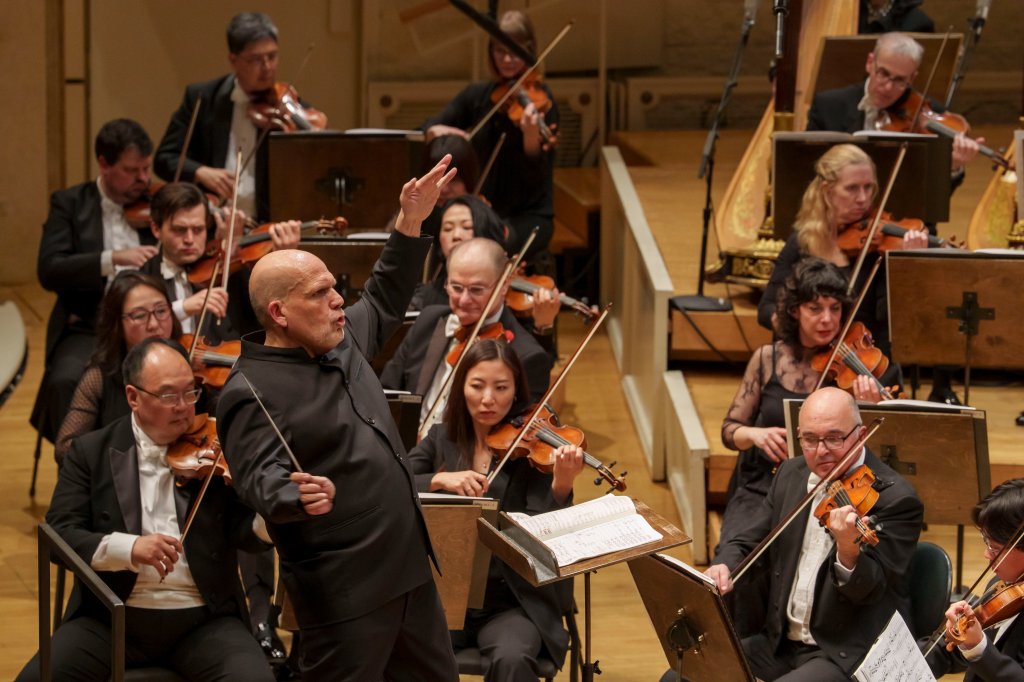
Yet beyond these shocks, the symphony’s structure invites just as much fascination, particularly the perennial debate over the order of the middle movements. Should the jagged, sardonic Scherzo come before the tender Andante moderato, or after it? Scholars, conductors, and audiences have argued the merits of both sequences for decades. Personally, I favor the Scherzo-Andante order, which van Zweden also chose.
Of the three Mahler symphonies performed by the CSO over the past month, the van Zweden-led Sixth may well have been the most convincing. His trademark intensity was a natural fit for the work’s volatile nature. But what set this interpretation apart was his restraint. Rather than imposing himself on the music, van Zweden unleashed the orchestra and let it go, allowing the score to speak for itself. There are conductors who can make an interventionist approach work in Mahler—Michael Tilson Thomas comes to mind—but van Zweden wisely doesn’t try to be.
The first movement Allegro, with its relentless, militaristic march, can easily be distorted by extremes, dragged down by sluggishness or whipped into frenzy. Van Zweden struck a compelling balance, keeping the music taut yet fluid. The low strings were especially vivid: sharp, resonant, and driving the movement forward without ever bogging it down. His precision boosted the Scherzo, where the CSO’s slashing strings, shrill woodwinds, and menacing percussion brought Mahler’s grotesque, lurching dance to life with sardonic clarity.
This clarity and pacing served van Zweden well in the Andante. As a movement, it offers the only real moment of calm between the harrowing march of the first movement, the jangling scherzo, and the cataclysmic finale. The terror of the surrounding movements sublimates into beauty here, with phrases flowing effortlessly. The CSO’s strings provided a warmth that tingled with fragility as each moment passed into the next.
That serenity didn’t last long. The finale erupted with orchestral violence. Once again, van Zweden let the music speak for itself. Climaxes surged naturally, the movement’s internal chaos laid bare as it spiraled into collapse. The music pummeled the audience raw before dissolving into oblivion.
The movement’s defining gesture—the hammer blows—were delivered with ferocity. Mahler’s hammer has become a ready-made hook for the Sixth, sometimes used by orchestras to anchor entire marketing campaigns. Some performances elevate the hammer above everything else, even the massive orchestral forces required for the symphony. For the hammer to work musically, it must be shocking, forceful, and slightly unexpected. The CSO’s hammer was the best I’ve heard.
From my seat in the lower balcony, I could see everything as it unfolded. When principal percussionist Cynthia Yeh brought it crashing down into the wood block, the bang was perfectly timed and executed. I do wonder, though, how the effect landed for those seated on the floor, where the hammer—tucked at the rear of the stage—was likely obscured. Did the impact catch them by surprise? I hope so.
Friday’s performance captured the full sweep of Mahler’s vision—violent, tragic, and strangely beautiful—with searing climaxes, well-judged tempos, and carefully balanced orchestral textures, allowing principal players to shine, marking a thrilling sendoff for the CSO as they prepare to take this work to Europe.
Posted Saturday morning on the CSO’s Instagram account
Elsewhere:
Lawrence A. Johnson at Chicago Classical Review
“The half-hour finale is nearly a symphony in itself. Here too, van Zweden’s direction was impressive, as isolated notes slowly arise out of the darkness, coalescing and finding form like the wind strands in “The Adoration of the Earth” in Rite of Spring. The surging power and virtuosity of the playing was staggering even by CSO standards as the music gathers force and confidence, only to be repeatedly felled by the inevitable fate of the thudding hammer blows. (Following Mahler’s dicta, the conductor dispensed with the third and final blow.) The bleakness of the coda was stark and unsparing, with the sepulchral maunderings of the lower brass conveying an existential desolation.”
Debra Davy at Splash Magazines
“Although the overall mood of the 6th is dark, even anxiety provoking, the achingly luxuriant Andante notably excepted, it is a very rich creation, enormously interesting, and well worth listening to again and again, especially in the hands- and under the baton- of an Orchestra with this hair trigger responsiveness, and a conductor this talented. “
Discover more from Gathering Note
Subscribe to get the latest posts sent to your email.
 Gathering Note
One thought on “Jaap van Zweden returns with a blazing Mahler Sixth”
Comments are closed.