Originally published on Seen and Heard International
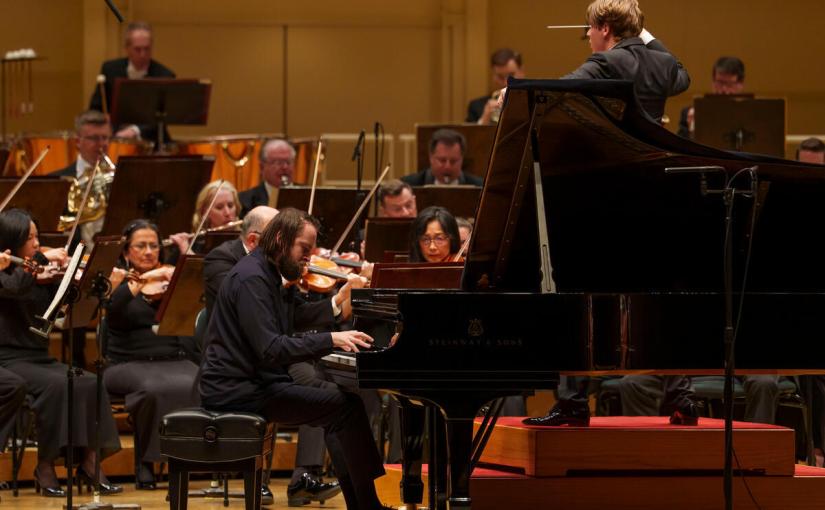
Brahms’ Second Piano Concerto is a meaty work.. It may not be as imposing as Mahler’s Third Symphony, but large enough in musical vision that it places great demand on both soloist and orchestra. Thus, it was an appropriate choice for Klaus Mäkelä’s second week with the Chicago Symphony Orchestra, and an equally fitting farewell for Daniil Trifonov, concluding his season-long role as the CSO’s artist in residence for 2024–25.
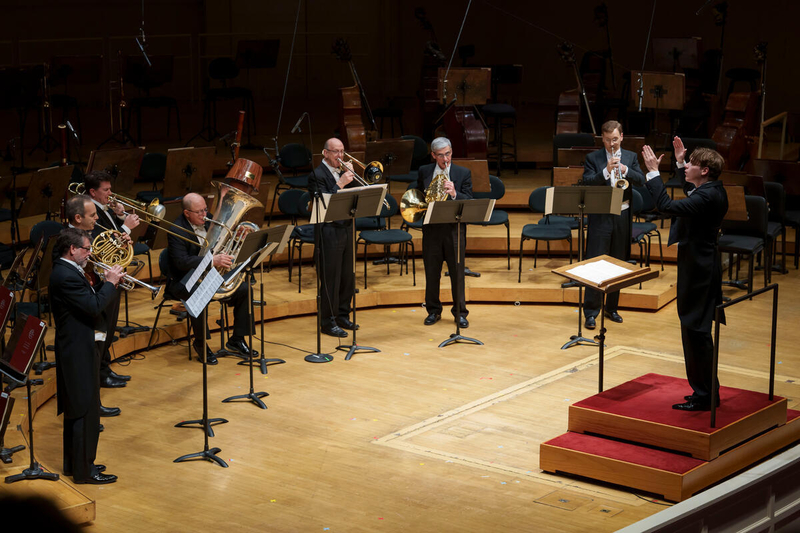
No less serious was the second half: Pierre Boulez’s Initiale, a compact brass fanfare originally written for septet, followed by Dvořák’s Seventh Symphony.
It was a compelling program, following on the heels of Mäkelä’s performance of Mahler’s sprawling Third Symphony the week prior. Each of the three works had its own magnitude—none perhaps as long as the 100-minute Mahler—but all weighty in expression and execution.
Boulez’s Initiale, for one, packed a striking amount of musical dazzle into just five minutes. The work, which has been expanded in celebration of Georg Solti’s 80th birthday, was performed here in its original form as a septet, showcasing the CSO’s muscular brass section, it was both taut and gleaming. With 2025 marking the centenary of Boulez’s birth, the inclusion of Initiale was also a meaningful gesture. Boulez, who served as the CSO’s principal guest conductor from 1995 to 2006 and later as conductor emeritus, helped shape the ensemble’s modern identity—and the brass made his demanding music look effortless.
Brahms’ concerto, symphonic in scale and emotional range, spans four movements and nearly 50 minutes. It is work that challenges soloist and orchestra alike. Trifonov filled the first half of the concert with a performance both intensely focused and sharply etched. Staring straight ahead, his body slightly hunched over the keys, Trifonov played with matter-of-fact precision. His execution was sharp, displaying technical command time and again. But his interpretation was flexible, too. He hurled himself into the music when called for, yet brought tenderness and restraint when required—such as the lyrical Andante, where principal cellist John Sharp added a songful and beautifully shaped solo.
Mäkelä and the orchestra provided taut, exuberant support to the soloist. As Trifonov turned inward, mining every detail of Brahms’ score, Mäkelä shaped a performance that flowed naturally from beginning to end, balancing the orchestra’s raw power with moments of warmth and repose.
Those qualities carried into the second half with Dvořák’s Seventh Symphony. Mäkelä’s leadership was effusive, barely pausing between movements. He kept tempos urgent, rhythms snapped with vitality, and phrases sculpted and complete. The symphony’s Czech flair remained intact, even as Mäkelä emphasized its architecture and Brahmsian weight.
Brahms’ Third Symphony was a known inspiration for Dvořák’s Seventh, and while Brahms tends to receive more attention from orchestras, this symphony’s perfection is that it arguably does more with less. Its immediacy and tight construction make it a standout in the repertoire, especially in a performance as driven and cohesive as this one.
Klaus Mäkelä’s two weeks in Chicago have now come to an end. It felt like a short fortnight. There’s still time before his title officially shifts from music director designate to music director, but these concerts—last week’s Mahler and this week’s Brahms, Boulez, and Dvořák—offered a clear glimpse of what lies ahead.
The CSO is perhaps the most “American” of America’s premiere orchestras—virtuosic, powerful, and clean in timbre, but with an adaptable performance style to suit any category of classical music. Mäkelä understands this deeply. More importantly, he has already shown he knows how to guide this extraordinary ensemble in becoming the best version of itself, no matter the repertoire.
Elsewhere:
Hannah Edgar at Chicago Tribune
Against the Mahler, Mäkelä’s Dvořák 7 (continuing through this weekend) came away as a more cohesive musical statement. In performance, Mäkelä maintained that “long line” through the entire piece: Returning motives varied slightly but effortlessly, as though being sung in real time. The string hiccup beginning the Scherzo theme was whistle-clean; rather than beating through busy sections, Mäkelä resurrected his favored move of pointing at instruments with moving lines, or, occasionally, mouthing along to them.
Lawrence A. Johnson at Chicago Classical Review
Mäkelä had the full measure of this symphony from the jump—literally, giving the downbeat nearly before the entrance applause had subsided. From the hushed mystery of the introductory bars to the stormy main theme of the opening movement, the conductor balanced the taut drama against Dvořák‘s gracious lyricism—which he drew out wonderfully, always bringing the composer’s bucolic writing for woodwinds to the fore.
Kyle MacMillan at Chicago Sun Times
Rounding out the evening was a bright, warmly spirited performance of Dvořák’s Symphony No. 7 in D minor, Op. 70, including a taut, thrilling take on the Scherzo third movement. The CSO delivered a consistently fluid, robust sound, especially in the strings, that was ideally suited to the composer’s fervent, full-bodied romanticism.
Many questions remain, of course, but these two weeks have made it clearer why the CSO chose Mäkelä as its next music director. If he can continue to deliver interpretations on this level, then the orchestra should be on solid footing when he takes over as music director in September 2027.
Debra Davy at Splash Magazines
Johannes Brahms’ beloved Piano Concerto No. 2 in B-flat Major, Op. 83, 1878-81, is comprised of four movements, beginning with a distinct, clarion horn call seemingly to the Orchestra, which brings forth a graceful melody. The piano responds with such another before setting forth on a virtuoso expansion. Trifonov’s playing is sure, emphasized, yet appears effortless; he neither dominates nor retires. The conductor kept his eyes and firm attentive direction on all instruments as the piano and Orchestra in large ensemble proceed to develop dramatically together, with the horn theme intervening and played by different parts of the Orchestra.
Discover more from Gathering Note
Subscribe to get the latest posts sent to your email.
 Gathering Note