
Minkowski Takes Leap from Baroque to Classical with Jupiter and Les Boréades

Marc Minkowski, Photo Credit: Benjamin Chelly

Originally published on Seen and Heard International

Gods and mythology long influenced music, especially during the Baroque and Classical periods. This era saw a cultural shift, drawing greater and greater inspiration from pre-Christian societies. The larger-than-life characters of mythology offered spectacle and theatricality, especially for Baroque opera. They provided dramatic material for the genre, fueling its growth. But beyond entertainment, these stories also offered allegory and moral lessons, appealing to audiences seeking philosophical themes. This realm of gods, myth, and magic formed a loose programmatic thread through the January program of Chicago’s Music of the Baroque. The evening in Harris Theater off the city’s Michigan Avenue featured three pieces from different music “gods” and Marc Minkowski’s debut with the orchestra.

Continue reading Minkowski Takes Leap from Baroque to Classical with Jupiter and Les Boréades
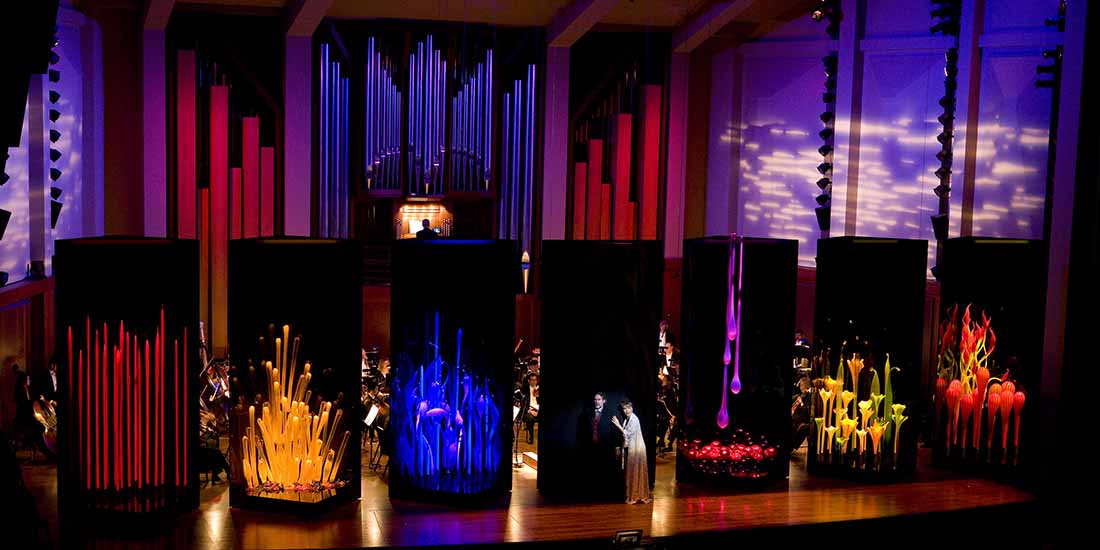
“Let the door be shut and bolted”

Photo Credit: Chihuly Studios, Terry Rishel 

Esa-Pekka Salonen joins the CSO for a two-week residency focusing on Bartók. In week one, Salonen pairs the Concerto for Orchestra with his own Sinfonia Concertante for organ and orchestra, while in week two Bluebeard’s Castle shares the stage with Beethoven’s Second Symphony. As of this afternoon, there are still ample tickets available for Bluebeard’s Castle, and anyone who can go should.

It is one of the spookier pieces of music out there, and Bartók’s vocal writing is excruciatingly demanding. I’ve seen it staged on a double bill with Schoenberg’s expressionist masterpiece Erwartung. But, it was my first experience with the opera, a semi-staged concert performance in Seattle that is firmly planted in my memory. Gerard Schwarz pulled out all of the stops to make it a memorable evening. Schwarz’s production was unforgettable, partially thanks to Charles Simonyi’s support, which enabled the creation of glass sculptures by Dale Chihuly representing six of the seven doors opened by Judith and Duke Bluebeard. This striking production has since traveled to other venues, undoubtedly thrilling audiences.

While Chicago’s performance won’t feature Chihuly’s vibrant sculptures, it boasts its own impressive draw: Esa-Pekka Salonen conducting, alongside soloists Ekaterina Gubanova and Christian Van Horn.

Omar’s Journey is a new milestone for the Quad City Symphony

James Dixon, Himie Voxman, and Dimitri Mitropoulos, 1952. Photo Credit: University of Iowa

For over a century, the Quad City Symphony Orchestra (QCSO) has stood as a cultural gem nestled between the major Midwestern cities of Chicago, Minneapolis, Milwaukee, and St. Louis, just a few blocks from the banks of the Mississippi River. Throughout the 20th century, as musicians, soloists, and orchestras embarked on regional tours, the QCSO often served as a strategic and welcoming stop. It provided a platform for artists en route to more renowned venues, enriching the local cultural scene and solidifying the orchestra’s role as a significant hub in the Midwest’s music circuit. This legacy helped foster a deep tradition, making the QCSO a cherished institution in the region.

One of my most treasured keepsakes from this era with the QCSO is their cookbook titled Standing Ovations. It’s a quintessential Midwest cookbook, filled with hearty recipes and straightforward preparations. What truly makes it a keeper, however, are the contributions from the QCSO’s frequent guest artists, such as baritone Robert Merrill (Cheese Pancakes), cellist Leonard Rose (Steak With a Kick), and the Contiguglia Brothers piano duo (Fusilli with Creamy Zucchini), among others.

Continue reading Omar’s Journey is a new milestone for the Quad City Symphony