Mozart’s ‘Abduction’ is New Again!

In the world of classical music, one can choose to either look to the constantly modern for inspiration or search through the centuries past for brilliant surprises. The Lyric Opera of Chicago tends to do both. Last season, the opera company put on John Adams’ Dr. Atomic and this year, the Lyric brings us this Mozart jewel – The Abduction from the Seraglio. Although more well-known than Mozart’s Bastien und Bastienne, one can hardly call this opera part of the standard repertory. For one thing, you need singers of exceptional quality, especially for the bass role of Osmin and the soprano role of Konstanze. Another challenge is balancing the contrived plot of captured tourists trapped in a foreign land with the true raw emotion of the piece. On all counts, this new production of The Abduction achieves superbly.

The opera in question was written when Mozart was 26 and still getting his legs under him. He desperately wanted a success in his newly adopted home, Vienna, and this opera was to give it to him. Even the emperor enjoyed it, although he famously complained that it had “too many notes.” Indeed, the opera has so many musical ideas and such high ambitions that the seams tend to show. The trade-off of course is the sheer beauty of the music. I know reviews are more about performances than music, but the music in this opera is wonderful. Osmin’s first aria, Wer ein Liebchen hat gefunden, is a miraculous piece of music, balancing the amorous words of the song with the quick turn to jealousy and control on the part of the singer. Such amazing pieces abound for all the main characters, in the instance of Belmonte, the tenor hero, over and over. He has no less than four arias, a couple duos, a trio, a quartet, and a lot of German dialogue. The point: the singers have their work cut out for them, in glorious style.

Fortunately, the Lyric put together an exceptional cast of singers. Matthew Polenzani, who has sung many roles for the Lyric in the past, including a wonderful run in Tchaikovsky’s Onegin, was the perfect Belmonte. His voice, nonplussed by the challenges of the music, is so fluid and well-honed that it does whatever is needed. Erin Wall, this production’s Konstanze, has a razor sharp voice, perfectly controlled and highly flexible. There were several times during the opera when I chuckled out loud at Mozart’s excesses, combined with sheer wonderment at Ms. Wall’s abilities. In the second act, for example, she had to sing two of her arias back to back. In the first, the soprano sang of deep loss and sadness, the audience enthralled and still. Moments later, she had to begin her fireworks aria, Martern aller Arten. The coupling of the two arias should be a test for any soprano, requiring emotional and virtuosic range. Ms. Wall had it all.

The high point for me was Andrea Silvestrelli, the opera’s Osmin. Mozart writes a bass part so low that Osmin’s first utterances boggle the mind with aural depth. Silvestrelli, who will be doing Wagner for the Seattle Opera later this year, has a voice that is amazing. With it, he could cross all the gauntlets Mozart placed before him. Not only that, Silvestrelli brings such wonderful, larger than life acting to the piece as well. He was fun to see and jaw-dropping to hear, especially in pieces like the duet, Ich gehe, doch rate ich dir. The less serious pair of Pedrillo and Blonde, were also portrayed by wonderful singer/actors. Steve Davislim was able to show his comedic side through most of the piece, but showed his chops in the serenade In Mohrenland. It was a rich, beautiful tenor, wasted in the role. Aleksandra Kurzak was a wonderful foil to Silvestrelli, and she could match him note for note, move for move. They could easily have their own television show playing domineering wife and witless husband.

The opera has many such balances – Belmonte and Konstanze, and Pedrillo and Blonde are contrasts, as are Osmin, the boorish Turk and the Pasha Selim, a wise and generous man. The music, wonderfully performed by the orchestra under Sir Andrew Davis, has those contrasts as well, beginning immediately in the overture. The task of the designers for this new production, director Chas Rader-Shieber and Set/Costume Designer David Zinn, then was to bring that to the fore. Their solution: contrast the true emotions of the characters on one stage with the silly location of the opera on another. Most of the first act has the world of the Pasha on a stage, complete with painted backdrops and lavish costumes. The stage sits on the Lyric stage, almost as if the opera itself is aware of its artifice. When Belmonte appears, he stands in front and removed from the stage to show his connection to the emotional side of the story. Osmin is of course, prominently displayed on the artificial stage. As the opera progresses, the artifice is blown away and we are left witness to characters who love and pine for each other, and grieve at their separation. The stage on the stage is merely a barren plank, and by the third act, the stage is gone entirely. Although a wonderful intellectual idea, visually, it makes the subsequent acts less stimulating. After all, at this stage of Mozart’s game, we are given solo aria after solo aria. There’s not much going on. To subtract visual stimulation makes it less appealing, although what remains is pure magic – Mozart’s music.

Next year, the Lyric Opera tries its hand at Mozart’s The Marriage of Figaro, and if this season’s rendition of the composer’s early classic is an indicator, it will be a triumphant success.

Baroque Band Hits its Stride

On an uncommonly warm, but commonly torrential, March day in Chicago, I was in attendance at the first concert of the new year for Chicago’s period-instrument orchestra, Baroque Band. The concert was entitled Suite Candy and featured, get this, suites. It was a decidedly French and German affair, with pieces by Lully and Rameau in the former camp and Telemann and Bach in the latter. The savvy PR minds at Baroque Band even imported hand-made chocolates from a chocolatier from Iowa. Beyond the great music as a draw was a true first for the orchestra – the inclusion of winds, two oboes and bassoon. What a pleasure it was to hear their reedy sounds mixed with the strings of the band. Overall, this confection was a real treat.

The concert began with the Baroque Band, fifteen string members strong, augmented by period oboes and bassoon, performing a suite from Lully’s Le Bourgeois gentilhomme. The sheer aural sensation of the added winds in the intimate space of the Grainger Ballroom made the suite truly enjoyable. I prefer my French baroque a little lighter in its string tone and much more florid, but there was a feeling of excitement on the part of the orchestra to have the winds on board, and to be performing again for its subscription series.

The winds having exited, the Baroque Band invited its own Craig Trompeter, one of the two continuo cellists, to be soloist in Telemann’s Suite for viola da gamba and strings, TWV 55: D6. The viola da gamba is an interesting-looking instrument. It is cradled between the legs of the performer, has many strings and has a much less resonant sound than the cello. Its sound is rather archaic, but was a wonderful contrast to the rest of the strings. I especially enjoyed the movements that brought that contrast to the fore, as in the Bourree, which had duo writing for the viola da gamba and its successor, the cello. Their timbral differences were evident and enjoyable. Mr. Trompeter’s playing was filled with assurance and poise. Hearing this tremendously pleasurable performance allowed me to realize how talented Georg Philipp Telemann was. Such committed performances of music that has so much surprise and novelty should lead to a deeper appreciation of the composer. If Vivaldi can be celebrated for a mere four violin concerti based on the weather, then certainly Telemann can be lauded for his music, numbering in the thousands of compositions. 

After the intermission, Rameau’s music for Les Indes Galantes, in English ‘The Galant Indians’, was performed. In it, Rameau attempted to present the dances and songs of four savage lands: Persia, Africa, Latin America and North America. I don’t know how successful he was, it being difficult to imagine African slaves singing “a charming French Air” as written in the notes. Once again, I found the playing to be less than transparent, and the characteristically French ornaments, like endless trills at the end of melodies, left me wondering about the Baroque Band’s versatility.

Johann Sebastian Bach’s Suite No.1 was chosen to conclude the evening. In both the Telemann and Bach, the orchestra was truly in its own comfort zone. The oboists, their faces bright red, were madly speeding through the infinite string of notes in the opening overture, as Mr. Clarke chose a break-neck speed for the movement. I was disappointed with that choice because it makes the music seem rather rushed. I know playing many of Bach’s pieces quickly is a sign of an orchestra’s virtuoso acumen, but it degrades the music when played so fast. The rest of the suite was given some room to breathe and came off much better.

For my ears, the Telemann was the true winner in this concert, eliciting an inspired performance from all involved. The audience also found reward from the inclusion of the period-instrument wind instruments. They will no doubt make subsequent appearances as the next set of concerts for this small ensemble is nothing less than Handel’s Messiah. Having had the pleasure to see the Baroque Band mature since its inception, I look forward to what this new jewel in Chicago’s musical cap will come up with.

Pinchas Zukerman at 60

The following is a paragraph from Zukerman’s official biography

for this year, outlining his ambitious plans in celebration of his 60th birthday:

“Pinchas Zukerman turned 60 on July 16, 2008 and celebrates with a schedule which comprises more than 112 concert engagements and travel to 17 countries including France, India, Israel, China, Turkey, Peru, New Zealand, Austria, Russia and the United Arab Emirates. He performs orchestra, solo recital and chamber music repertoire in more than 34 cities. He spends 10 weeks teaching in his role as Director of the Pinchas Zukerman Performance Program at the Manhattan School of Music, and as Artistic Director of the National Arts Centre Summer Music Institute in Ottawa, which includes the Young Artist Programme, Conductor’s Programme and Composer’s Programme. Currently in his 10th season as Music Director of the National Arts Centre Orchestra, Mr. Zukerman conducts London’s Royal Philharmonic Orchestra in Moscow, Italy and Spain as well as the Dallas Symphony Orchestra on tour in the United States. He performs with the New York Philharmonic, Chicago Symphony, Cleveland Orchestra and National Symphony Orchestra and joins the Israel Philharmonic in New York’s Carnegie Hall, Bombay and Israel, the Orchestra Philharmonique de Radio France and the Gulbenkian Orchestra. Mr. Zukerman and pianist Marc Neikrug give recitals in Vienna, Philadelphia, New York and Chicago.”

It is an astounding world tour to say the least, and I was in attendance at the last concert mentioned – a recital with pianist/composer Marc Neikrug in Chicago’s Harris Theater. He performed a healthy variety of pieces, mostly for violin. With that slight instrument, Pinchas performed Mozart’s sonata, K.454, Franck’s Sonata in A, and Takemitsu’s From Far Beyond Chrysanthemums and November Fog. With his viola Zukerman brought forth the brooding and pensive viola sonata of Dmitri Shostakovich. As a gentleman in front of me uttered to his wife, Zukerman made it all “look effortless.” The problem was that I wished there were a little more effort put into connecting with the audience.

For this recital, the violinist/violist wore what looked like pajamas – a flowing black shirt, like from a Chinese restaurant, some black pants and the most comfortable shoes he could find. They looked like structured socks. His accompanist, bald with a long ponytail, was a little more dressed up. The Mozart was first, and as the notes stated, the piece is to start with a grand and forceful statement in unison, as befits a piece of music written for the emperor. What I heard was a lot less forceful, almost anemic. Zukerman barely moved as he played, eyes locked onto his music stand. There was barely any communication between Zukerman and Neikrug either. Don’t get me wrong, Zukerman’s playing is flawless. As a musician who has to muscle a sweet tone out of the grouchy viola, his violin tone is rich and full, effortless. He commands a treasure-trove of skills on the violin, brought out in full measure when necessary. The only reservation is that he seems to make no connection to the music or the audience when he plays. After the Mozart was over, he immediately took off his glasses, bowed once and walked off, Neikrug right behind him, and the page turner behind him.

He bolts right out with his viola and sends us into a world we are not prepared for: Shostakovich’s Sonata for Viola and Piano, the composer’s last musical utterances. The piece opens with pizzicato of yet another melancholy melody. Zukerman plays with a little more passion and commitment. This music fits his performance style perfectly: constrained and inhibited. During the work’s middle movement, with all of its folksy tunes and flourishes, Pinchas lets go. It is a very convincing reading. The last movement is fascinating, and if you don’t know this piece of Shostakovich, go out and listen to it. It is an homage to Beethoven, even taking the basic outline of the composer’s “Moonlight” sonata as this sonata’s foundation. It is an eery piece and ends quietly, effectively played by Zukerman and Neikrug. The stunning contrast between the sweet violin sonata of Mozart and the brooding viola of Shostakovich left me cold. They were strange bedfellows to say the least, and really didn’t complement each other well. Again, the performers flew off the stage.

The audience was duly impressed by whatever Zukerman was giving as they proceeded to talk and chat. I was sitting behind a large contingent of Russians who waved to others and spoke softly during the performance. They were having lots of fun, although listening intently to the music wasn’t part of that fun. Twenty minutes for intermission having passed, Zukerman et al. burst forth back on stage. The house lights gave no indication that it was time to return, so everyone was still standing around as the violinist was ready to go. Takemitsu’s piece was short, as they all are, and spare. It evidenced Zukerman’s commitment to bringing a panoply of music to the audience. Unfortunately, the audience seemed disconcerted by the intermission, and so it passed without much notice.

The program concluded with Franck’s Romantic sonata for violin. In four movements, it was described in the notes as being “large.” The playing was beautiful, the violin in his hands seemed small, almost like a toy fiddle, but the sound was smooth and effortless. The playing was also uniform. The performers moved from the first to the second without notice, the break almost non-existent. The same for the third and fourth movements. Of course, this may be a matter of interpretation, creating two related movements instead of four, but it just made the piece seem rushed. The ending flourish was played hastily  and off they went again. There may have been an encore, but I didn’t stay.

Pinchas Zukerman is a world-reknown musician with due fame for his various musical gifts. I just don’t think that one of those gifts is being a live performer. I have also seen him with the CSO, and he just seems bothered by having to perform in front of others. It makes the whole affair seem condescending. His recordings play up his exceptional performing ability, whereas live performance detracts from it, as you look at this man who appears put-upon. This concert gave me that impression, and although it had a lot of variety and beautiful music making, a performance without connection is a pretty dull performance. Listen to him on CD or MP3 instead.

Chicago’s 09/10 season can’t get any better

haitinkThe Chicago Symphony Orchestra recently released its next season, and I believe it is probably the most dynamic and varied season we have seen in recent memory. The season is focusing on the three conductors that make up the universe of excellence at the CSO: Bernard Haitink, who will be leaving us after this season, Riccardo Muti, who will take over in the 2010/2011 season, and Pierre Boulez, the symphony’s conductor emeritus who will be celebrating his 85th birthday. Surrounding these three gentlemen are no less than 23 guest conductors, representing virtually every conductor of note in the world. Combine that with exceptional soloists, new commissions and interesting repertoire choices, I am pretty excited about the new year in Chicago.

First things first. It must be stated that Chicago likes its music on the conservative side. We certainly are no slouch in promoting new music, and the CSO has a whole series of concerts called MusicNOW that are led by the two composers-in-residence, Osvaldo Golijov and Mark-Anthony Turnage, but you won’t find a lot of it on the main stage. It should come as no surprise then that Haitink will be focusing on the Germans in his final stint here, and Muti is presenting his version of the German canon as well. Haitink has always been known as a great interpreter of the Germanic tradition, whether Bruckner, Mahler, Brahms or Beethoven. During the course of his tenure here, he has conducted all of them, and so it is fitting that Haitink’s leadership in Chicago will culminate with a three-week celebration of Haitink and Ludwig van Beethoven. He will conduct all nine symphonies during the course of three weeks, together with the Leonore

overtures and Calm Sea & Prosperous Voyage. Muti is here for a short while and will conduct a Bruckner symphony (I’m sure to allay the fears of conservative Chicagoans who question his chops) and four performances of Brahms’ A German Requiem. He had a runaway success with the Verdi Requiem this season, so it seems fitting to continue with the Brahms. Taken together, you can see that the orchestra isn’t breaking new ground with our principal conductors. Fortunately, Boulez and our guests will scratch that itch nicely.

Pierre Boulez will be celebrated in a month-long series of concerts, some led by him, others in honor of him. He will conduct performances of Bartok’s Bluebeard’s Castle and his concerto for two pianos, percussion and orchestra. He will also lead performances of his own composition, Livre pour cordes, as well as a flute concerto by Marc-André Dalbavie. David Robertson will conduct a concert in honor of the composer/conductor, featuring works by composers associated with Boulez: Stravinsky, Berg and Messiaen. The Symphony has also commissioned two new works for the season: James Primosch’s Songs for Adam

with baritone Brian Mulligan and Dmitri Yanov-Yanovsky’s Cello Concerto performed by Yo-Yo Ma. In another example of old and new, Passion Week at Orchestra Hall will feature performances of Bach’s St. John Passion with Golijov’s St. Mark Passion, a sensational double-header.

The list of guest conductors is stunning for this season. Here they all are: Roberto Abbado, Semyon Bychkov, Sir Andrew Davis, Christoph von Dohnányi, Charles Dutoit, Sir Mark Elder, Rafael Frühbeck de Burgos, Paavo Järvi, Vladimir Jurowski, Nicholas Kraemer, Bernard Labadie, Ludovic Morlot, Gianandrea Noseda, Peter Oundjian, Trevor Pinnock, Alexander Polianichko, Carlos Miguel Prieto, David Robertson, Esa-Pekka Salonen, Robert Spano, Markus Stenz, Michael Tilson Thomas, Mitsuko Uchida and John Williams. These conductors are mostly responsible for introducing the symphony to works they have never played, like Harrison Birtwistle’s Night’s Black Bird; Ruth Crawford Seeger’s Andante for Strings; Kaija Saariaho’s Orion; Vaughan Williams’ The Lark Ascending; Ligeti’s Violin Concerto; and Martinů’s Frescoes of Piero della Francesca. Igor Stravinsky is especially well represented, with performances of his Rite of Spring, Dumbarton Oaks Concerto, Concerto for Piano & Wind Instruments, the ballet Agon, and his rarely performed oratorio Oedipus Rex. The ballet and oratorio are both led by Michael Tilson Thomas, and that is truly a highlight for me.

Taken all together, the 2009/2010 season is one of the greatest we have had in recent memory and one of the most interesting and compelling of any orchestra in the United States. Feel free to take a trip to Chicago. Come for the orchestra, stay for the opera. The Lyric Opera has a nice, well-rounded season planned as well.

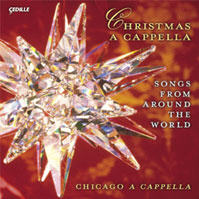
Chicago A Cappella’s Christmas album sparkles with new vocal gems

chicagoacappella

Chicago A Cappella, a top notch vocal ensemble from the Windy City, really sparkles in its new holiday recording, entitled Christmas A Cappella. The CD contains 18 songs from around the world and each number is given a superb performance by this ensemble. Continue reading Chicago A Cappella’s Christmas album sparkles with new vocal gems