Every fall, as Chicago’s classical music season begins to take shape, the question arrives in one form or another: What should we hear?
It is a reasonable question. There is too much music to hear everything, and the start of the season comes with an abundance of possibilities. Hannah Edgar has offered her choices for the fall in the Chicago Tribune. The Chicago Classical Review has published its critics’ picks. Lists like these are useful.
The difficulty is that Chicago has too much good music for a sensible list of “must-sees.” Choosing ten or fifteen performances suggests that the rest are somehow less important. It also tends to reproduce the hierarchy that already exists. The large institutions get larger audiences, the established names get more attention, and the smaller organizations are left trying to make a case for themselves in a city where there are already more concerts than can reasonably fit on a calendar.
After the pandemic, that matters more than it once did. Live music came back, but not entirely. Some organizations recovered quickly. Others are still rebuilding audiences, budgets and the sense that a concert is something people simply do. Classical music and opera have been particularly vulnerable to that disruption.
So I am less interested in making a list of things you should hear than in suggesting that you go hear something.
If the Civic Orchestra of Chicago is within your means and your schedule, go whenever you can. If operetta and light opera appeal to you, Great Lakes Operetta deserves a look. If film music is your thing, there is The CheckOut and the Chicago Philharmonic. They need audiences. And audiences need them.
There are, of course, some performances that I am especially curious about today.
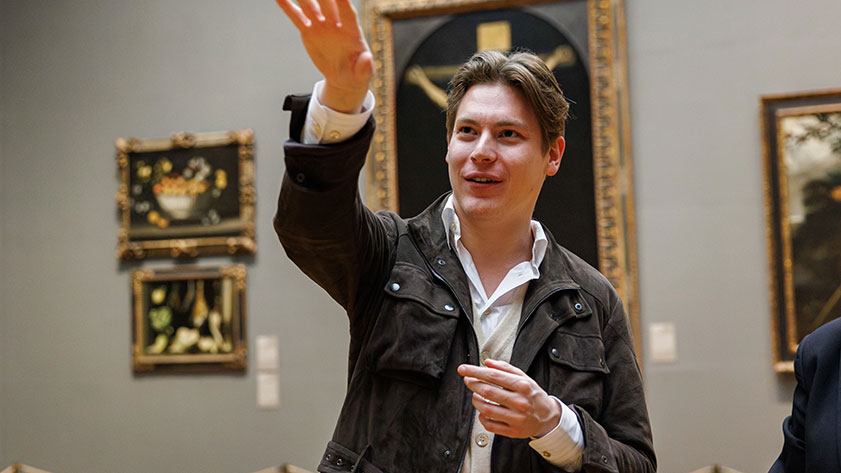
Klaus Mäkelä’s fall residency with the Chicago Symphony Orchestra is at the top of my list. He begins with Sibelius’s Symphony No. 7 and Shostakovich’s Symphony No. 4, a pairing that seems designed to test the limits of proportion. Sibelius compresses his symphony into a single movement of austere metamorphosis. Shostakovich lets his Fourth sprawl across nearly an hour, filling it with grotesquerie, violence, parody and enormous orchestral forces. Mäkelä has conducted and recorded both works. The interest here is not just to hear a young conductor tackle difficult repertoire, but in hearing these two extremes are placed next to each other.

Mäkelä turns to Mahler the following week with the Symphony No. 9. I have liked his Mahler in the past. He is a conductor with an acute sense of what is happening moment to moment, and Mahler rewards that kind of attention. The Ninth is particularly suited to it. Its structure is strange even by Mahler’s standards: two slow outer movements frame a Ländler and a demonic Rondo-Burleske. The symphony gradually turns inward until the music seems almost to disappear.
At Lyric Opera, Enrique Mazzola completes his Mozart–Da Ponte cycle with Don Giovanni in a revival of Robert Falls’s lauded production. I came to Mozart’s operas much later than I should have, and Don Giovanni is one reason I regret that. Mozart gives us a character who is impossible to defend and somehow makes us wait to see whether he will change his ways. This revival boasts an excellent cast, with Christian Van Horn, Lawrence Brownlee and Mané Galoyan at its center.

Michael Abels and Rhiannon Giddens’s Omar is perhaps the season’s most intriguing opera proposition. The opera won the Pulitzer Prize in 2023 and has already established a life beyond its 2022 premiere at the Spoleto Festival. The Quad City Symphony performed a reduced concert version last year. Chicago now gets the full work, though only for a limited run. Abels is one of the elder statesmen of Black, American composers. In addition to a substantial body of concert music, he has been Jordan Peele’s musical muse, composing the scores for Get Out, Us and Nope.
The chamber‑music calendar offers its own pleasures. Nicholas Phan joins the Jasper String Quartet for the Midwest premiere of Vivian Fung’s Lamenting Earth, a song cycle for voice, quartet, and piano drawn from Claire Wahmanholm’s poem O and climate‑change texts by Kaufman Music Center students. Fung keeps a potentially abstract subject grounded in human experience. Premiered in 2024 by Phan, the Jasper Quartet and pianist Myra Huang, the work appears in Chicago with its original collaborators back at the helm.

The Varo String Quartet returns to Rosehill Cemetery for its fourth season there, this time with Philip Glass’s String Quartet No. 9, “King Lear,” alongside Janáček’s “Kreutzer Sonata” quartet and Anna Thorvaldsdóttir’s Rituals. There is a theatrical thread running through the program. Glass’s quartet is drawn from his score for the 2019 Broadway production of King Lear.
Glass will also be the subject of a Nova Linea Musica program featuring Seattle Symphony principal flutist Demarre McGill and cellist Wendy Sutter, who will perform Songs and Poems and Songs and Poems 2 alongside works by composers influenced by Glass. With Glass approaching his 90th birthday, there should be no shortage of opportunities to hear his music this season.
For early music, Music of the Baroque’s performance of Bach’s B-minor Mass is an obvious attraction. Bach’s monumental work can easily become weighed down by its reputation, but it sounds best when its enormous architecture is allowed to remain intimate. Music of the Baroque is well equipped to do that.
Ars Musica Chicago begins a two-part survey of Arcangelo Corelli’s Op. 5 sonatas in November, with violinist Amelia Sie performing the complete set across two concerts this season. The individual pieces are familiar to anyone who knows Baroque violin music, but hearing the set as a whole offers a chance to hear how Corelli helped establish the musical language that other composers would follow.

Back at Orchestra Hall, Masaaki Suzuki leads the CSO in Handel’s Messiah. I usually steer clear of holiday offerings, partly because familiar music can become so familiar that we stop hearing it. Suzuki is one of the finest interpreters of Baroque music working today, and his performances have a way of restoring the sense of discovery that can fade from familiar pieces like Messiah.
All of this is only a fraction of what the season offers. The point isn’t to catch everything. It’s to remember that Chicago’s musical life is still larger than any list can hold, and that it depends on people showing up.
And that sense of presence is the best reason to go to a concert this season. Not because someone has put it on a list. Go because there is something happening in a room, on a stage, that will exist only for a few hours and then be gone.
Leave a Reply