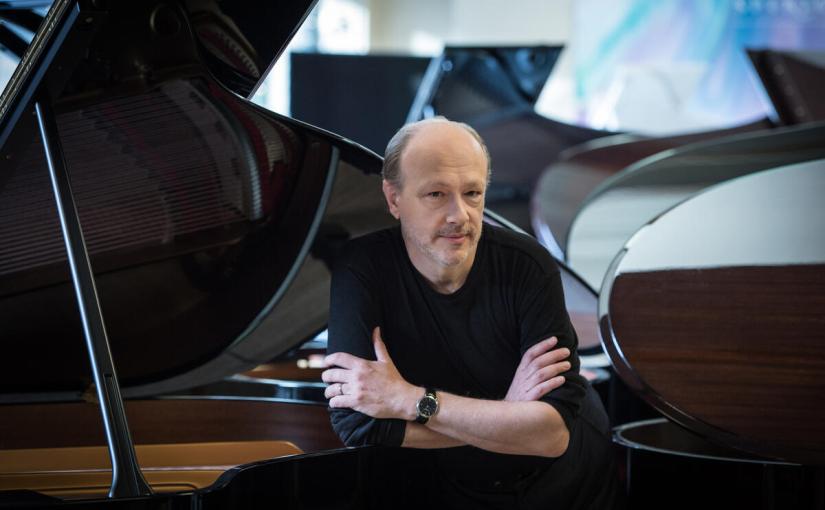
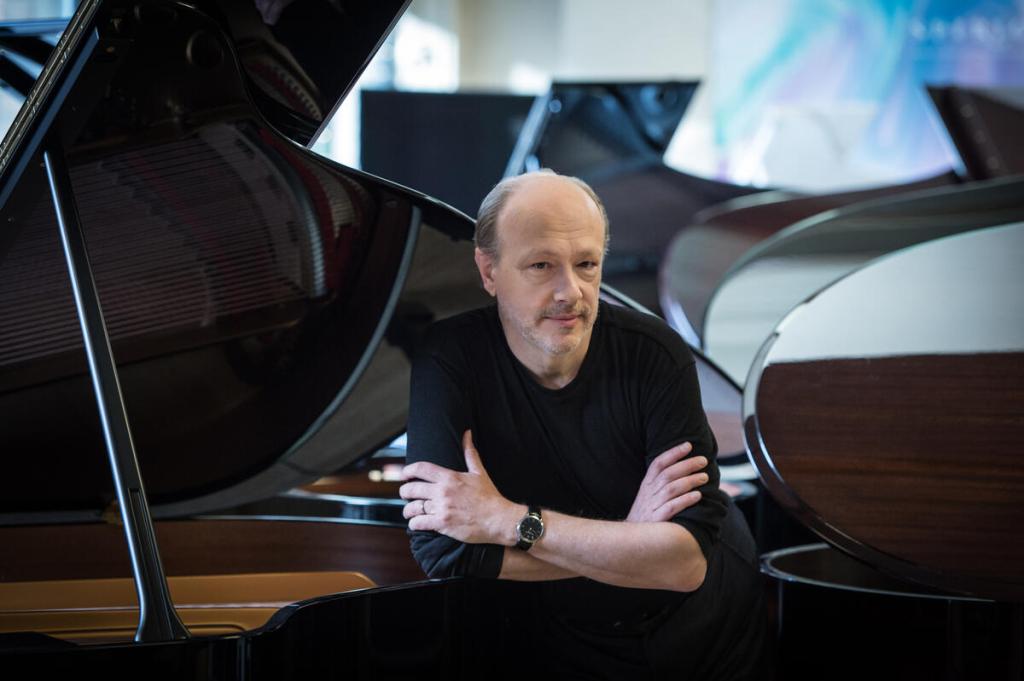
Canadian pianist and polymath Marc-André Hamelin has been one of a small handful of pianists pushing for a reconsideration of Charles Ives’ piano music, especially Sonata No. 2, better known as the Concord. Whether his advocacy earns the piece a coveted spot in the standard piano repertory remains to be seen. For now, though, Ives fans must grab their chances when they can to hear Hamelin play it.
One such opportunity arrived February 22, when Hamelin performed the ‘Concord’ Sonata as part of Symphony Center Presents’ piano series. The Ives’ sat at the heart of the program he brought to Orchestra Hall. At nearly an hour, it swallowed the first half whole. The second half was more approachable: Robert Schumann’s Fantasiestücke (Fantasy Pieces) and Scriabin’s Sonata No. 4 in F-sharp major. The whole program gave Hamelin a stage to do what he does best — championing strange, difficult music with the kind of playing that makes you wonder why anyone ignores it.
Ives’ Concord opened the recital with a jolt, dropping the audience straight into his world of musical mashups. I think it was the right call. Ives’ music works like a collage: hymns, folk tunes, the sounds of New England life all thrown together. But he’s not just assembling bits of Connecticut nostalgia for the fun of it. He’s making music about spiritual yearning, beauty, and humor, and about what his community and country actually meant to him. Buried inside all that noise are real statements about what it means to be American.
Hamelin, who has recorded the sonata twice, made a convincing case for it. The four movements are each named for Transcendentalist figures: “Emerson,” “Hawthorne,” “The Alcotts,” “Thoreau.” Each lands differently. “Emerson” is chaotic and wildly assembled, with phrases piling into each other. “Hawthorne” runs more like a scherzo, jagged and unsettled in a way that brought Ligeti’s harder etudes to mind. “The Alcotts” pulls back into something warmer and more domestic, the most conventionally beautiful music in the whole piece. “Thoreau” closes everything down with music so turned inward you almost forget how it all started. Running through the whole work is Beethoven’s da-da-da-dum from the Fifth Symphony, not used with Beethoven’s bluntness but as something quieter and more aspirational. It also conveniently outlasted a cellphone that went off during “The Alcotts.”
Hamelin was remarkably lucid throughout, pulling melodies and motifs cleanly out of Ives’ tangled textures. In “Hawthorne,” he pushed hard through the movement without ever seeming to tire. “The Alcotts” brought out some of the afternoon’s most luminous playing. And “Thoreau” had an appropriately ruminative quality.
The second half belonged to Schumann and Scriabin. Schumann’s Fantasy Pieces are eight short works that swing between his two extremes. One is the quiet, introspective side you hear in the opening nocturne “In the Evening” and the restless “Why?” Its antipode is undoubtedly the unhinged energy of “Whims” and a stormy “In the Night.” Hamelin handled both sides well, finding the right character and rhythmic give at each turn.
Scriabin’s Sonata No. 4 closed things out. Though just eight minutes, it covers a lot of ground. Hamelin played the opening Andante with a dreamy, slightly ambiguous quality (close in feeling to what he’d done in “The Alcotts”) before digging into the Prestissimo with real ferocity. Hamelin followed Scriabin’s sonata with two generous encores: “Jeux d’eau” from Ravel’s Miroirs and Rachmaninoff’s Etudes-tableaux Op. 39, No. 5. A strong finish to a strong afternoon.
Hamelin’s performance didn’t settle the question of whether Ives’ Concord Sonata will ever claim a permanent place in the standard repertory. That debate will continue. But on this Sunday afternoon, it felt entirely possible. If enough listeners encounter it in performances as committed as this one, Ives’ strange, beautiful vision of American Transcendentalism might finally find the wider audience it has always deserved.
Originally Published on Seen and Heard International
Around Chicago:
Tim Sawyier, Chicago Classical Review
“The Canadian pianist (who now resides in Massachusetts) dashed off the precipitous scampering of “Hawthorne,” deftly using a ruler-sided wooden board to create hazy pentatonic clusters of black keys. There is a moment when a quiet church hymn is interrupted by jarring cacophony, which visibly jolted much of the audience, before Hamelin whipped up a raucous carnival atmosphere to close the second sketch.”
Discover more from Gathering Note
Subscribe to get the latest posts sent to your email.
 Gathering Note