Each February for the past 27 years, Dennis Northway has convened musicians to perform the work of George Frideric Handel in Oak Park. Not the Messiah that appears with metronomic regularity each Christmas, nor even the Water Music or Royal Fireworks that surface on classical radio, but the unfamiliar catalog that gradually receded from public memory after Handel’s death. Even after relocating from Chicagoland to the Pacific Northwest, Northway has returned annually to sustain this unlikely tradition.
That there is a Handel Week Festival at all feels something like a miracle. The composer who once dominated European musical life now occupies a peculiar position: universally recognized for a single oratorio, largely unknown for everything else. Yet here, in the sanctuary of Pilgrim Congregational Church, the thread holds.
The opening concert on February 15 offered something even more rare: Handel’s instrumental music was experienced as a spirited, intimate conversation. The program combined the structural brilliance of his concerti grossi with the nimble wit of an organ concerto, as well as the vocal acrobatics of an early cantata, nicely balancing familiarity with discovery.
Three opus 6 concerti anchored the program. First published in 1739 when Handel was 54, these works—12 in total— stand as a master’s summation of the Baroque concerto grosso. Northway conducted the G minor and C minor concertos (Nos. 6 and 8), while fellow conductor Eli Zelman took the podium for the A major (No. 11). The ensemble performed commendably, navigating the shift from the brooding intensity of the G minor to the brightness of A major concerto with clarity and sympathetic engagement.
There can be a certain sameness when these works appear in sequence—the formal structures repeat, the musical language remains consistent—but cellist Steven Houser, violinist Thomas Yang, and harpsichordist David White seized their individual moments to inflect the performances with character. Other groups might offer more stylistic flair or period-instrument authenticity, but this group accomplished what mattered: they presented the music with straightforward sincerity in a way that served the works well.
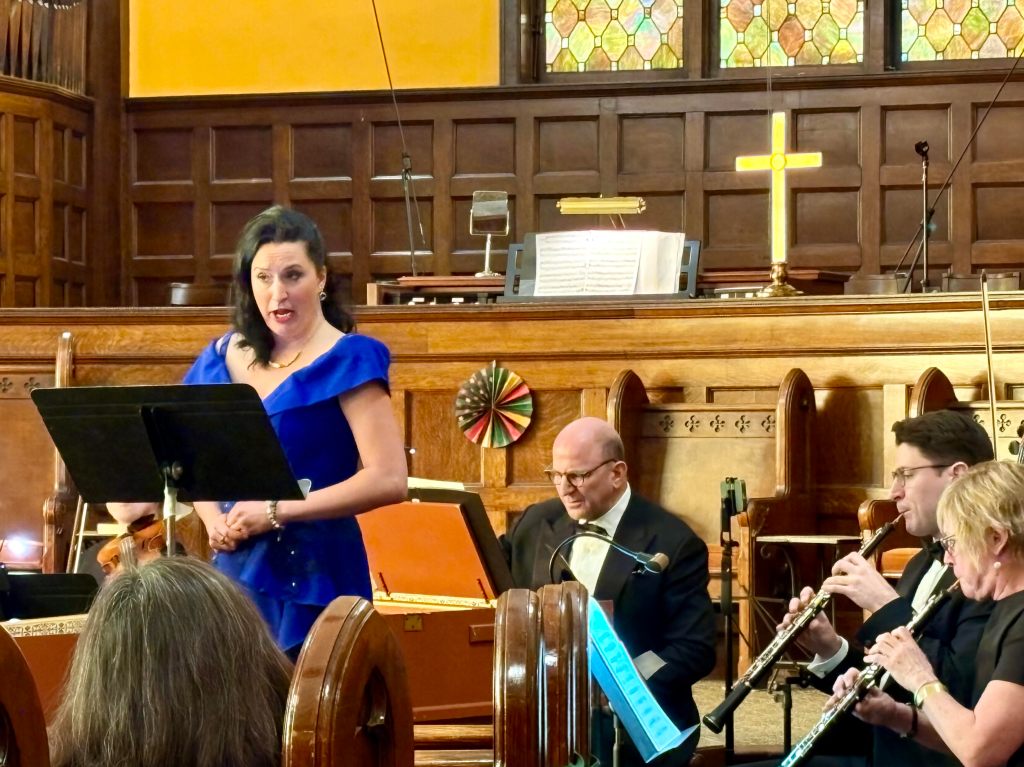
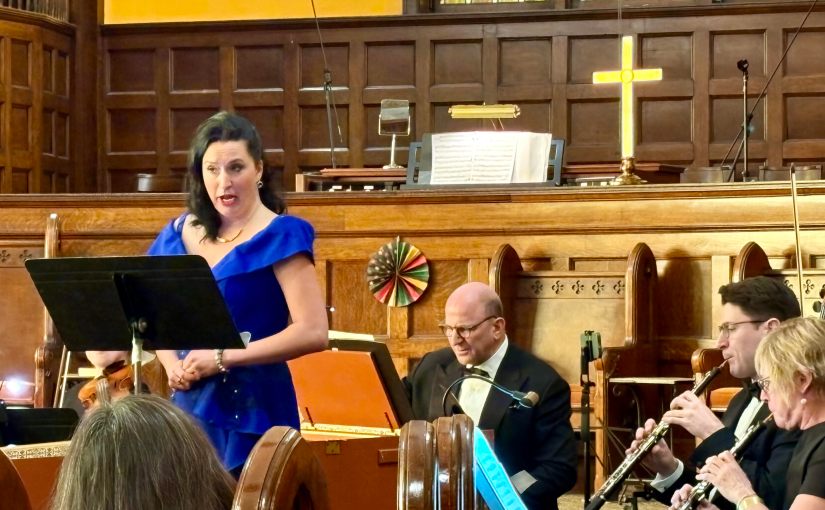
The revelation of the afternoon was the cantata Saeviat tellus inter rigores, a virtuosic rarity from Handel’s Roman period. In 1707, the then 22-year-old composer was living under the patronage of wealthy cardinals in a city where the Pope had temporarily banned opera as immoral. Deprived of the stage, Handel poured his theatrical instincts into sacred cantatas like this one, written for the Carmelite Order to celebrate the Feast of Our Lady of Mount Carmel. The result was a curious hybrid of liturgical music infused with operatic drama.
The text exhorts the order to stand fearless against worldly threats and the weapons of Lucifer, secure under the Virgin’s protection. It is militant, apocalyptic language, and Handel responds with music of corresponding intensity. The cantata demands much from the soprano: breath control for long, spun phrases; stamina for multiple arias; and the technical facility to execute fast ornamental passages with both precision and meaning.
Josefien Stoppelenburg met those demands with steely, acrobatic singing. Her voice has a directness that cut through the ensemble without harshness. This is Handel at his most characteristic, embellishing text in ways that feels essential for the listener’s understanding. Even in the “Alleluia’s” most extravagant flourishes, where lesser singers might fragment the line, Stoppelenburg held the performance’s center, maintaining musical coherence. The standing ovation she received felt genuinely deserved.
After intermission, David White moved from harpsichord to Pilgrim’s organ for the Organ Concerto in G minor Op. 4, No. 3. Handel’s organ concerti are curious works. They are less formal than the concerti grossi, more improvisatory in spirit. This particular concerto has an unusual chamber-music quality; the opening movement is a lament featuring solo violin and cello alongside the organ in trio texture.
Handel’s organ parts were often sketchy, expecting the performer to improvise. The score provides outlines and basic figuration, but much of the detail falls to the organist’s discretion. White, an accomplished church and chamber musician, did exactly that. His playing was elegant and constructive. It was assertive in the solo passages, where he added his own flourishes with taste and style, yet supportive when the ensemble required it. Pilgrim’s organ, with pipes at both front and rear of the sanctuary, filled the space generously without overwhelming. The instrument has a warm, enveloping sound rather than the brilliant, penetrating quality of some larger organs, and White exploited these qualities well.
The success of the afternoon rested not on volume but on the invisible threads of communication between players. This is music that assumes such communication—and depends on it. The concerto grosso itself is even premised on dialogue. Northway’s programming choices reinforced this sense of conversation. By interspersing the concerti grossi with the cantata and organ concerto, he prevented the afternoon from settling into predictability. Each work illuminated aspects of Handel’s style that might have been less apparent in isolation. The result was a portrait of the composer more complete than any single genre could provide.
Originally published on Third Coast Review
Discover more from Gathering Note
Subscribe to get the latest posts sent to your email.
 Gathering Note