Central Iowa in July is not a place most people associate with opera. The corn and soybean fields south of Des Moines run flat and full beneath a wide sky, the heat presses down, and the towns along Highway 69 move at the pace of a long summer. Indianola has a grain elevator, a small liberal arts college (empty of students until the fall), and—every summer since 1973—one of the more adventurous opera festivals in the United States.
The Des Moines Metro Opera (DMMO) summer festival doesn’t coast on name recognition. You will not find a season built around just showing opera’s greatest hits. The company has staged Benjamin Britten’s operas ten times since its founding, including The Turn of the Screw, Peter Grimes, and Billy Budd. Last year’s season included Stravinsky’s The Rake’s Progress and Janáček’s The Cunning Little Vixen. At most American companies, selecting just one of those would be seen as a departure. In Indianola, it was just a regular summer.
The 2026 season, which runs from June 26 to July 19, follows a structural formula the company has refined over decades. The festival operates on a repertory system: from Friday to Sunday each week, three different operas are performed in close succession. The lineup this year: Puccini’s Tosca, which the company hasn’t staged since 2009; Carlisle Floyd’s Of Mice and Men, in a co-production with Houston Grand Opera, Lyric Opera of Kansas City, and Florida State University; and Karol Szymanowski’s King Roger, a Polish opera from 1926 that almost nobody performs. Two of the three works are tied to centenaries. Floyd was born in 1926; King Roger premiered the same year.
The proximity of three such different works each weekend is central to this festival’s artistic formula. Tosca, with its familiar verismo sweep, sits alongside an American opera that most audiences have never heard, as well as a 100-year-old Polish work that remains largely unknown outside specialist circles. The contrast is not coincidental. It is the product of deliberate construction, and it is what gives DMMO’s summer season its distinctive character.
Michael Egel has been the company’s general director since 2013. At the time, DMMO already had a reputation for staging seldom-performed works. When he arrived, Egel intended to lean further into that identity. “I developed a list for the board as part of the vision. I made a list of pieces that I wanted to see done at our company, things that we had never done before, and another list of things that had been done once decades ago that probably should come back.”
Every year since, he takes a ruler and draws a line through what has been accomplished.
“I made the commitment that every season would have at least one piece, if not two pieces, that had never been done at the company,” Egel said. “That was huge. It reinvigorated the repertory and the spirit of curiosity.”
Getting an institution to move in that direction takes time. Egel built his case with the board over several years, presenting the list as a vision for what the company could be. Egel believed that programming curiosity was itself a form of institutional identity, something that distinguished the festival from other companies and gave audiences a reason to return that went beyond the comfort of familiar titles.
What he is protecting against, in his telling, is a slow disappearance. The repertory he cares most about is early to mid-twentieth century opera: music written after the late Romantics and before the era of minimalism, a period that produced an enormous body of work now largely absent from American stages. “I fear that there’s a widening gulf,” he said. “Early to mid-twentieth century works that are just falling into the cracks of oblivion.”
The gap he is describing is real. Most regional American opera companies, facing financial pressure and the need to sell subscriptions, fall back on a narrow core of works: a handful of Puccini titles, Carmen, La Traviata, a Mozart or two.
This repertory pressure has become something of a crisis of nerve in American opera, and companies that program adventurously tend to do so with considerable anxiety about box office. What makes the Des Moines model noteworthy is not that it programs unusual works, but that it has built an audience that expects them, and has returned for them year after year for decades. The success of the festival provides a counter-argument to the belief that this type of programming is a financial risk. While other companies are reducing their offerings, DMMO has expanded its performances and seen ticket revenue increase by 68% over the past ten years.

Of the three works this season, Carlisle Floyd’s Of Mice and Men is perhaps the most personal choice for the production team. David Neely, the festival’s long-time music director, met Floyd at the Sarasota Opera and has conducted Of Mice and Men before; this season, however, Christopher James Ray will be on the podium. Floyd, who died in 2021, is best known for Susannah, a 1955 opera set in rural Tennessee that became one of the most frequently performed American operas of the twentieth century. Of Mice and Men, which Seattle Opera premiered in 1970, is less frequently programmed, and Neely argues it has been undervalued.
For Neely, Floyd’s significance to American opera extends beyond any individual work. The contemporary American opera scene, he says, owes more to Floyd’s pioneering efforts than it typically acknowledges. “He was at the forefront of developing American opera,” says Neely. Floyd demonstrated, over a long career, that American subjects treated in a direct vernacular language could sustain the operatic form, and that opera did not need to reach for European models of abstraction or grandeur.
The distinction Neely draws between Susannah and Of Mice and Men is useful. Susannah, he suggests, draws its power from regional color, from the sound and idiom of a specific American place. Of Mice and Men reaches for something else. “Susannah is more about the vernacular of the place; Of Mice and Men transcends the vernacular. You feel the landscape in the music.” Of Mice and Men’s musical language, in Neely’s view, is more internalized, less tied to surface texture and more concerned with depicting the weight and struggle of Steinbeck’s world.
Floyd adapted Steinbeck’s novella himself. He was his own librettist throughout his career, and in working with the source material he stayed faithful to the plot and characters while organizing the material into three acts. The essential shape of Steinbeck’s story remains intact, which Neely argues gives the opera a sense of structural inevitability—the kind of story in which each scene both satisfies and prepares you for what comes next. “The storytelling is direct, like Steinbeck. There’s an inevitable kind of pull to where the opera is going. At every turn of the story you savor the moment, but also everything is preparing you for what’s next.”
King Roger is harder to codify and harder to stage. Szymanowski wrote it between 1918 and 1924; it premiered in Warsaw in 1926. The opera is set in 12th-century Sicily, in a court where King Roger’s realm—ordered, rule-based, and Christian—is disturbed by a mysterious Shepherd preaching sensual and spiritual freedom. Roger’s queen, Roxana, falls under the stranger’s influence. The king himself, initially resistant, becomes increasingly fascinated. By the opera’s end, which takes about eighty minutes to reach, Roger has relinquished certainty and stands alone, greeting the rising sun.
What this means musically is a score that draws from several directions without settling into any of them. Late Romanticism is present, as is something closer to Debussy in its textural quality, alongside what Neely describes as Polish primitivism and the sound of Orthodox church music. The opera shifts character across its three acts, the music changing alongside Roger’s inner transformation. The result is atmospheric and strange. It is, as Neely puts it, “extremely challenging,” not only musically but logistically, “It has an enormous chorus, and requires a large children’s chorus. Obviously it has a big bacchanal scene, so you need dancers. It packs a lot in.”
Neely reads the opera as an autobiography, a story Szymanowski told about himself. “It’s an allegory of Szymanowski’s own struggles. Issues of repressed sexuality, Apollonian versus Dionysian.” Roger’s final salute to the sun is, in this reading, an act of self-acceptance rather than triumph. The opera’s ambiguity is part of what makes it difficult to categorize and part of what makes it interesting.
The practical obstacles to staging King Roger are significant enough that even larger companies rarely attempt it. That a mid-sized festival in Iowa is taking it on is, by any measure, an extraordinary decision. Neely believes the moment is right. “We’re in an era now where young singers know Russian diction, and that was a simple step to Polish diction. There’s less intimidation by the language.” The generation of singers currently coming up through training programs is more comfortable with a wider range of repertory than previous generations, and that has expanded what companies like DMMO can realistically stage.
Egel and Neely would say the question of whether Iowa is ready for King Roger misses the point. The people who come to this festival have been coming for years, in many cases decades, precisely because of operas like this one.
Jeff Nigro is a good example of how that happens.
Nigro first came to the festival in 2009, when the company staged Weber’s Der Freischütz. He lives in Chicago and would describe himself, he says, as an “opera nut.” Nigro saw his first performance at the Lyric Opera when he was 12 and has been an attentive follower of the art form since. He originally planned to work his way through Midwestern opera companies as a kind of regional tour. But by 2015—just six years after his first trip to Indianola— he had become a regular and one of the company’s most ardent boosters, bringing car loads of friends to the festival with him each summer.
“I would not describe myself as a casual opera lover. I mean, I’m really, really into it,” he said.
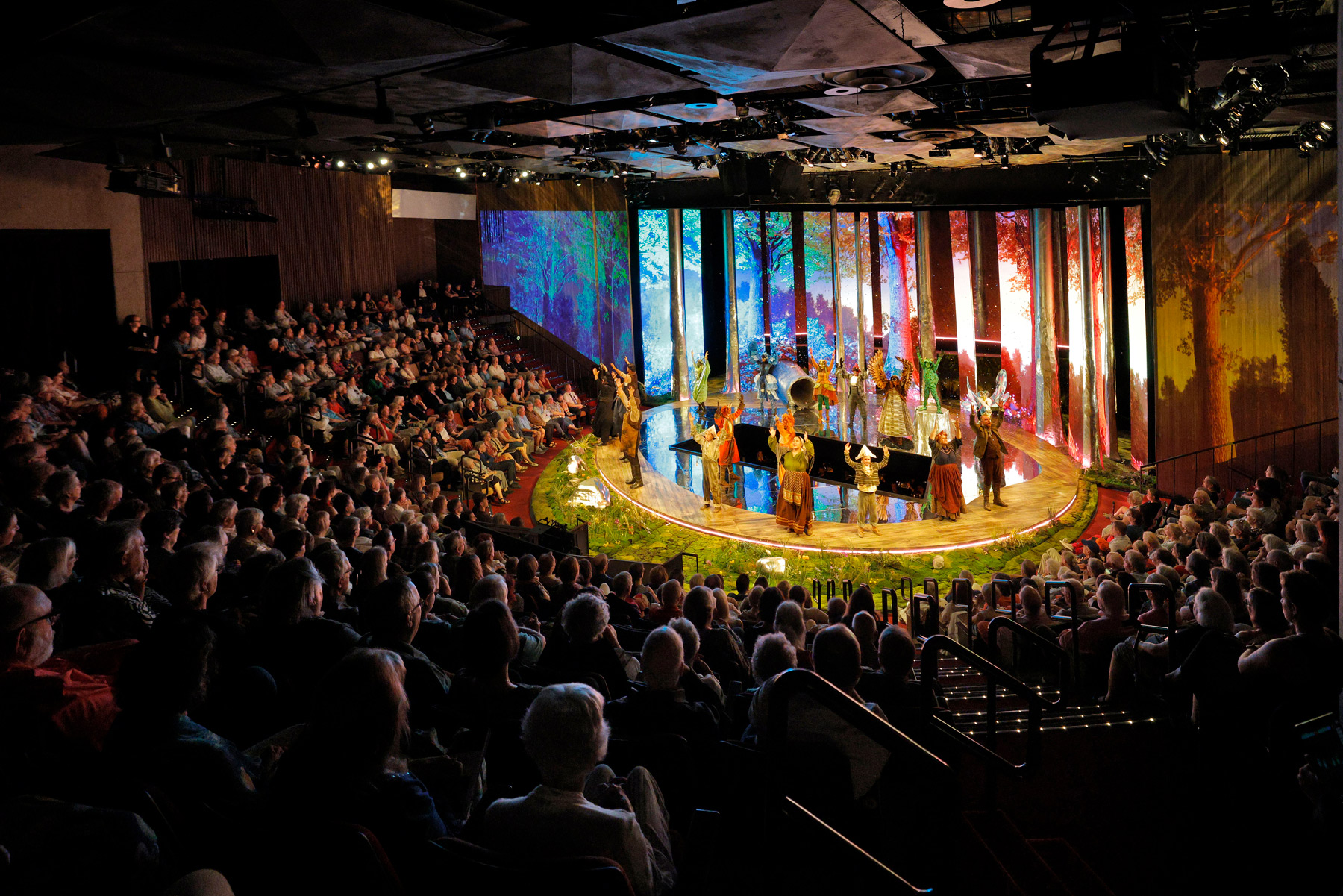
What keeps Nigro returning is a combination of things: the quality of the productions, the caliber of younger singers that the festival attracts, as well as the theater itself. The Pote Theatre at the Blank Performing Arts Center features an arena-style thrust configuration that extends the performance space directly toward the viewers. The configuration eliminates the conventional distance between performer and audience and forces directors to think differently about staging. Nigro remembers a production of Billy Budd where singers were moving through the rigging just above where the audience sat. “When Billy is doing that haunting final aria that he has, it just pulls you in because you’re that close.”

There is also something about the festival’s scale and setting that is harder to quantify. It is not a major metropolitan institution. There are no red carpets, no grand foyers with famous donors’ names on the walls. The experience is concentrated entirely on the performances. For Nigro and other regulars, that concentration is part of the appeal.
During the pandemic, Nigro sat in a work meeting listening to colleagues describe where they planned to travel once restrictions were lifted. Paris. Rome. New York. He said he wanted to go to Des Moines. “I want to go to Des Moines. I want to go to Indianola because I missed it that much. It’s just the highlight of my summer.”
Egel, for his part, is already thinking about the list. There are still lines to draw. He hints at a minimalist opera next summer, plus more Italian opera sometime soon.
“We need to get back to some Italian pieces because people are starting to ask if I have a thing against Italian opera.”
The festival’s logic has always been cumulative. Each unusual work performed makes the next one more imaginable, both for the audience and for the institution itself. What the Des Moines Metro Opera has built over 50 years is a compact between the company and its audience developed, expanded, and re-affirmed one opera at a time. The argument is simple: There is more music worth hearing than the opera circuit tends to program, and in central Iowa each July, you can hear it.
Details on the 2026 Des Moines Metro Opera festival season and ticket information can be found here.
Originally published at Seen and Heard International
Roxanna’s song from King Roger
Christopher James Ray interviews Carlisle Floyd about Of Mice and Men
Leave a Reply