Gathering Note

Notes from the concert hall

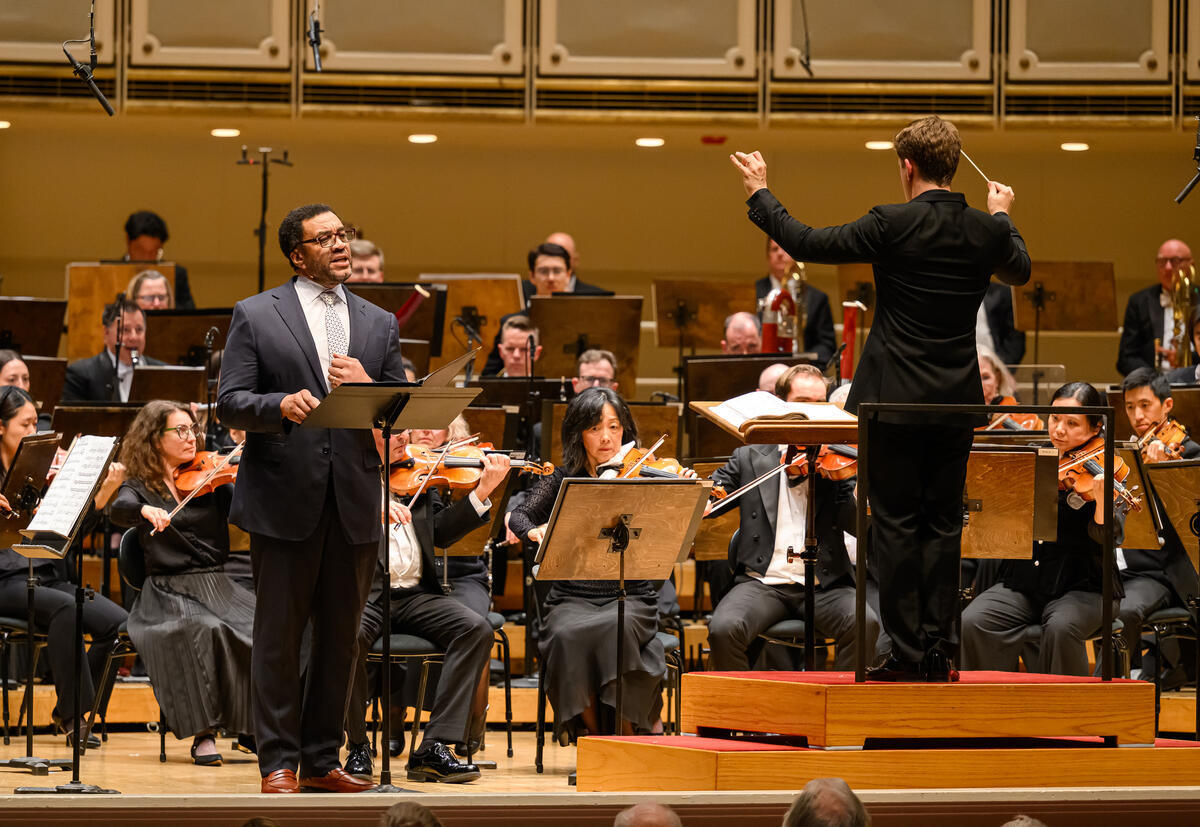
  • Assistant concertmaster Yuan-Qing Yu and conductor James Gaffigan perform Kreisler’s Violin Concerto in C Major. Photo Credit: Todd Rosenberg Photography

    Thursday’s program for the Chicago Symphony Orchestra was originally meant to spotlight the conductor and violinist Pekka Kuusisto, whose curiosity and range have made him a rare figure on international stages. His program would have traced a neat line between old music and the new works inspired by it. Kreisler’s Violin Concerto in C major, a pastiche of Vivaldi, would sit beside Grieg’s Holberg Suite and Einojuhani Rautavaaras The Fiddlers, both rooted in antique forms. The second half would pair Haydn’s Symphony No. 64, the “Tempora mutantur,” with Anna Clyne’s Haydn‑inflected Sound and Fury—a work for chamber orchestra and tape.

    Then Kuusisto withdrew. Earlier this year he announced that he would stop performing in the United States for the foreseeable future, citing the country’s political climate. His absence left a hole in the season and a genuine loss for Chicago audiences.

    (more…)
  • Elim Chan is set to be the San Francisco Symphony’s next music director starting in 2027. It’s a smart choice for the orchestra roiled by the pandemic, artistic shuffles and institutional belt tightening.

  • Antonin Dvorak and family.

    For their final program of the 2025–26 season, the Rembrandt Chamber Musicians—drawn from the Lyric Opera Orchestra and the Chicago Symphony Orchestra—offered a thoughtful look at how geographic displacement can refine a composer’s identity. The concert, performed May 17, was delivered with the poise of musicians who thoroughly understand the mechanics of ensemble playing.

    Dvořák’s “American” String Quartet in F major and Mikhail Glinka’s Grand Sextet in E flat major do not often appear together, yet both emerged from periods when their composers were living abroad.The link between the two works is less stylistic than biographical. Each reflects a composer working at some remove from home, testing new influences.

    (more…)
  • My colleague Louis Harris at Third Coast Review has written a lengthy profile of Chicago composer Stacy Garrop, whose music he loves. Garrop is one of many excellent contemporary composers who call Chicago home.

    Interestingly, when she listens to music, it’s not usually classical. “One of my approaches to that is I do listen to a lot of pop and rock and folk music. Because they’re all short. Form, tension, and relaxation are the most important parameters to me as a composer. If I’m listening to a pop song, I can easily hold on to the form and I can analyze the shape and the chords. It’s easy for me to follow. If I were to do that with the symphony, that would take up way too much headspace.” In addition to pop, rock, and folk music, she admits to enjoying K-pop, especially the visual performance of it.

    An excerpt from Garrop’s oratorio Terra Nostra

  • Joyce DiDonato sings Neruda Songs this weekend with the CSO.

  • The Chicago Sinfonietta announced that it is entering what leaders are calling a “strategic renewal period.” Founded by Paul Freeman to elevate minority artists and expand representation in classical music, the orchestra was guided by his vision until his retirement in 2011, when Mei-Ann Chen succeeded him. The pandemic dealt the organization a heavy blow, and in the years since, it has struggled to regain stable footing.

  • Multidisciplinary future arrives at Harris Theater with “Icons and Innovators”

    The house lights at the Harris Theater rarely dimmed on an occasion as self-assured as “Icons and Innovators.” This program, held on May 2nd, was ostensibly a tribute to Joan Harris, the philanthropist whose fingerprints are all over the Chicago cultural map and the Juilliard School. It was a night of high ceremony, featuring video testimonials from the likes of Barack Obama and J.B. Pritzker. Yet, beneath the formal tributes lay an argument about the state of American music.

    The Harris Theater opened in 2003, filling a specific void in the city. It was designed as a home for mid-sized performing arts groups that were too large for intimate lofts but would be swallowed whole by the city’s larger venues. By championing this middle ground, Joan Harris created a space where the experimental could meet the established. Saturday’s concert felt like a natural unfolding of that mission.

    (more…)
  • The Chicago Symphony’s concerts this weekend are dedicated to Michael Tilson Thomas, who died on April 22nd at his home in San Francisco. He was 81. Like so many others, I became unmoored by the news. Not because I knew him personally, but because so many of the concerts I remember most vividly from the last 30 years were his.

    Friday’s reminder came by way of Karina Canellakis, who led the CSO through Tchaikovsky’s Symphony No.5. The performance kept pulling me back to a night in Seattle in 2009, when MTT was conducting the San Francisco Symphony on a West Coast tour. That Tchaikovsky was something. Rope-a-dope with the audience’s emotions. Canellakis, to her credit, played the same game.

    What made Tilson Thomas rare was how exuded curiosity and love for his craft. He never seemed to be going through the motions. Through his illness, he continued to make music. That commitment was visible long before his diagnosis. When he took the podium, you felt it was safe to surrender to the music. The ride would be worth it. It was through MTT that I fell in love with Ives, gained a much deeper appreciation for Mahler’s symphonies, and embraced Cowell, Ruggles, and Scelsi.

    (more…)
  • Photo Credit: Karen Almond/Met Opera

    It’s a strange thing to survive a mass shooting and, years later, feel grateful for the knowledge it leaves behind. Grateful for understanding what comes after, and how that single event reshapes every life it touches. Kaija Saariaho’s Innocence is built entirely from that “after.”

    I’ve just returned from seeing it in New York, and I can’t shake the feeling that Innocence is one of the great works of art of the 21st century so far. It may be the most honest work of art I’ve ever encountered about what gun violence actually does to people.

    (more…)
  • Photo Credit: Todd Rosenberg

    Opera in the 21st century is caught between two impulses: the push to say something new, and the pull to rely on what already works. New operas get commissioned and staged. Old standbys get revived, reimagined, and sometimes over-explained. Neither approach is wrong, but both carry risk. This spring, two productions running concurrently at Lyric Opera illustrated that tension as cleanly as anything I’ve seen in years.

    Gabriela Lena Frank’s El Último Sueño de Frida y Diego arrived with serious momentum, while Matthew Ozawa’s production of Madama Butterfly took one of the most-performed operas in the repertoire and tried to fix what’s broken about it. One succeeds where the other stumbles, and together they make a useful case study in what opera gets right and wrong when it reaches for something beyond the obvious.

    Exceptional singing marked both productions. Madama Butterfly was carried by Karah Son’s Cio-Cio San, who more than lived up to the reputation she has built in the role, while Evan LeRoy Johnson soared as Pinkerton. In Frida y Diego, Daniela Mack and Alfredo Daza infused natural feeling into their respective roles as Frida Kahlo and Diego Rivera, which were otherwise thinly written.

    (more…)